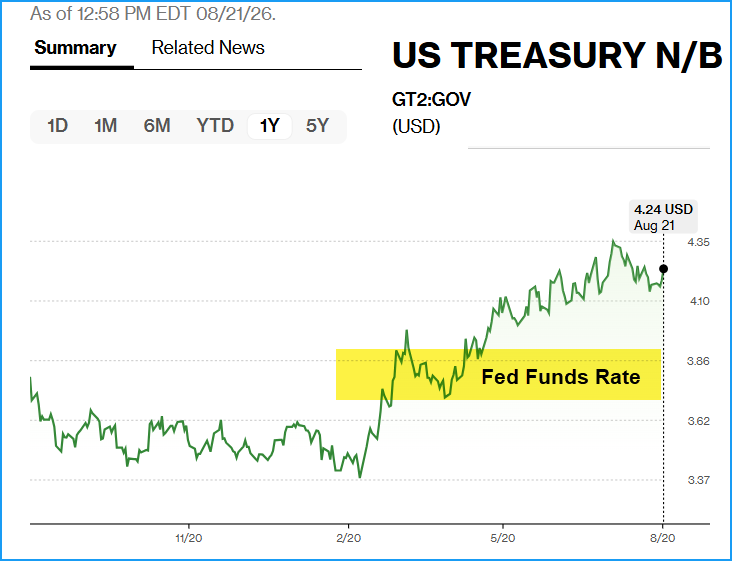
I am not sure you understand bond trading. If you buy a 30-year bond that yields 14%, and then you sell it when the same yield is 7%, do you make money or lose money? If so - how much?
Have you traded bonds before? Bessent is basically making a bond trade here. The US sold super-high several years ago, and now we’re buying back when its on sale. If I made this trade, I’d be pretty happy with the result. I mean, a 29% profit?
That’s one reason I bring Boomers up every so often. Plus they are easily triggered. One comment and they rush to gang up on a person and clamour to say “You’re so bitter, you must live in your mom’s basement. Plus. it wasn’t me. Here’s my story of why I deserve all my stuff.” It makes the cage rattling amusing, though it’s a bit too easy.
But I’m also an equal opportunity pointer out of truths. As you say, there is truth there. I’ll point them out about anyone and anything, plus have a bit of fun about anything and anyone. You just notice the Boomer stuff because it triggers you.
What I mean is that when the gov issued that 20 year 1.87% debt, it committed to a stream of 1.87% payments then the $100 face value.
Now it buys them back when the Yield to Maturity is 5%. Yes, it gets to buy them back at (say) $60, so it has made a profit (as paying out $60 is better than paying out $100). But to the extent that it issues new debt to cover the $60 price, and at the current market interest rate of 5%, has it made money? As now instead of paying out 1.87% pa, it pays out 5% pa. It’s just changed the profile of its cash in and out. It hasn’t found a way to arbitrage a profit by buying back a low interest rate bond and issuing a higher interest rate bond. Has it? I don’t think it has as both transactions take place at the current market interest rate of (in this example) 5%.
Then, as a next layer of complexity, you say, "But Rob, it’s long term rates that are 5% but short are (say) 4% - so by buying back long and issuing short, they are saving money. I agree. But, as you pointed out earlier, they are now exposed to interest fluctuations at each rollover of the short term bonds. And as I pointed out, there is also a risk that not everyone will want to rollover.
I have just eaten an American-style meal tonight, as it happens. It was Cowboy Beans, though. Maybe that means I’ll wake up in the morning tipping the scales at 300lb. But knowing my luck, I’ll still have my wonky English teeth!
You see. I take the mick out of everything. There’s no hate here.
If you were to go try bond trading for a few months, you’d get what I’m saying without any effort. Coupon differential times duration drives magnitude of profit or loss.
I’m guessing that’s how Bessent sold this to Trump. “We’ll buy back that debt for pennies on the dollar due to long-ass duration and the massive change in coupon since issuance. Our overall debt will drop as a result.”
Everyone long those 30-year bonds at a 2-3% coupon are DEEP in doo doo. If Bessent offers a slightly above-market price…of COURSE they’ll jump at the deal.
Maybe I would, but I don’t. And I think I’m unlikely to land a job as a bond trader. But if you, as one of such people, can explain it, I’d be grateful, but ok if not.
Yes, it will, as you buy back $100 face value of debt and only need to issue (say) $60 of debt to do so. BUT - and this is what I am saying - you are committed to a higher interest rate going forward. So, each year, you now have to borrow a bit more to pay the 5% coupon over and above what you would have done to pay the 1.87% coupon. So it comes out the same in the end - swapping a 5% YTM bond for a 5% YTM bond - even if one is 1.87% coupon and the other is 5% coupon.
So now we are looking at the trade from the other side.
Taking things at MV - the bonds are priced based on the current yield. That’s why a 1.87% bond is worth less than $100 - to make the YTM the market rate of 5%. So that loss has already happened to the original purchaser. Them selling at $60 crystallises that loss. But if they roll that $60 over into a new bond, their YTM (all things being equal) will also be the market rate of 5%. The bond will have a different cashflow profile - but the total return is baked into their YTM figures - which are both at the current mkt rate - both the investors sell and their (same day) buy. No?
Where is the profit (or loss) here from the sell and the buy? Assuming same duration and risk profile.
All things being equal, what happens is (a) the US government can report less debt outstanding as it retires, say, $1b for $551 million (at 55.1 cents on the dollar) but also (b) the interest expense remains virtually unchanged because the bond price reduction is offset fairly equally by the new higher rate (not exactly right due to duration mismatches, but close enough).
Still, issuing $1b and then buying it back for ~ 1/2 that amount is good work, if you can get it.
The other play here is if the US government can force a reduction in the short end of the curve. If so, then this could really be seen as a big positive by the Trump team.
And to pile on to all that (which I agree with), what happens if the market overall jumps from a risk on mood into a risk off mood? As in, Evil September arrives.
Bessent can cash in on the differential now, then once the market has its burp, he can sell a lot more long-dated debt (2020 redux) and the overall debt numbers will have improved, with the overall maturity structure maybe not changed much at all.
I’ve placed a small starter position, I believe I’m extremely early to the party.
My main concern is government delay of regulation start dates which I have no control over.
And illegal smuggling of refrigerants which is estimated at 20-30% of total legal trade volume.
I’m hoping someone from the industry or even outside of the industry can see something I don’t before I build a full position.
I bet if you tried harder, you could learn to challenge comfortable beliefs and biases and be a gadfly without coming across as rude, superior and holier than thou. I’m guessing that what happens is you give yourself permission to be rude and superior to certain groups, but not to other groups and individuals. The community discussions here at PP are the best I’ve ever seen on the internet, and most of your comments are a part of that. But there are times when I believe you are rude and dismissive of others. I think that usually happens when you make assertions (without data) about whole groups of people as if they were one giant group of identical individuals. Examples: 1. “Boomers all do this and think that.” 2. “Americans think or do…” 3. “All cops are bastards (ACAB),” which is actually a chant and a poster frequently heard and seen at Antifa and BLM protests in the US. An occasional ad hominem and rude wisecrack might be “fun” for you as you say but not for others. And most of all its not constructive or additive to the discussion or community.
We’re a small group of fellow travelers here and allies against some very nasty trends in this modern world. We should exercise as much care and courtesy as we can. Right?