Stablecoins and the Unstable Truth Behind Them

There is an awful lot wrong with Aaron’s understanding, and most of his argument is just assertions - always qualified with words and phrases like perhaps, maybe, possibly. Assertions that he then treats as facts upon which he builds the rest of his narrative. I might post separately about that, because I took a lot of notes and read the transcript. But the result is quite lengthy. Too much for here.

Here I want to respond to a question @cmartenson posed near the end, when he asked Day about the funding for Tether. Chris said:

“So I’m not clear how the stable coins creates 2 trillion of additional demand. Cause that’s like new money is coming from somewhere when you would still have to, somebody has to buy those in the first place. Right. I mean, outside of tether, which mints them at the tether treasury, right? I don’t know what happens there, but I’m not clear how this creates additional demand. I’ve heard the sense say that, but the mechanism baffles me because if I have money in a money market fund, it’s already in treasuries. If I have money at a bank, it’s already in the bank reserves and those reserves are very typically already housed in treasuries.”

Isn’t it just a Peter-pays-Paul scenario, Chris asks. Day’s response is garbled. But this is something I’ve looked into.

The answer is no, from what I’ve gleaned of the plan. First of all, it’s not Tether that’s printed with no backing, as Day asserts; it’s USD. Fiat USD – stealing from the future – is the base layer for all that follows.

It’s also not true, as Aaron asserts, that “most” of Tether’s backing is “probably” in bitcoin and gold. As I understand it, the bitcoin and gold that Tether holds is from excess bottom line company profit. It is not a part of the backing of issued Tether. However, perhaps absent a formal audit, Tether has made the case that the company is well-capitalized, which means it has additional resources to prop up Tether’s peg to the dollar, should that ever become necessary. It’s another move to encourage confidence.

Tether asserts that it has 1:1 USD for every issued Tether, and holds the vast majority of it in short-term treasuries. Apparently it also hedges those holdings by diversifying some into stock and several crypto-adjacent startups, including a new bitcoin treasury company it owns the majority of, named Twenty-one (XXI). I think Tether also has some Strategy and Metaplanet. Somewhere I read something about percentages and allocations, but I don’t remember where. Having learned something about Tether founder/CEO Paolo Ardoino, I expect he’s being conservatively prudent while taking considered risk to stay above inflation.

This means that there will be no mass exodus from existing Treasuries, nor from bitcoin and gold, in order to buy Tether-backing Treasuries. It’s already backed to the satisfaction of the US government.

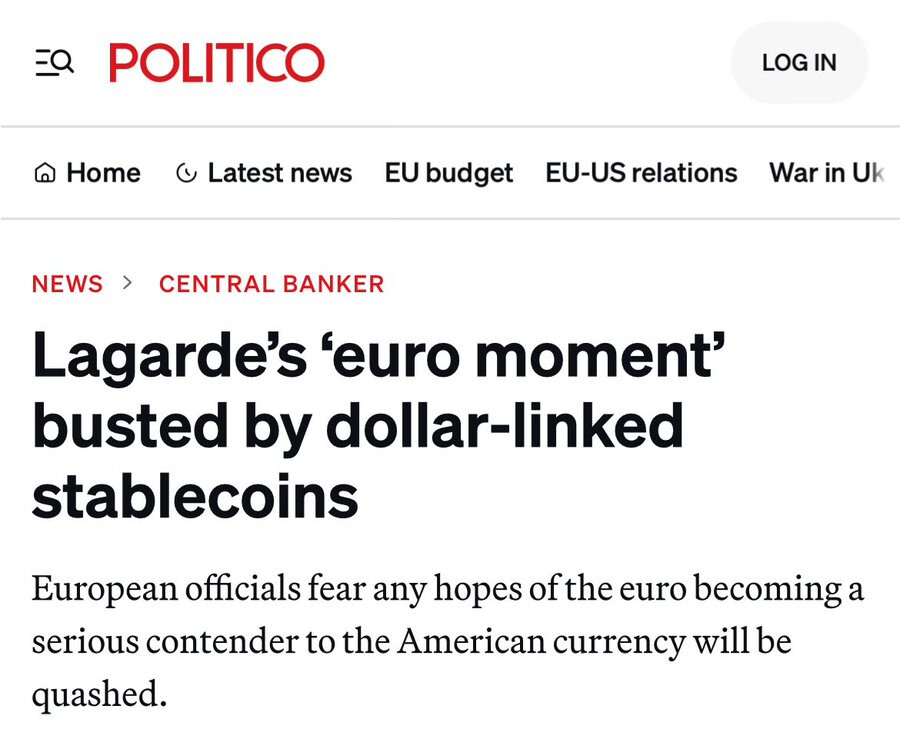
What the government is hoping is that by regulating Tether - so that it is assured to back minted coins with USD on the balance sheet and short term Treasuries - more global entities will adopt Tether as the digital version of the dollar that it actually is. It’s an act of formalizing what already exists to give it the stamp of US government approval, thus opening up its use to regulated entities domestically and globally. That obviously dramatically increases Tether’s potential market.

Here’s the thing: when a corporation in, say, Nigeria, buys Tether with Naira to engage in trade with, say, Singapore, that Naira ends up as new value stored in Tbills. That Singaporean merchant might cash out, of course, but as the networked system continues to build, at least some portion of the received Tether will remain as Tether so that the Singaporean can conduct transnational business with some other entity. All of the billions and (eventually, the US hopes) trillions maintained in Tether will represent more newly created US debt sequestered in Tbills that just keep rolling over.

And that’s likely to happen. After all, companies large and small all over the world keep some portion of their operating cash in USD today. It’s not a new thing taking place. All that’s happening is that Tether, because it doesn’t require the buyer to go through a bank or forex – therefore, doesn’t require that the business be bankable – will be available to many millions more people. Lower income people who, perhaps, just want to save their wealth in the most stable of fiat currencies; Tether gives them instant access with no banking privilege needed. So this plan will harvest their wealth to fund the US debt, along with the wealth of larger entities and even nation states who want seamless access to digital dollars.

Like the so-called tariffs, this is another way the US plans to get the world to pay for the restoration of the US economy.

A third target is the bitcoin sovereign fund. The well-known correlation (not uni-directional causation that Aaron posits) of bitcoin’s price rise and tether printing encourages the Administration to imagine that by helping bitcoin to increase in value they can stimulate global demand for Tether – because Tether is widely used as digital dollars for crypto traders, and as bitcoin is about 65% of the crypto universe market cap it receives about the same percent of new allocations by crypto traders.

That is what drives bitcoin’s price – good old demand outstripping supply. Our government just wants to make that as easy as possible, because as bitcoin’s value on the upcoming US balance sheet grows exponentially, it will at least offset the exponential growth in sovereign debt. Trump and company hope it will outstrip the growing debt, reducing the debt-to-gdp ratio. As the ratio drops, the US’ ability to borrow more money increases without causing run-away inflation.

Will it work? I guess we’ll see. I think: perhaps for awhile, but that, too, is going to run out of roadway – probably in a decade or two, when bitcoin saturates the global market’s demand for it as a store of value. In the meantime, I think bitcoin’s going to rip very dramatically up the vertical part of the S-curve of adoption. And apparently so does Trump’s financial brain trust. (Plus, along the way they are pumping their own bitcoin bags.)
7 Likes

That makes so much sense to me.
Dollar stablecoins are not targeted towards Americans (for now).

People around this world deal with many fiat currencies.
These people may lack the capability to utilize metals or Bitcoin or physical access to paper US dollars.

Hence, these people would migrate towards the least stinky fiat notes viewed from their perspective.
The US Dollar stable coin could look wonderful compared to their other choices. That is where the “non treasury based” billions of monetary value comes out from under the global matress storages from around the world.

The US dollar stable coins would then be phased in replacing paper dollars in America.

All very convenient for an end times, trackable, controllable, universal buying and selling global control system.

I don’t disagree with anything he said, though I don’t think you’d ever catch me using so many words. I’m not sure why it would cause you to lose confidence in gold. Think of the tokens as just an ETF+. Initially, they drive the price up. Next, someone counterfeits them, and the underlying price falls due to the dilution with “as good” substitutes. Eventually the fraud is exposed and the people holding the real thing will be much better off than the bag holders. Gold will not become a currency at any point in this. We’re also really early in that game. Maybe getting a bit late in the ETF and derivatives game.

Although, if you want to lose confidence in gold, note that 16 Psyche supposedly has $700 Quintillion worth of gold/metals at today’s prices. Then consider how long it will take to start mining it.

@cmartenson raises an excellent question at 1:08, and Aaron answers that essentially an asset-swap happens. I don’t believe this is correct. @vtgothic is right, but I think I can state it clearly.

Think of it in terms of a currency war.

  1. Banks create money ex nihilo to buy things.
  2. BRICS+ banks are using less and less of this ex nihilo money to buy US Treasuries; this is at least partly an intentional stratagem to damage the US economy.
  3. Stablecoin are growing in popularity everywhere.
  4. The most popular stablecoin companies can be forced to buy US Treasuries.
  5. BRICS+ banks use more and more ex nihilo money to buy commercial credit (i.e. loans to customers) in their own currency.
  6. Given premiss 3, commercial credit as in premiss 5 will be converted to stablecoin.
  7. Given premises 4 and 5, BRICS+ banks will be indirectly forced to fund the buying of US Treasuries with their own currency.
  8. Given premiss 1, ex nihilo money from the BRICS+ banks enters the US economy outside the BRICS+ control.
  9. This partly defeats the stratagem in premiss 2.
5 Likes

Yes, nicely put @ilovemartinis.

I’ll piggyback to add: this is all part of the Trump Administration’s large plan to keep the dollar strong overseas - meaning, strong demand - even while weakening it both domestically and overseas - meaning, diluted purchasing power.

That, they anticipate, will help the US to inflate away its debt without losing financial clout in the world; but, indeed, growing it.

In sum, all of these shennanigans we’ve seen lately, including so-called tariffs and balance sheet bitcoin, constitute a multi-pronged effort to strengthen the dollar’s reach while shrinking the US’ debt-to-gdp ratio. They think that they can maintain and expand US economic hegemony, frustrate BRICS, and save and rebuild the US economy to its former glory.

5 Likes

Exactly.

A simple way to keep track of this:

USD down + Treasuries’ yield down + gold sideways = BRICS+ losing.

(up/up/up = BRICS+ winning)

Good news, Aaron will be detailing all of that at our Summit event in September for everyone attending.

I’ll see about packaging that up for people who can’t make it.

Aaron goes the extra mile to help people get out of the system, going so far as to have attendees leave with digital wallets installed & funded, and goldbacks in hand.

1 Like

Nice one Chris! Thanks for that. I csan’t make it rom Australia this year althogh I did seriously consider it. I will make it one of these years…Was driving the three hours to my farm today to get my laptop which I had left here yesterday when I drove back to the city house and was thinking about gold backs. SPecificsally, how i might get in contact with the US producers and figure out how I might launch some Aussie ones!
Anyway, if you do have some bandwidth to package it up and give us access then that would be pretty awesome!

1 Like

The second order effect of this is that then the central banks of, say, Nairobi, no longer need to keep USD (really, Treasuries) in reserve.

You are describing a disintermediation process, the result of which is that the Treasury demand simply shifts from a centralized holder to a set of decentralized businesses and individuals.

I strongly suspect it won’t work that way, because that would strip power and control from the central banks who are constantly intervening to set the price of their currency for their own economic and political needs.

Can you imagine if Japan’s BOJ lost control of setting the exchange price for their currency? It would probably be a complete disaster.

I get why Trump, et al., would be keen to try this, but I can also appreciate why other countries would be keen to avoid it.

2 Likes

IS it not possible that the following happens:

  1. Gold is revalued at lets say 20K providing USD$5TR on the balance sheet of the treasury.
  2. Rather than paying down debt, They use that 5TR to buy stablecoins, and hence treasury bills.
  3. THey then use the stablecoins to buy BTC pumping up the price of BTC, of which they have a few hundred thousand n their balance sheet also.
  4. THey then use the use that extra balance sheet $$ to buybmore stable coins and rinse and repeat…??

Yeah, it will be interesting to see how this plays out. I also don’t think it’s going to work as they envisage it.

But I don’t think this is only disintermediation. Or, there might be some of that but I don’t think it’s zero-sum. For a start, I’m having trouble understanding where in your view the creation of new value fits in - real contributions to growing gdp. That’s not peter paying paul, that’s new economic activity that requires and so receives new coinage.

Separately, the world’s economies are all busy printing new fiat, diluting purchasing power, of course, but the purpose of the Trump Admin scheme is to facilitate more of that without producing runaway inflation. It seems to me, as that new currency is printed into existence it has to go somewhere; Trump et. al. want more of it to flow into USD to offset our printing at the expense of their economic stability - and think promoting Tether as a dollar-equivalent coin and store of value is the way to do it.

Then, too, to some extent, a strong Tether/USD link will steal value from other currencies as other economies sink faster than USD. Some, perhaps growing, portion of what might have been sequestered in Germany’s or Japan’s stock market will shift into Tether, bolstering our Treasuries market.

On the side, btw, I expect we’ll see more gambling as folks engage in increasingly desperate attempts to “win big” in the crypto casino. This newly approved system also facilitates that by making it easier to both create new junk coins and tokens, and to play the expanding market. I think that’s a moral crime.

2 Likes

Joël Venezuela is a legend in the crypto community for doing just that- living entirely off crypto. He has been unbanked for over 10 years. He has a podcast. He mainly uses a cryptocurrency called Dash, which was one of the original privacycentric cryptos. Aaron Day would know him for sure. At any rate, it definitely can be done easier than you would think.

Working as intended?

2 Likes

Almost a week later, here’s a takedown of Monero by Matthew Kratter. What he’s openly trying to do is convince Monero techies that they’re running down a faulty trail, that Monero’s privacy is faulty, and that Bitcoin needs their tech abilities, being the best option for breaking the control grid.

In his usual calm style, he outlines the faults in Monero’s system that make it considerably easier to trace Monero transactions, and to discover owners, than can be done in Bitcoin. He also mentions, and I provide the link to, a site that documents the methods that have been developing and used since 2021 to doxx Monero wallets, identify owners, and prosecute criminal activity. Additionally, in the podcast notes, Kratter links to a several tech-oriented bitcoiners’ previous work on the shortcomings of Monero.

My own primary take-away is that the tools for doxxing accounts and tracking transactions are developing quickly, and are increasingly powerful. I’m increasingly doubtful that real privacy is possible. But the issue of unconfiscatable is still up. At least with Bitcoin it still requires cooperation of the coin’s holder to access the coin, if a person holds their own key to their self-hosted wallet - that’s because there’s no central location that can be tapped into, or a human who can be coerced, to give up a bitcoiner’s keys except the bitcoiner. None of the options Day proposes on his website (linked by @spiritualwarrior above, comment 7) match Bitcoin’s security.

The old problem remains: cryptocurrencies can solve for 2 of 3 needs, but cannot achieve all 3. The options: decentralization, security, speed. Bitcoin selected for the first 2.

Kratter’s 10 minutes.
The “Monero Leaks” web page.
Crypto Trilemma Explainer.