Adam Rozencwajg: The Greatest Energy Shock in History Is Unfolding

Originally published at: https://peakprosperity.com/adam-rozencwajg-the-greatest-energy-shock-in-history-is-unfolding/

Once a quarter, I get to sit down with Adam Rozencwajg, and it’s always a treat. Adam is a Managing Partner at Goehring & Rozencwajg, a natural resources investment firm.

This was the first time I got to speak with Adam since the Iran war broke out, and the Strait of Hormuz (SoH) was effectively closed down.

The energy shock that’s underway is not just historic, but the largest in history. It’s larger than the 1973, 1979, and 20922 crises combined.

Adam tells us that the physical volumes lost are already approaching ~1 billion barrels after ~8 weeks, with the shortfall not immediately recoverable upon reopening

Despite this, market complacency is extreme. Oil has hardly reacted to the realities as compared to its movements in prior eras. But don’t worry, it will.
(Source – G&R)

Adam explained that the IEA’s accounting for the alleged oil surpluses in 2025 was flawed. Where the IEA claimed there was a 2-3 million barrel per day (Mb/d) surplus throughout 2025, inventories built up minimally during that period of time. If such a surplus existed, those inventories would have shot higher by 60 to 90 Mb per month.

But now that the Strait has been closed down for just over 2 months at the time of this recording, all floating inventories have already been depleted, and onshore inventories are starting to wither away.

The idea that the US is going to become the world’s oil and NG producer is not supported by the facts. Adam and his team run a comprehensive neural net analysis on shale production, and their view is that US shale oil production growth is over.

In support of their model’s conclusions is this chart of the last remaining shale basin that’s shown any growth at all since 2019: the Permian.
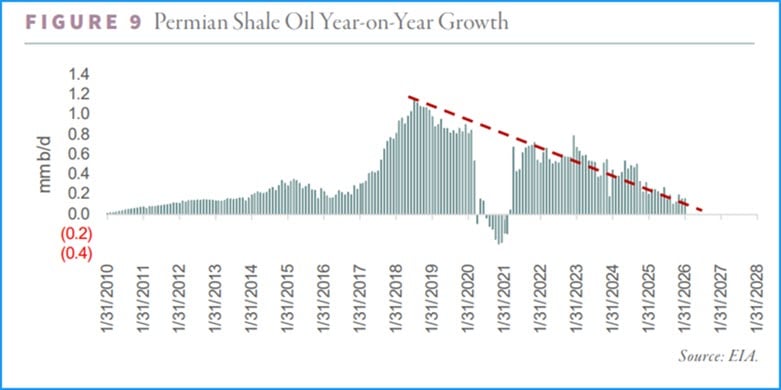
With every passing month and year, the Permian has been offering up less and less production growth, and it will struggle to meaningfully increase its output for anything longer than brief, capital-intensive bouts.

All of this leads to the prospect of oil shortages and market black swans as sudden shortfalls and price adjustments become the mechanisms by which reality and physics assert themselves.

A short-term spot oil spike above $200 is possible due to delivery squeezes and logistical lags (tankers move slowly). Long-term, chronic underinvestment (~$500B vs. the needed $1–1.5T upstream annually) sets up a multi-year bull market.

While the crisis is exacerbating the urgency, in many ways, this is a classic resource investing bear cycle that will be followed by a bull market. Underinvestment leads to shortfalls, which lead to higher prices, which lead to more investment, which leads to oversupplies and declining prices. Up and down, over and over again.

On that basis, Goehring & Rozencwajg’s latest quarterly missive also runs a new method for calculating the degree of over- or under-investment, and commodities are about as unloved and underinvested at the moment as they ever have been in the past 100+ years.

In Adam’s view, the Strait closure is a catalyst/accelerant, but not the root cause of our energy predicament. Structural issues such as depletion, chronic underinvestment, rising marginal costs, and surging demand (especially power) point to a multi-year commodities bull market, most pronounced in oil and natural gas. Capital-starved sectors with bearish narratives embedded offer significant upside once reality sets in. Gold has already broken out; most other commodities remain early in the cycle.

Tune in to hear it all for yourself.


Timestamps

00:00 The Energy Shock: Understanding the Current Crisis
08:42 Market Complacency: The Disconnect Between Prices and Reality
14:29 The Strait of Hormuz: Implications of Closure
21:14 Shale Production: The Future of U.S. Oil Supply
32:59 Geopolitical Noise and Market Dynamics
35:40 The Future of Natural Gas
51:21 Understanding Commodity Markets and Investment Opportunities


FINANCIAL DISCLAIMER:

The information contained in this video and the resources available for download through our affiliated website are not intended as and shall not be understood or construed as financial advice, nor should be interpreted as a solicitation to sell or offer to sell investment advisory services. No person who currently works for or contracts with Peak Prosperity or Peak Financial Investing is an attorney or accountant, nor are we holding ourselves out to be, and the information contained in the video and on the website is not a substitute for legal or tax advice from a professional who is aware of the facts and circumstances of your individual situation. While Peak Financial Investing is a registered investment advisor, please note that this podcast is not intended to be investment advice.

All information has been obtained from sources believed to be reliable, but its accuracy is not guaranteed. There is no representation or warranty as to the current accuracy, reliability or completeness of, nor liability for, decisions based on such information and it should not be relied on as such. We have done our best to ensure that the information provided is accurate and provides what we feel is valuable information. The views expressed are subject to change based on market and other conditions.<

No guests or clients appearing on the podcast receive any form of compensation for their appearance and obtained no other benefit from either Peak Prosperity or Peak Financial Investing.

All investing involves risks including the possible loss of capital. Asset allocation and diversification does not ensure a profit or protect against loss. Please note that out- performance does not necessarily represent positive total returns for a period. There is no assurance that any investment strategy will be successful. All investments carry a certain degree of risk. Dividends are not guaranteed, and a company’s future ability to pay dividends may be limited.

Additional important disclosures for Peak Financial Investing may be found in our Form ADV Part 2A, which can be found at https://adviserinfo.sec.gov/firm/summary/319672.
7 Likes

Will the Oil Shock affect Satanic murder rituals in Laurel Canyon by the American Satanists?

Apparently, the 1960’s Hippie movement’s leaders were overwhelmingly the children of very powerful members of the American “Deep State”. “The Lizard King”, Jim Morrison’s, dad was some big U.S. Navy Admiral who pulled the Gulf of Tonkin False Flag. Can you believe it?! What a Rip Off!

The U.S. anti-war Hippie counterculture Left was basically co-opted by U.S. Intelligence to thwart and stymie the egregious anti-fascism of the 1960’s Left. The entire American political system has been thoroughly rigged for decades. The U.S. Financial System has probably been anally Kinjiro-ed for decades as well? Forget about it….

What is the relationship between the different powerful Satanic Oligarchical groups “At the Top” running everything, like The Epstein and The Clinton and the Trump Weirdo’s?

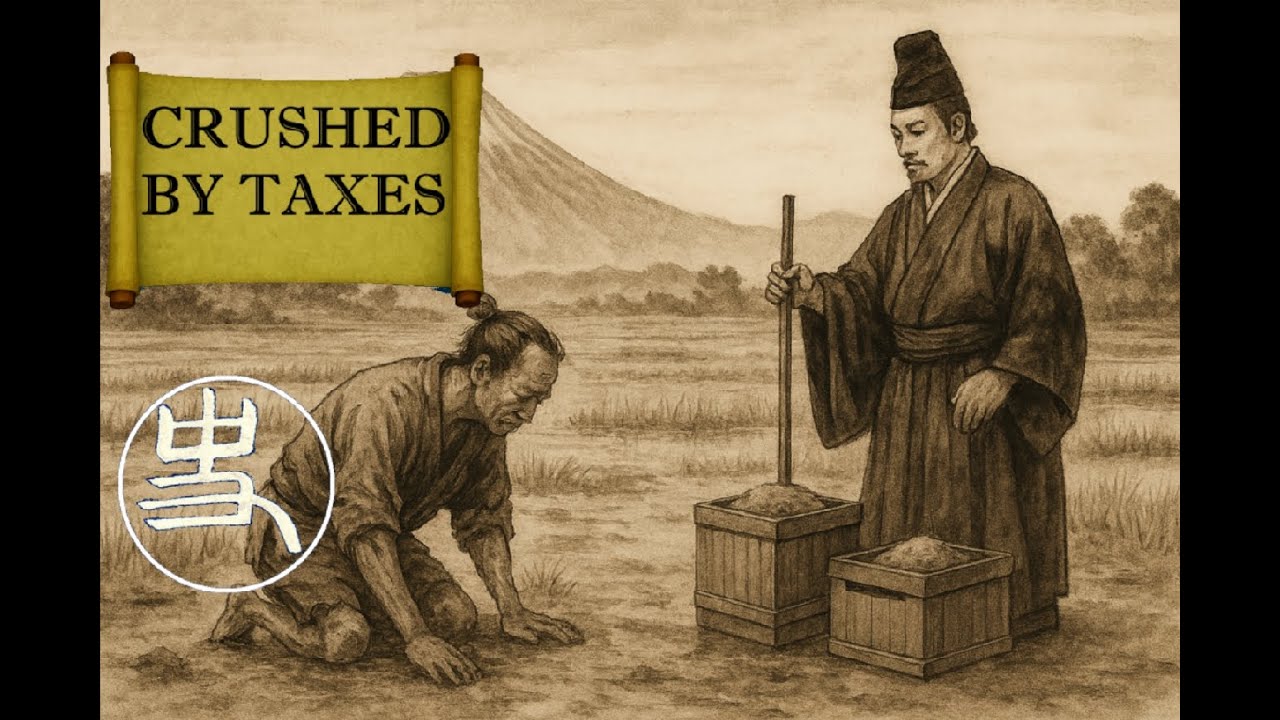
Kinjiro’s Way - Apparently, the Japanese have an extensive history of Famine.

1 Like

Michael Yon grew up in Winter Haven, Florida. Michael Yon once said that his “Grandma” was a big Spiritualist who could foresee the future.

Winter Haven is mentioned in the book “Weird Dreams Inside the Canyon”, and it is about 1 hour away from Cassadaga”, Florida. I don’t know what “Cassadaga” means in the Creek language.

Cassadaga Spiritualist Camp (officially the Southern Cassadaga Spiritualist Camp Meeting Association) is a historic Spiritualist community in Cassadaga, Florida (Volusia County), often called the “Psychic Capital of the World.” It is one of the oldest continuously active Spiritualist camps in the United States and the oldest in the Southeast. 
History
• Founded in 1894 by George P. Colby, a trance medium from New York. Colby claimed his spirit guide, Seneca, directed him to the site during a séance to establish a Spiritualist community in the South. 
• Colby had connections to Lily Dale Assembly in New York (a famous Spiritualist camp). He homesteaded land in Florida around 1875 and later deeded acres to the association.
• The community was formally chartered in December 1894 and grew as a winter retreat for Spiritualists. It was listed on the National Register of Historic Places as a historic district in 1991. 
What It Is Today
It is a small, unincorporated 57-acre community with about 55 homes, many historic. Residents and certified practitioners focus on Spiritualism, a religion based on the belief in continuous life after death and communication with spirits through mediumship. 
Key features include:
• Certified mediums and healers — Practitioners undergo at least four years of training in mediumship, healing, ethics, and public demonstrations.
• Colby Memorial Temple — The main historic building for Sunday church services, lectures, and events.
• Bookstore and Information Center — Open to the public for books, gifts, and scheduling readings.
• Parks and meditation gardens — Including Horseshoe Park and a Fairy Trail for quiet reflection.
• Events — Weekly workshops, seminars, healing services, candlelight services, guest mediums, and quarterly Gala Days (festivals with vendors, readings, and activities). 

As always, a joy to listen to Adam delve into the quantitative side of things. Having merely listened this evening, I’ll have to give it a thorough watch-through tomorrow evening to take in all the figures. It’s almost a manageable picture of the future, if we just focus on the oil and gas part. And also if not too much more stuff gets blown to smithereens.

2 Likes

Outstanding interview.

Always love to hear from Adam.

3 Likes

If crude goes to say 150USD, how would this affect precious metals? It isn’t clear to me that if would be instantly positive for precious metals. Considering that silver is squeezed by industrial demands, wouldn’t rising energy prices cause demand destruction in the silver market, potentially pushing silver down?

BTW i am super new to all of this, so forgive my ignorance.

8 Likes

I’m really grateful for this conversation about the internal economics of the oil industry. I asked the question about a month ago and this has in spades addressed the issue.

If there ain’t no money, if the cost/benefit doesn’t work out, stuff isn’t getting done.

3 Likes

If only there was a new distraction to make all this oil stuff go away:

https://x.com/healthranger/status/2052081585990598920?s=46

4 Likes

Gotta love this pearl of wisdom from our transportation secretary

https://x.com/realstewpeters/status/2052422621875044465?s=46

6 Likes

It seems he graduated from the George Bush School of Please Don’t Panic.
“Let’s go shopping!”

https://www.c-span.org/clip/white-house-event/user-clip-bush-shopping-quote/4552776

Bush: “Go out and shop”

3 Likes

$110.33 to fill up the truck this morning. We are fortunate that my husband and I share the car and generally use the truck when it’s needed for purpose. But still, that’s a lot of cha-ching! These people have no clue what it’s like in the real world.

7 Likes

That’s nice work peeling apart the commodity price to S&P ratios in Figs. 2 – 6. Yes, it seems undeniable that commodities in general are currently under-valued, though as Adam points out, gold may skitter sideways for a time now, having racked up gains in the past couple of years. I wonder how silver looks under this same analysis?

Eyeballing Figs. 5 & 6, there seems to be a 20 to 30 year periodicity in all five of the plots, with maybe some related harmonics. Though it might be edging close to voodoo, a quick FFT might reveal some additional trends.

1 Like

Anybody here on CRAK? Follows crude oil and crude refining. Positives? Negatives? Just opinions not financial advise? Can I ask that on PP without getting my pp spanked? TIA.

1 Like

I’m so confused by the title on this one. In listening to Adam here I’m thinking we have nothing to worry about. Go bullish stocks and commodities will trend sideways forever.

What with the market, oops I mean the ““market””, being so obviously rigged, I don’t understand how the S&P ratios can be meaningful at all.

1 Like

That’s the beauty of putting the intermediate data on a semi-log plot and then de-trending the result. It peels out all of the exponentially accumulating increases in valuation due to any underlying factors. In a true and just world, that would be from increasing productivity and accumulated wealth, but it also works just fine for adjusting out fraud.

1 Like