Creak! Pop! Rivets Are Flying All About

Originally published at: https://peakprosperity.com/creak-pop-rivets-are-flying-all-about/

Good news, inflation cooled down in June, bad news the government is still fabricating inflation numbers that simply don’t track your actual shopping experiences.

Officially, according to the BLS, the June inflation reading was 3.5%:
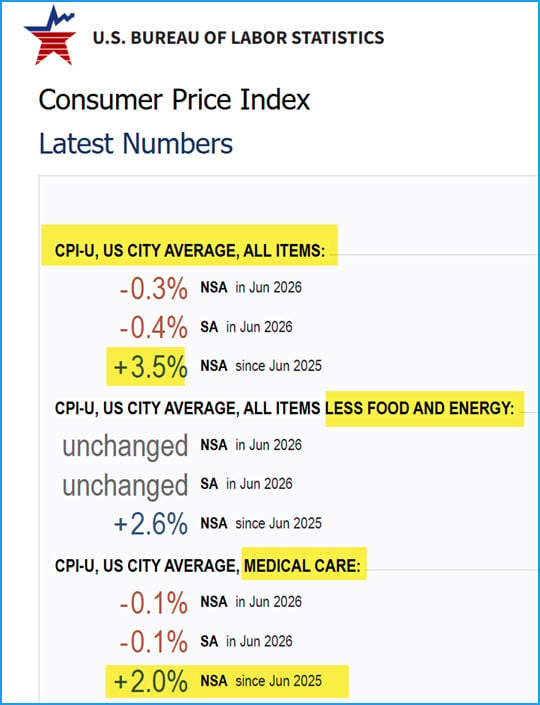
According to the BLS, ‘medical inflation’ was only 2.6% yr/yr, but you may have noticed, as Paul and I did, that our health insurance premiums went up considerably more than that.

This is as good a place as any to expose the ridiculous lengths to which the BLS goes to hide the true inflationary impact that is primarily caused by government deficit spending.

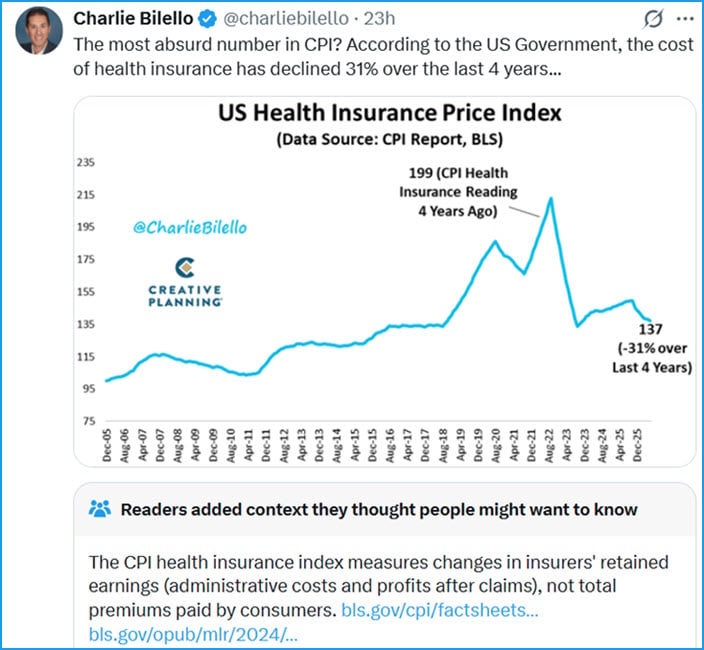
As Charlie Bilelo notes, according to the BLS, health insurance costs have declined by 31% over the past 5 years:
LOL!

As a proposed community note revealed, the way the BLS ‘calculates’ your health insurance costs is by using the profits of health insurance companies as a proxy for health insurance costs.

I’m sure somebody could make an argument for that, but if that method results in the preposterous claim that health insurance costs have gone down by 31% over five years, then it’s a really dumb method that needs to be chucked.

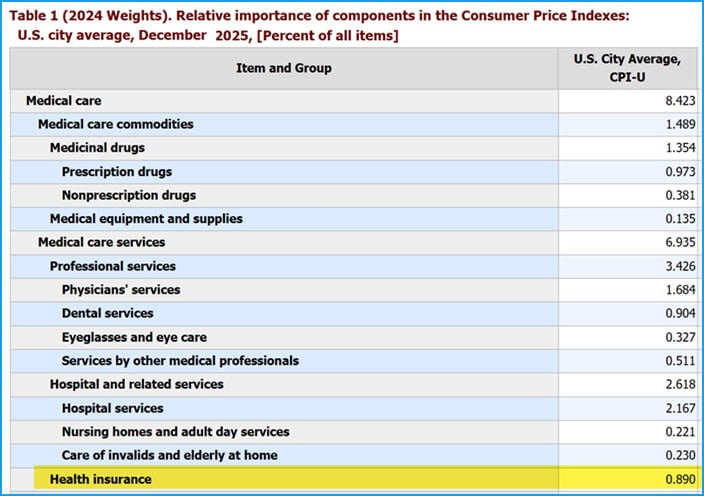
Further, the BLS severely underweights health insurance at just 0.89% of the average monthly ‘basket’ of spending.
In reality, for many families, health insurance is higher than their mortgage or rent payments.

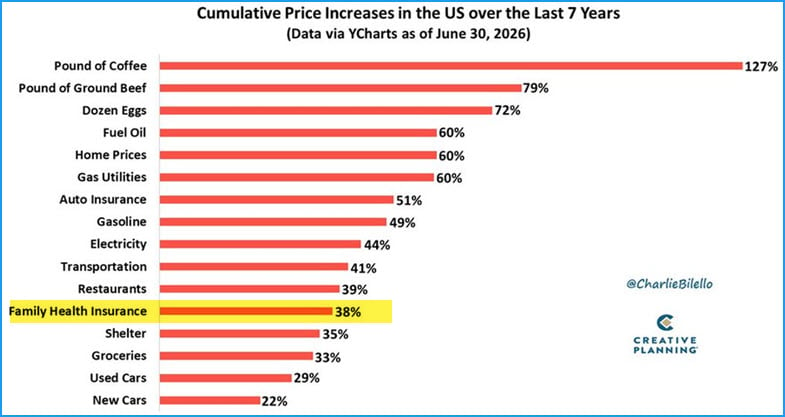
I know what you’re thinking; why not just track the actual prices of health insurance instead? That would be defensible and smarter than using a janky proxy like HC profits which can be rigged and jiggered six ways to Sunday.

On that basis, health insurance costs are up 38% over the past 7 years.
The summary here is that inflation, while having moderated somewhat according to the BLS, remains well above the Fed’s official target rate of 2%.

And it’s probably going higher…

Future Inflation

The headwaters of the inflationary Nile, is government deficit spending.

June was yet another whopper of a month for the US government deficit clocking in at $120 billion. June is usually a very light deficit month because it’s when estimated tax payments are due.
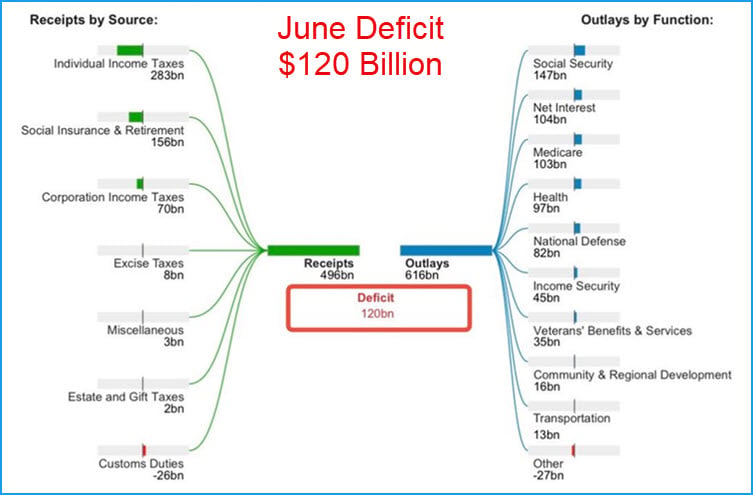
But the true deficit is probably even higher than that. The government is projecting a deficit of $2 trillion, but the actual amount of new debt the US government took on over the past 12 months is $3.2 trillion.
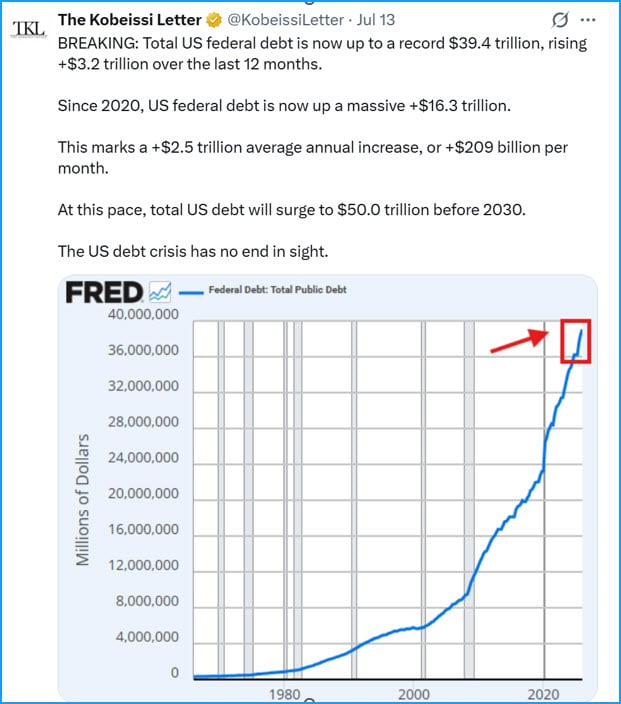
I know the calendar year and fiscal year are off by a few months, but are they off by $1.2 trillion? Not a chance.

So, on top of Federal Reserve money printing (+$200 billion since December 25) and government deficit spending, we also have the never-ending war with Iran which has, again, dialed up in kinetic intensity this prior week.

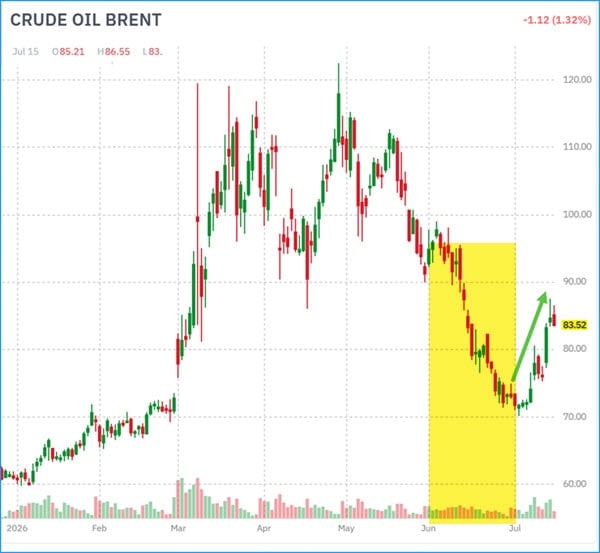
A big reason inflation fell in June is because the price of oil fell significantly in June (yellow highlight). But it’s been moving higher in July…and I expect it will move a LOT higher over the coming months, especially if Trump escalates from here.
Creak! Pop!

Paul and I also discussed the South Korean KOSPI stock index which has undergone a powerful -31% ‘correction’ over just 17 days.
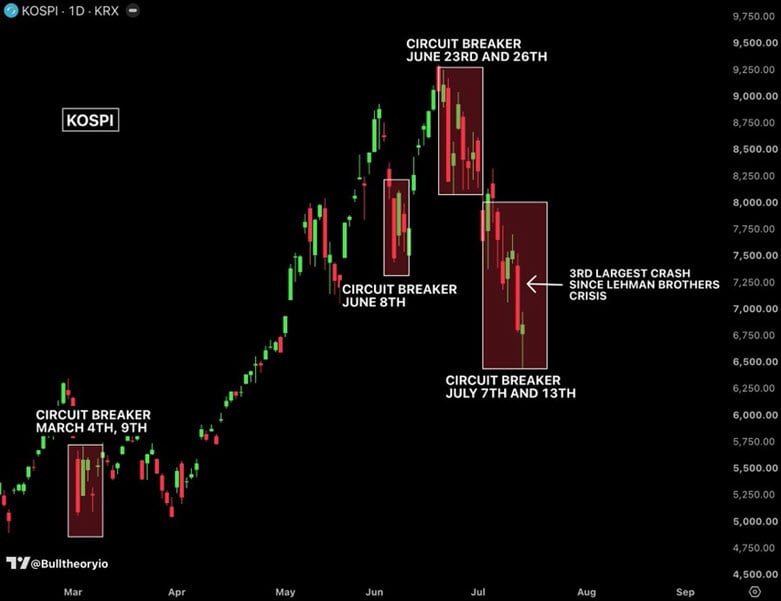
Recalling that events tend to spread from the outside-in, the KOSPI provides a warning signal, as does the yen rapidly weakening, and bonds stubbornly selling off.

As is typical of us, Paul and I both urge prudence. Prepare for the downside while the skies are still relatively blue, focus on resilience, and avoid over-reliance on passive strategies.

Until next time….



Timestamps

00:00 Introduction and Disclaimer
01:07 Inflation Trends and Health Insurance Costs
05:51 The Flawed Measurement of Inflation
11:51 Market Reactions and Economic Pressures
17:56 Investment Strategies in Uncertain Times
24:09 Government Spending and Future Inflation Risks
25:51 Navigating Social Security Changes
29:05 The Impact of Government Spending on Inflation
33:57 The Consequences of Military Spending
37:42 Energy Markets and Inflation Dynamics
42:03 Geopolitical Tensions and Oil Supply
49:36 Market Signals and Economic Indicators
55:21 Market Complacency and Risk Management
58:42 Historical Lessons and Preparing for Market Downturns
01:01:28 Global Market Signals and Emotional Investing
01:04:26 Navigating Market Volatility and Emotional Pain
01:10:22 Understanding Market Cycles and Future Risks
01:17:35 The AI Bubble and Future Economic Trends


FINANCIAL DISCLAIMER:

The information contained in this video and the resources available for download through our affiliated website are not intended as and shall not be understood or construed as financial advice, nor should be interpreted as a solicitation to sell or offer to sell investment advisory services. No person who currently works for or contracts with Peak Prosperity or Peak Financial Investing is an attorney or accountant, nor are we holding ourselves out to be, and the information contained in the video and on the website is not a substitute for legal or tax advice from a professional who is aware of the facts and circumstances of your individual situation. While Peak Financial Investing is a registered investment advisor, please note that this podcast is not intended to be investment advice.

All information has been obtained from sources believed to be reliable, but its accuracy is not guaranteed. There is no representation or warranty as to the current accuracy, reliability or completeness of, nor liability for, decisions based on such information and it should not be relied on as such. We have done our best to ensure that the information provided is accurate and provides what we feel is valuable information. The views expressed are subject to change based on market and other conditions.<

No guests or clients appearing on the podcast receive any form of compensation for their appearance and obtained no other benefit from either Peak Prosperity or Peak Financial Investing.

All investing involves risks including the possible loss of capital. Asset allocation and diversification does not ensure a profit or protect against loss. Please note that out- performance does not necessarily represent positive total returns for a period. There is no assurance that any investment strategy will be successful. All investments carry a certain degree of risk. Dividends are not guaranteed, and a company’s future ability to pay dividends may be limited.

Additional important disclosures for Peak Financial Investing may be found in our Form ADV Part 2A, which can be found at https://adviserinfo.sec.gov/firm/summary/319672.

2 Likes

Speaking of Inflation, particularly Oil Price Inflation, how do these Oil Cargo Shipping Contracts work?

At what point does the Insurance Claim kick in? Is that the real reason why the MOU was signed?

Can we just buy an oil cargo ship stranded in the Persian Gulf at 10 cents on the dollar and then just leave the gay Filipino crew stranded on the ship inside the Strait of Hormuz and then just take profit from the Oil Price Inflation?

Or, then sell the oil cargo ship to the Chinese and let “Charlie” finagle a way out of the Strait of Hormuz, like during the Tet Offensive in 1968 in “NAM”?

1 Like

So as folks noted US exports dollar inflation, are wars like Iran mandatory to force folks to take and pay those debts?
Coz someone has to take bad loan and that inflation or it wouldnt work. Gold trade wouldnt need pesky currencies.
(I have x amount of gold, you have y, then we have balancing accoutns for trade and just calculate net so physical gold hardly ever moves… good old classic bilateral trade… as easy with computer with tri or quad participants nowadays)

1 Like

Sal Mercogliano (‪@wgowshipping‬ )
Has full youtube channel of all about shipping, including insurance as that is critical part of it.

While insurance not main point, they talk a lot of these topics here with Nate Hagens:

1 Like

Somebody on Hal Turner:

“Netanyahu is really going to destroy the whole Western economy presumably so that his banking friends can buy up the remains for pennies on the dollar, pound, Euro etc”

4 Likes

Maybe this is a nomenclature/definition thing, but anyway.

When Paul talks about passive vs “risk managed”, it sounds (could be wrong) as though he is talking about 100% equity vs stock picking (which he does for clients?).

But passive doesn’t mean 100% equity or “all in” on risk, does it? People are encouraged to balance the level of risk by having a % of bonds - and retuning that every year, so as stocks go up, they keep taking a bit off the table (which Paul also talks about) and putting it into bonds. As I say (could have it wrong) the way Paul talks about “passive” is as though there is no risk management (there is) and you’re all in for an equity ride (which is not necessarily the case).

Vs “risk managed” - his active approach. Yes, managing risk is sensible but, as I say, it is done with passive/tracker portfolios. Then his approach to managing risk (stock/asset class picking) is more than managing risk, it is actively trying to pick the winners of the next X years, then selling and buying the next thing. That’s active investing/trading, which isn’t what “risk management” implies - though there can be some overlap, like in many things.

It’s probably terms or me mishearing, but I don’t feel like I agree when Paul uses these terms and then what he goes on to describe and the pros/cons of these approaches.

1 Like

Hal Turner today:

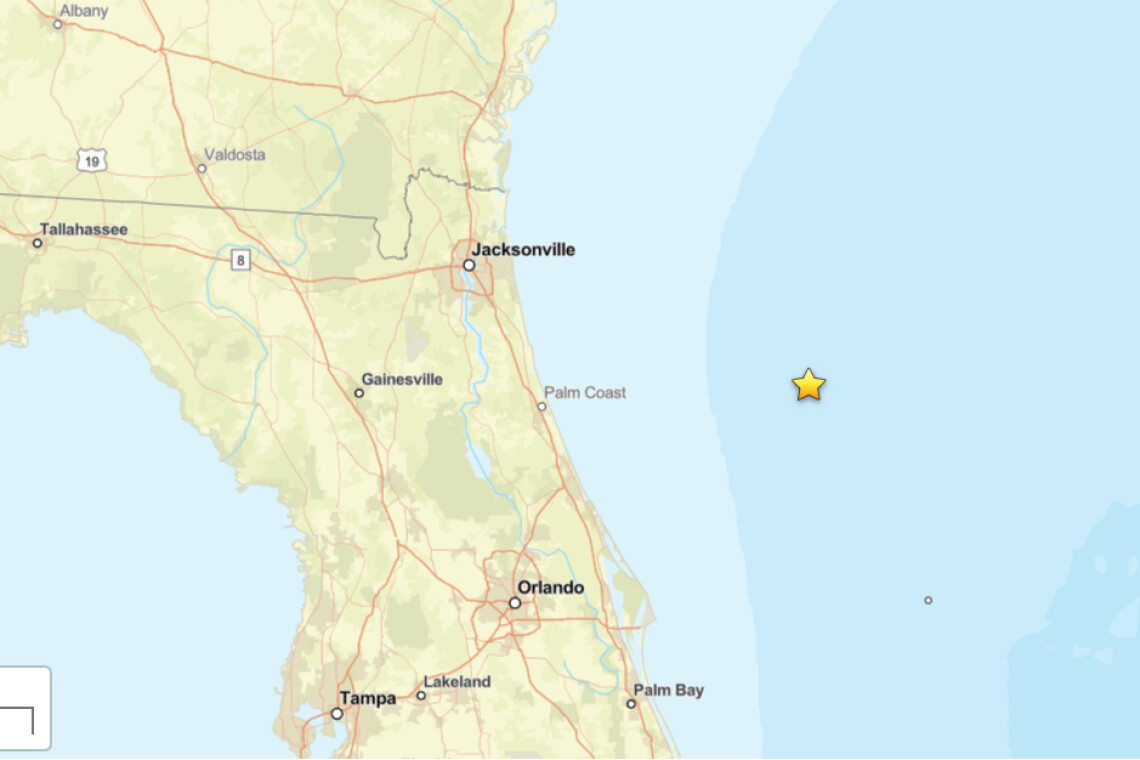
“The United States Geological Survey (USGS) reported a Magnitude 3.9 “Experimental Explosion” off the east coast of Florida at 7:04 PM eastern US Time yesterday.

They report "The recorded ground motions from this event are more typical of an explosion than a naturally occurring earthquake. The Navy has conducted Full Ship Shock Trials in this region in the past.

There have been no news releases from the U.S. Navy or from the Department of Defense warning anyone this was being done, and no such releases explaining what was done.”

3 Likes

Before I retired, my employer reduced the cost of monthly insurance, but substantially increased the deductible and co-pay. If all you tracked was insurance cost, and not total cost…

3 Likes

I do not track government statistics. They are as bad as the input received. I have first hand experience in collecting “data”.

Medical rates cannot be reduced without eliminating the virtual monopolies that exist. First is the insurance monopoly. Second is the government monopoly that forces the medical system to provide free medical to all the uninsured regardless of costs. Third is the tort legal operation that has set up a system that uses the court system to milk fees from the medical system.

Who pays these insurance fees?

· General Surgeons: $25,000 – $60,000 annually

· Orthopedic Surgeons: $40,000 – $120,000+ annually

· Neurosurgeons: $150,000 – $200,000+ annually.

Government is absolutely not “of the people, by the people, and for the people”. It has become a means for groups to use its powers to rip off each other. So, government is the biggest part of the problem simply because we the people cannot change any of its practices. Today’s most in-your-face example are voting rules.

3 Likes

Sorry folks but this episode goaded me into letting go. Let me preface this by writing, this is my opinion based on my research. I have very little $$ still left in the equity markets.

Creative Destruction.
How much destruction of value will Ai impose on the economy? Sure, Ai will increase productivity but it will do so by destroying the investments of everyone who is replaced by the availability of Ai productivity. But what is Ai productivity and how is it measured? Sure, we will get better materials, better information, better correlations, etc. Lots of things. But better materials mean the plants that made the not-so-good materials become worthless. Who takes that loss? The little guy with no insider info, no special education, no real financial fiduciary, etc. You think that the past 10-15 years has made a few fantastically rich (read accumulate financial power) but at the expense of guess who? The pigeons otherwise known as small investors. Just wait to see how Ai amplifies this situation! The setup to socialize losses of the “well placed”, friends of the right people, etc. were put in place following the Savings and Loan crisis. No need to wait, it is already here. How fast did the current top billionaires get their wealth/power? Even President Trump made $2 billion on his Truth Social network. It is here and now. The visceral general feeling of the people is happening, not with the old but with the young who see their dreams fading into the future. This just adds to the size of the normal number of left-thinking population. Call it change that is happening too quickly for humanity to absorb into the national culture. Too rapid change destroys political cohesion and cultural stability. Perfect for the extreme left to amplify and take power.

Petroleum Price
The reason the price of petroleum is below expectations is that the demand for it has been destroyed through destruction of refining facilities. Something to consider. With the facilities out of commission, who else uses raw petroleum? Dr Anas Alhajji at https://www.macrovoices.com/ The price shock is in the refined products not the raw material (petroleum). National storage facilities will be filled with petroleum prices set by governments, not by the markets.

2 Likes

I posted a similar comment to a previous interview with Paul, but it applies again today. Given ridiculous health insurance premiums, a viable alternative may be Crowd Health, which sounds like a true way to pool risk. (coupon code: darkhorse)

Full disclosure, I haven’t tried this product, but my plan is to switch to them should I ever lose my software engineering gig. (Tech is good but volatile…) I heard about them through the Darkhorse Podcast, which is also what introduced me to Chris when he was interviewed by Brett Weinstein.

2 Likes