I was recently interviewed by Clayton and Natali of Redacted, as well as by Mario Nawfal.
On Redacted, we discussed the looming risk of the largest energy shock in U.S. history, how current policies are ignoring or covering up the severity of the situation, and the real-world impacts already showing up in gas prices, food prices, and broader economic pressures. We also explore practical steps for protecting wealth through assets like gold and silver amid these challenges.
During the interview with Mario, we discussed the political fallout from recent events, including the ousting of Thomas Massie, the concerning trajectory of U.S. foreign policy and potential conflicts, the staggering national debt situation, and broader systemic risks facing the American economy and global stability.
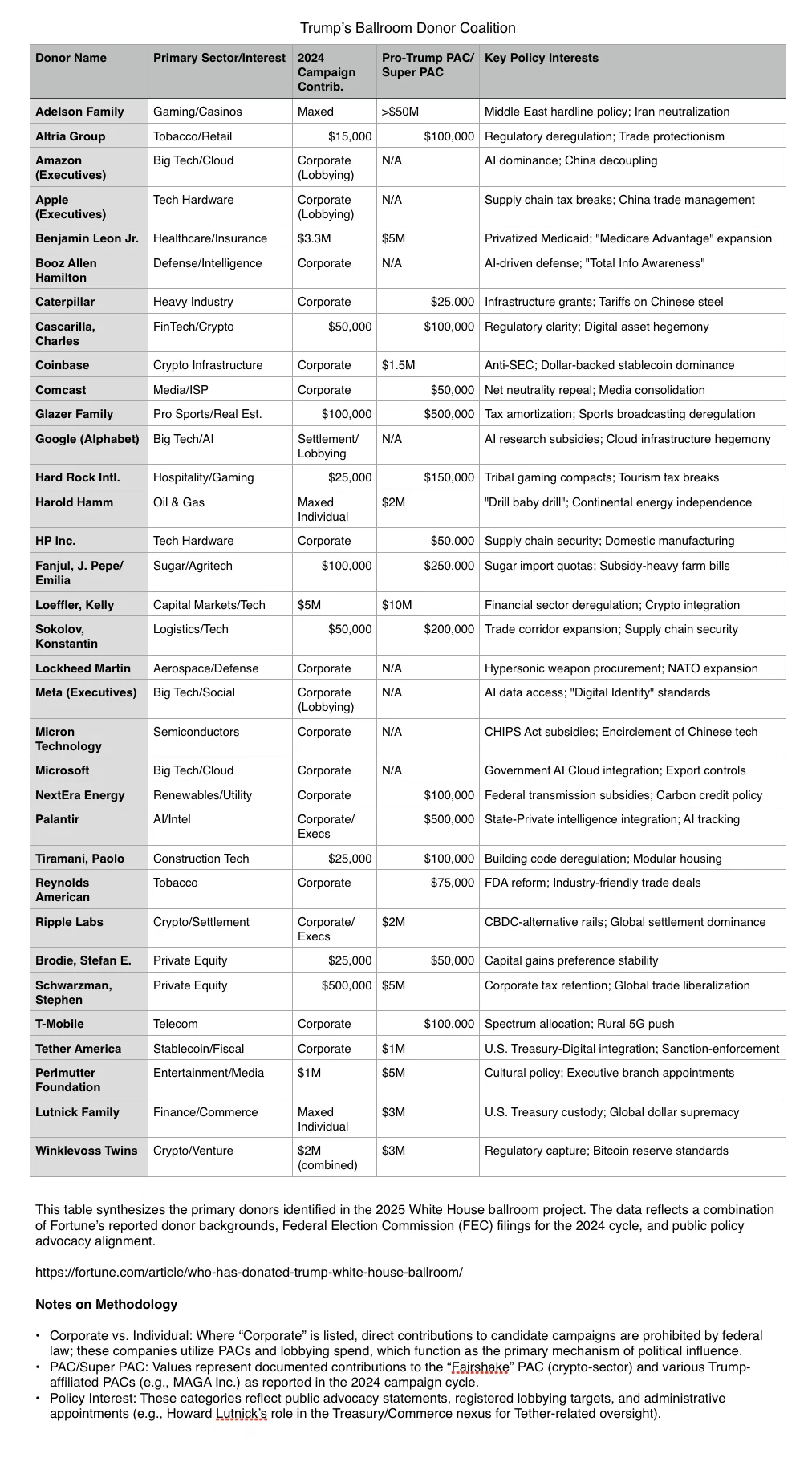
The Whitehouse released a list of donors to Trump’s ballroom in April of 2026 - they represent the coalition of interests driving the policies of the executive branch. Here is a list of the “Trump Ballroom Donor Coalition” with some AI assisted analysis.
I picked a name off the list at random last night: Fanjul family.
We have deployed the USS Nimitz Carrier Strike Group to Cuba (approx. $135 million/month operating cost).
The Fanjul family are members of Trump’s Ballroom Donor Coalition - having also contributed to Trump’s 2024 campaign and PAC’s. Their purported $4 billion fortune is based in the sugar industry and, surprisingly, they are prepared, as May 20, 2026, to “rebuild Cuba”. Remarkable!
The Fanjul family had its many sugar mills and land taken by the Cuban government in 1959. The family are in dominating control of sugar in the Western Hemisphere, with control of supply chains, labor, and land across the Caribbean.
Title III of the Helms-Burton Act grants U.S. nationals the right to sue—in U.S. federal court—any person or company that “traffics” in property that was confiscated by the Cuban government after January 1, 1959. That means that, in American courts, Cuba owes the Fanjul’s for what was taken in 1959. Anyone who used what was taken, owes the Fanjul’s in American courts. When the Cuban government falls, their debt to the Fanjul’s will be unpayable - but that is alright, the Fanjul’s have money. They will take Cuban land and other property in exchange and manage the island . . . like a big sugar plantation.
The Thomas Massie interview on Tucker Carlson (the second one) revealed this link: the donors to the ballroom, the “Arc de Trump”, and the renaming of the Kennedy Center are the people running the Trump administration.
Pick any other name off the above Ballroom Donor Coalition list and you are going to find the relationship to U.S. policies currently being implemented, no matter the costs to the rest of us (can we send the bill for the Carrier Strike Group to the Fanjul’s sugar company?).
From 5 to 50 percent is certainly easier than 0 to 50.
Having some experience from growing 5 percent for a season or more is worth so much in being able to find your way through scaling up. Spending time with gardeners or small farmers is a great way to learn. There is a hospital in Pennsylvania that has a Rodale garden on the campus. I have stopped on my way home from HBG twice and walked the perimeter of the garden demonstration grounds and learned so much just snooping from a small distance after hours.
Having the tools and supplies on hand because you have already been working a smaller garden could mean the difference between success or not if materials goods are suddenly hard to come by due to war famine resulting in a huge uptick in gardening
Getting scalable infrastructure in place puts you in much better place than starting from nothing.
For all these reasons I am not really gardening at my place this year but instead preparing to garden a whole lot more next.
Chicken coop is getting a new roof, and some renovations so it’s ready to host it’s full capacity of birds. It’s at about 25-33 % currently.
I am working on irrigation. Getting water to coop, and putting a water line and bib to fence for the small fruits. Next layer will be putting irrigation and drips or soakers for each area/ grouping because dragging hoses or containers of water gets old when you are old. Irrigation for perennial herb and tea garden also.
I have decided to bring a heavy gauge metal tube framed greenhouse with poly panels onto property. I get too much wind for a high tunnel at this location and a typical green house kit would not last even with modifications. Fresh green stuff in winter saves cash, and getting things started to extend seasons means two crops out of garden spaces instead of one. Small pots of fresh herbs sell well here so there would be income or trade potential.
It’s in my end of the world. If the ability to travel still exists in the future, and you’re passing through look me up. I’ll take you to the Rodale Institute farm which is open to the public and available for self-guided tours. Very inspiring and educational.
I’m enjoying a lazy day today reading a book related to gardening I’d highly recommend. Specifically because it has a good overview of what storage crops to grow, how to store them, and how to use them. Contrary to the title, there are other strategies for ways to have cold storage besides building a root cellar. Most importantly, none of this requires canning, freezing, or energy inputs.
Thomas Massie’s loss felt like a real gut punch. Apparently being an independent thinker and being willing to say “no” when the rest of the gang just goes along to get along isn’t a viable strategy. Something tells me he’s got plenty more coming though.
This is cheap. One crashed F35 to red sea costs same.
This sounds revansche of ~1940s when Castro took over Cuba and these sugar plantation + mafia folks were bitter they were driven out from their taxfree profit making machines.
Disappointing to see history repeating, well ehm human elites trying to repeat it 1:1 as hundred(s) of years ago.
There are 60 to 70+ fighter jets in this carrier strike group. This is the cost to sail the boats out, I believe, and a general estimate at that. Still, point taken. Sure wish I had that small change in my pocket. Wouldn’t have to go to the office anymore, that is for sure.
Is that 135M/M, a total cost or variable cost? I would suspect the variable cost of deployment in a war footing would only be a slight increase over fixed costs.
Just drove to the beach in Venice, surfed, hit the heavy bag behind Muscle Beach, sat down with a cappicino and processed the (fun and interesting) Mario Nawfal interview I listened to twice since yesterday.
My Bottom Line
May 7, 2026, CIA, “Iran can last 3 to 4 months.” This implies August or September of 2026 deadline for Iran to negotiate or face even bigger problems.
May 22, 2026, Chris Martenson of Peak Prosperity, “The U.S. is down to 50 to 60 days of fuel.” This implies July 11 to July 21 of 2026 deadline for U.S. to negotiate or face even bigger problems.
It really doesn’t matter to me who “wins” and who “loses” - if the U.S. runs out of fuel (i.e. depleted Strategic Petroleum Reserve) I am going to be fighting for my life and my family’s lives in a collapsing Los Angeles.
Brother, that is a troubling, sobering eventuality. We will all be visited with trials in the coming days. Hoping you have a solid Plan B. Collapse now and avoid the rush. Wishing you and yours the best…