Is It Too Late to Save the Financial System?

Originally published at: Is It Too Late to Save the Financial System? – Peak Prosperity

Welcome to the third podcast in the “Is It Too Late?” series.

Many people, myself included, feel like the United States is headed in the wrong direction. As in disastrously wrong. I wonder what kind of a world we are leaving for future generations…especially when it comes to the financial situation of the U.S.

Some, like Ray Dalio, have said that we’re already past the point of no return. All that’s left is for the U.S. to experience either a severe debt crisis or a currency crisis, and possibly both.

Today’s guest is noted economist Richard Werner, who caught my interest for this series when he appeared on the Tucker Carlson show and said that there’s possibly a path out of this mess. It involves redirecting government deficit spending (and “QE”) toward productive enterprises.

Is it feasible? Can it be done?

In this podcast, Richard Werner argues that America’s approximately $40 trillion national debt is on an exponential trajectory that is fundamentally unsustainable without major changes to spending, economic growth, or debt management.

Cutting to the chase, this seems unlikely given the current crop of political players and their addiction to reckless spending and uneconomic policies and programs.

Everything of late, especially including the centralization of banking into fewer and fewer behemoths, is working against a return to widespread economic prosperity.

One sour note for me was Richard’s soft promotion of the idea of abiotic oil possibly being a major factor that hasn’t been given proper attention. If I ever get an hour of Richard’s time on the topic, I am sure I can help clear that up; abiotic oil is just not a significant part of the story.

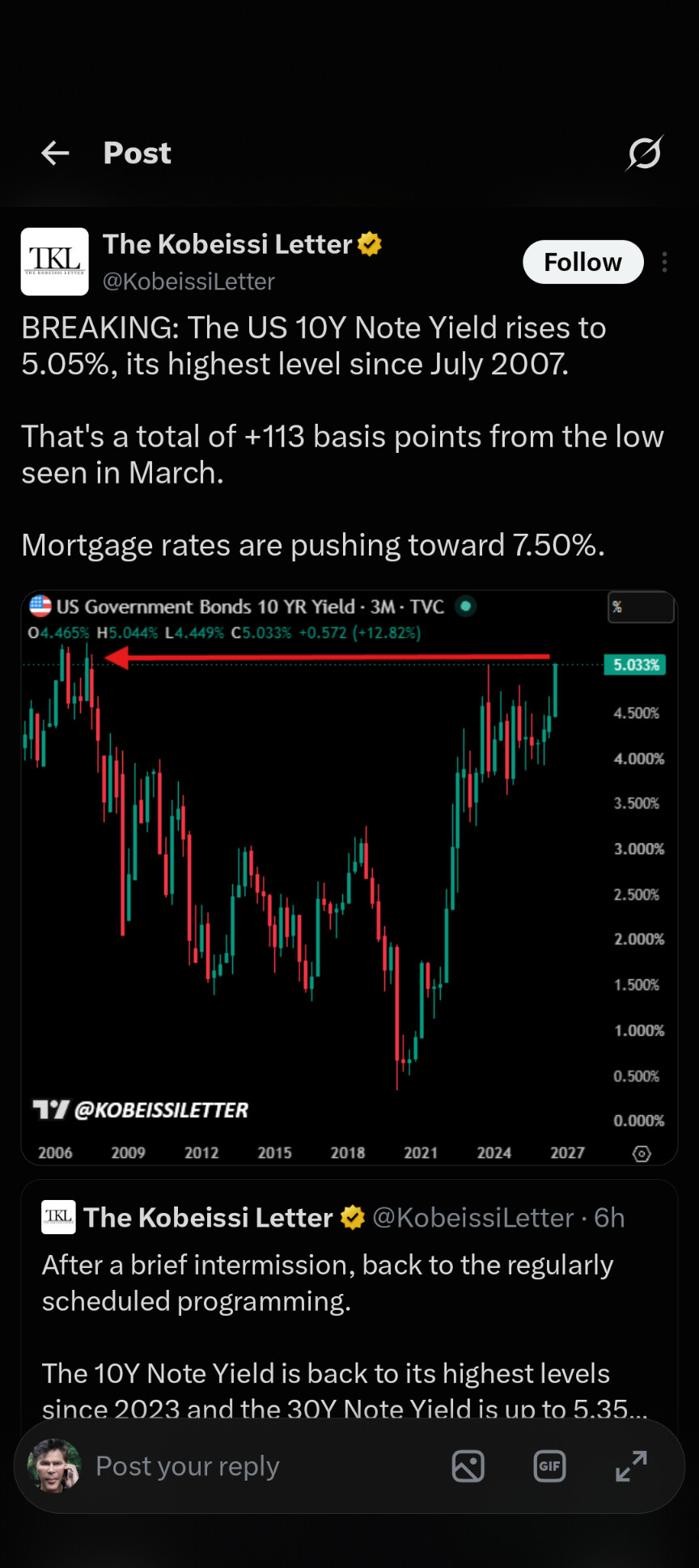
We also discussed digital currencies, the petrodollar, and the looming Treasury yield crisis that seems to be brewing.

I did not come away with a clear answer as to whether there’s a realistic chance of turning off the path we’re on, so for now I am going to stick with my old maxim: a body in motion will remain in motion.

In other words, the trajectory we’re on is the path.

And that path leads to financial and monetary chaos.


Timestamps

00:00 The Promise of Peace and Prosperity
01:38 Is America’s $40 Trillion Debt Sustainable?
04:12 The Economic Importance of Small Banks
11:24 Stablecoins and the Future of Dollar Debt
17:38 The Debt Trap and the Inflation Escape Route
23:56 How Banks Create Money and Fuel Bubbles
34:34 The Threat of Central Bank Digital Control
36:33 Energy, Economic Growth, and the Limits of Resources
42:00 The Petrodollar, War, and Dollar Dominance
53:07 What Happens When Treasury Yields Explode?
59:17 Japan’s Economic Warning for America
1:06:28 Is the United States Approaching a Breaking Point?


13 Likes

Another great selection by Chris. I see the breadth now: military/political with Joe Kent, intelligence with Erdman, and now finance with Werner. Chris teed it off with the graph and disturbingly, we went to log scales and the possibility of a trillion in new debt within days.

Chris’s summary is spot on: we’re on a trajectory, and we’re unlikely to veer off.

Interesting observation: Werner is critical of physicians and the pharmaceutical industry, but he’s comfortable with the term ‘central planners.’ Banking is a root cause problem by design.

11 Likes

Wow

https://x.com/hedgeye/status/2102792355774595173?s=46

4 Likes

Something that occurred to me. Let’s assume abiotic oil really is a thing. The next question to ask is, what’s the rate of production of abiotic oil? Does it exceed our global consumption? If abiotic oil production exceeds our consumption, then we shouldn’t see declining EROEI from our current set of wells. In fact, we should see increasing EROEI.

So abiotic oil could well be possible, but math suggests its rate-of-production most likely is not enough to supply the globe with its current consumption, based on EROEI declines that we are seeing.

16 Likes

Yeah that’s my concise reply.

Instead of debating the theory, just ask: where are the wells that refill? We see it with aquifers and the question becomes one of rate of filling vs rate of depletion.

If we find no specific case of an oil well refilling at a reasonable rate, then the theoretical details don’t matter. It doesn’t exist.

If it did refill then we could theoretically say the optimum extraction rate is not to exceed the refill rate.

10 Likes

Great guest! Werner is on my short list of experts I highly respect. Princes of the Yen is also a good documentary. I think I’ve mentioned it in the past.

I’ll have to listen a second time to catch everything. Lots of good discussion.

I don’t recall discussion of yield curve control or “financial repression.” Does he think that’s likely in the future?

My base case is rates rise near term (I don’t know if they go much higher than where they are today) but rates go down midterm under Fed and Treasury policies. YCC is how I picture them burning off some of the debt burden, alongside painful double digit inflation. Maybe that’s “the big print” Lepard wrote of.

After that… not sure. Maybe rates go up again; I’m not a believer in rates going up much more without a couple steps back down. If YCC last for a decade or so, that could inflate our way out of much of the debt but the currency would get killed and IDK what US currency will be in 2036.

I agree TPTB are pushing stablecoins as a backdoor CBDC and control mechanism. I’m not clear on the precise details of how it would be rolled out or how it would work.

An exercise I’ve wanted to do but haven’t sat down to do: make a chart with time in the x axis and the time required to increase national debt by $1T in the vertical. This would be a curve that slopes down and to the right. Where it hits zero (the x axis) is the blowup point. That would give a rough trajectory for when the debt crashes.

And wouldn’t it be funny if that were around 2030? :thinking:

3 Likes

I think we’re already past the best case scenario of walking away from the mess, and closer to the ending discussion of leaning all in to authoritarianism. Hey, hope it was worth worshipping imaginary number go up. I ain’t going to no war, there’s a better chance of all those recruitment centers in strip malls mysteriously going up in flames.


5 Likes

Very good interview.
Gotta wonder as i listen to these interviews/analysis week after week why do i have $$ in IRAs or in tbills???
and ask am i really irresponsibly long a certain asset when after each @chrismartenson podcast i want to run out and buy more PMs???
I am now thinking irresponsibly long means having a brokerage account or $$ in the bank.

6 Likes

Bingo!!! And what data has been presented regarding the ‘refill’ rate. It’s probably about the same as my savings account which adds a few pennies over time if you don’t factor inflation! (Actually I don’t keep a savings account, at least as far as banks are concerned.)

2 Likes

It involves redirecting government deficit spending (and “QE”) toward productive enterprises.

How bout we just cut government spending …drastically…and let private citizens decide what ‘productive spending’ is? Lets see how many pride festivals, windmills and transgender pedestrian crossings get built then.

11 Likes

The Wealth of the U.S. Economy just a couple of generations ago in retrospect was amazing. And, everyone took it for granted.

Maybe, get Morgan Freeman on “The Show” to discuss Economics” from a layman’s Perspective?

Is Morgan Freeman a “Chad”?

I like the link between abiotic oil and aquifers.

Seems like running this experiment shouldn’t be too hard. I suspect the oil industry doesn’t want to know the answer - but I also suspect the refill rate might be fairly slow.

Perhaps our current set of wells are the product of thousands of years of abiotic oil production accumulating - which we have half-drained in maybe 150 years.

Civilization relying on oil as our energy source is the Global Cult’s axis of control. If we were to discover free energy, it would blow everything up.

12 Likes

My point is the burden of proof should be on advocates for abiotic oil. Let them show one case of a refilling well… in actual existence not just a theoretical conjecture. No well, no debate. I don’t think there’s a known case.

5 Likes

I’m just guessing here, but - I suspect the oil industry controls all the oil wells, and they don’t want to know the answer. So the abiotic oll folks on the sidelines (who don’t have any oil wells, and don’t make money from their theories) might be hard pressed to get themselves enough mostly-empty oil wells and maintain them over the probably-5-years it would take to run the experiment.

Maybe it would cost a few billion dollars to run? And their ROI: “neener neener we were right.” Minus the few billion dollars it cost them.

We’ve seen this pattern before.

3 Likes

I had heard from a abiotic process occurring in TX, so I asked Google AI about it

9 Likes

is the fuel out photo from the US? We are not seeing that yet in Oz but think it’s not far off.

Are these lakes big enough to drive a fentanyl laden cigarette boat across? Kushner might want to blow up the boats and claim ownership of the lake oil to bring down the cost of diesel. Pesky citizens can keep the salt water and poisons because 5D chess, mid terms and MAGA.

2 Likes

Apparently, the correct spelling is Boehmer

2 Likes

Imagine, if you will, a planet completely covered with human cities three miles deep, and more on the way.

1 Like

Chris while this was mostly a very insightful piece he is absolutely wrong that there were no Japanese Government bonds issued before 1980. There may not have been statistics on national debt before 1980 but there was debt and there were JGBs in issue. Best to correct this or edit out that part otherwise you devalue the rest of a good episode with such a Yes/No factual error.
Best
John

1 Like