""Markets,"" Silver, and Redrawing the U.S. Household Poverty Line at $140,000?

Originally published at: https://peakprosperity.com/markets-silver-and-redrawing-the-u-s-household-poverty-line-at-140000/

Every year, Wall Street somehow manages to conjure up a Santa Claus rally. Perhaps it’s a self-fulfilling prophecy now because it has become embedded in Wall Street lore as common knowledge.

Everybody knows that everybody knows that stocks will rally…so I’d better get in on that!

But meanwhile, people struggle along in the real economy. The one in which, according to Michael Green, or Professor Plum on X, the poverty line for a family of four is $140,000.

But let’s begin with the inevitable Santa Claus rally.

December is the greenest month of them all, historically speaking. Even as terrible economic news rolls in about consumer health, shipping declines, layoffs and small business bankruptcies, the ““markets”” continue to power higher mainly based on the AI story.

But there we’ll note that the math ain’t mathing, as they say.

Finally more people are doing the math “IBM CEO says there is 'no way' spending trillions on AI data centers will pay off at today's infrastructure costs”“IBM's CEO walked through some napkin math on data centers— and said that there's "no way" to turn a profit at current… pic.twitter.com/dFwHbBMO9A

— kristen shaughnessy (@kshaughnessy2) December 2, 2025

The AI story is starting to sprout some stubborn mold, mainly along the lines of nobody being able to exactly explain where all the necessary revenues are going to come from.

On Wednesday, Dec. 3rd, Microsoft transferred some of that mold over to their block of cheese:

Futures Tumble on Report Microsoft Lowers AI Software Sales Quotas https://t.co/rpSjUtMLs4

— zerohedge (@zerohedge) December 3, 2025

But, as has been true for a long time, absolutely none of that mattered to the US equity ““markets”” on December 3rd, 2025:

Note that even the Small Caps (Russell 2000) are caught up in all this, fundamentals be darned:

Small Business Job Losses Soar In November; ADP https://t.co/AnJ9l8gpcX

— zerohedge (@zerohedge) December 3, 2025

Paul and I also discussed Silver and the idea that what we’re really witnessing isn’t higher prices for a shiny metal, but the beginning of the end for the old King Dollar regime.

In that context, these are indeed exciting times.

But the bulk of our conversation centered on the provocative position piece penned by Michael Green (ProfPlum on X), which posited that the actual poverty line for US families is now $140k for a household.

Here’s a link to the article, which I heartily encourage everyone to read.

His intro is great:

I have spent my career distrusting the obvious.

Markets, liquidity, factor models—none of these ever felt self-evident to me. Markets are mechanisms of price clearing. Mechanisms have parameters. Parameters distort outcomes. This is the lens through which I learned to see everything: find the parameter, find the distortion, find the opportunity.

But there was one number I had somehow never interrogated. One number that I simply accepted, the way a child accepts gravity.

The poverty line.

I don’t know why. It seemed apolitical, an actuarial fact calculated by serious people in government offices. A line someone else drew decades ago that we use to define who is “poor,” who is “middle class,” and who deserves help. It was infrastructure—invisible, unquestioned, foundational.

This week, while trying to understand why the American middle class feels poorer each year despite healthy GDP growth and low unemployment, I came across a sentence buried in a research paper:

“The U.S. poverty line is calculated as three times the cost of a minimum food diet in 1963, adjusted for inflation.”

I read it again. Three times the minimum food budget.

I felt sick.

The problem was that “poverty” was defined back when things were entirely different. Incomparably different in many ways.

Michael explains:

Orshansky’s food-times-three formula was crude, but as a crisis threshold—a measure of “too little”—it roughly corresponded to reality. A family spending one-third of its income on food would spend the other two-thirds on everything else, and those proportions more or less worked. Below that line, you were in genuine crisis. Above it, you had a fighting chance.

But everything changed between 1963 and 2024.

Housing costs exploded. Healthcare became the largest household expense for many families. Employer coverage shrank while deductibles grew. Childcare became a market, and that market became ruinously expensive. College went from affordable to crippling. Transportation costs rose as cities sprawled and public transit withered under government neglect.

The labor model shifted. A second income became mandatory to maintain the standard of living that one income formerly provided. But a second income meant childcare became mandatory, which meant two cars became mandatory. Or maybe you’d simply be “asking for a lot generationally speaking” because living near your parents helps to defray those childcare costs.

The composition of household spending transformed completely. In 2024, food-at-home is no longer 33% of household spending. For most families, it’s 5 to 7 percent.

Housing now consumes 35 to 45 percent. Healthcare takes 15 to 25 percent. Childcare, for families with young children, can eat 20 to 40 percent.

The problem is that the way the system is configured, a family might well find themselves doing worse and worse as they earn more and more as they try to claw their way out of crushing poverty.
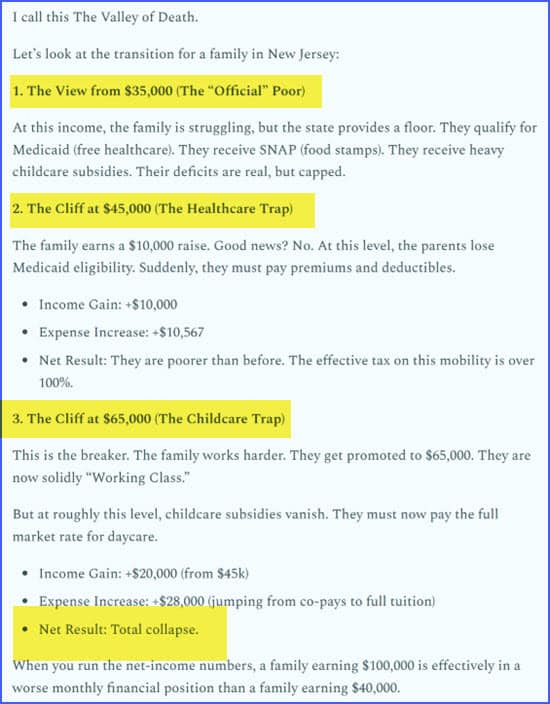
This is a well-known feature of public policy. Here’s how the city of Fayetteville, Arkansas, calculates the CLIFF based on hourly income:

(Source)

As a family moves from $10/hr to $26/hr, they do better and better, but still don’t achieve positive Net Financial Resources (NFR). That’s the “paycheck to paycheck” situation we talk about so frequently.

But then, between $26 and $27/hr, disaster strikes! Benefits are withdrawn such that a family earning $27/hr is not only far worse off than a family pulling in $27/hr, but they fall to the very worst point on the entire chart.

From there, they have to climb to $40/hr to claw their way up to zero on the NFR chart.

By the way, at 2,000 working hours, that’s an annual income of $80,000.

So, is the correct poverty line $140k or is it $80k…if we define poverty as lacking sufficient resources to provide any buffer for your family (aka ‘savings’).

I don’t know, but it’s well past time that we had the conversation.


Kiker Wealth Management – Our Endorsed Financial Advisors

Many investors today are looking for a more intentional, risk-managed approach rather than a passive “set-it-and-forget-it” strategy. If you’d like to explore how a disciplined process may help strengthen your plan, you can schedule a free, no-obligation meeting with Paul Kiker and the team at Kiker Wealth Management to review your portfolio and strategy.

Clients frequently share that Paul’s guidance brings charity and direction to their financial decision-making.

To schedule your initial meeting, please visit PeakFinancialInvesting.com, complete the simple form, and a member of Paul’s team will contact you within 48 business hours to arrange the first call.

“This is an endorsement. The individual providing these statements is not a client of Kiker Wealth Management but is a compensated promoter under a written agreement. Because they received compensation, they have a material conflict of interest in recommending Kiker Wealth Managements services. “


FINANCIAL DISCLAIMER. PEAK PROSPERITY, LLC, AND PEAK FINANCIAL INVESTING ARE NOT ENGAGED IN RENDERING LEGAL, TAX, OR FINANCIAL ADVICE OR SERVICES VIA THIS WEBSITE. NEITHER PEAK PROSPERITY, LLC NOR PEAK FINANCIAL INVESTING ARE FINANCIAL PLANNERS, BROKERS, OR TAX ADVISORS. Their websites are intended only to assist you in your financial education. Your personal financial situation is unique, and any information and advice obtained through this website may not be appropriate for your situation. Accordingly, before making any final decisions or implementing any financial strategy, you should consider obtaining additional information and advice from your accountant or other financial advisers who are fully aware of your individual circumstances.

12 Likes

My link to silver plus “poverty line” - I’ve posted this before, but repeating just ICYMI.

Minimum wage in 1963: $1.25.
5 Silver 1963 quarters = 0.9 oz silver.
Minimum wage (paid in silver): 0.9 oz x silver @ $57.50 per oz = $51.75 per hour.
Today’s (Federal) minimum wage: $7.50 per hour in FRNs.

Is the “5-silver-quarter” minimum wage above the poverty line? Seems a lot closer.

19 Likes

This seems totally fair. And quite probably we don’t have to be any more complicated than that.

So let’s carry this forward. Assume you are ageing, and want to solve for in-home care (just picking one example out of many).

Let’s assume it’s ‘light’ and that means 8 hours per day, and you want help for 340 days out of the year, family provides the rest during holidays and such.

That means you need (8 * 340 * 5) silver quarters per year of care.

That translates into $3,500 face value of silver quarters.

The number of people I know who have even one year of such expenditure in their possession I can count on one hand.

Speaking in terms of silver only, and removing the idea that you are going to apply the labor to in-home care…at 0.9 ounces/day, and assuming a 2,000 hour work year, this translates into 1,800 ounces of silver per year per worker.

Again, I know very few people who could sustain that level of silver output for very long.

So let me quote Grant Williams again; “However much gold you have, it’s not enough.”

Ditto for silver, I would say…

12 Likes

Please do a report on how to invest in “Food”. Michael Yon predicts worldwide famine.

Thank you

10 Likes

Congratulations Paul

6 Likes

You’ll know it’s over when Dunkin goes out of business.

3 Likes

for a smile:
I have tried to come to grips with the inflation, and value retention of stored wealth; comparing silver: increased cost in dollars over time, ease of transport, appreciation of inherent value, exchange for other products of value(?), …enjoyment of the the item. The revelation: single malt scotch wins (McCallans 12 year old). I have not gone the distance of allocating a percentage of investments, (less than .001% seems reasonable) but I am already past my best before date, so quantities may be limited.
As an aside, a college friend’s parent was was a retiring diplomat and as part of his transition had a LARGE store room (at least 2 semi-trailers worth) of distilled liquor, never thought it made sense before.

6 Likes

I wonder how universal that “middle income valley” is at least in western sphere (inc Japan)… I bet it is in every advanced economy and thus heavily linked to family formation.

Only places it (yet) isnt are poor countries that enjoy strong growth, as there was no money to have bloated government to begin with, so no taxes either. However all of those mature over time like China has done.
We’ve yet to see if energy markets will reorganize in next 10 years by shortages of materials, but otherwise this “16x food” will continue for now.

Ok so that’s quite a coincidence. I have a case of various bottles of medium-grade whiskey I stocked as a “go to heck” exchange plan a long while back. I just went to go look. Holy crap there’s one bottle of McCallan 15, and a pair of 12s. And they’ve been there for 10 years. Are they still ok? (Are they absolutely fantastic now?).

Others: Johnny Walker Black, Oban, Laphroig. Funny how things work out.

9 Likes

YES
There was a story of a dad in England (I think) that gave his son a dated bottle of 12 year old McCallans every year on condition he leave it untouched. In his mid 20s he got enough at an auction for his collection to buy a nice house. There is a website where this stuff gets hefty prices, but I couldn’t track down the news item (it was a few years ago)

3 Likes

I asked Grok how to determine the date of manufacture. There’s something printed on the inside of the label - hard to spot, in code, and you need a flashlight. Here’s Grok’s translation:

Code “L0998D L10 22:11 11:35” = Bottled November 22, 1999 (D = 1999).

My label: “L0368D L02 01/12 10:12”

Looks like Grok hallucinated a bit, but if it is correct about year, D = 1999, and so the Mac 15 I bought in 2014 (which sounds right)…is now basically a MacCallan 25.

That’s what, $2250? Ish? Sweet sister sadie.

Who knew!

[edit] I asked grok about value. It said $300-$500 on the secondary market. Original price was maybe $80.

4 Likes

does it change once it’s bottled? I thought is only changed if it was kept in the barrel.

5 Likes

I’m not a whiskey expert. Wine changes dramatically in the bottle, but that’s due to the cork. The “secondary market” price suggests that it does though.

Now I feel silly for getting the Johnny Walker - “gifts for normal people”, while the Macallan was intended as a “gift” for someone of higher status.

1 Like

Phil is correct… bottle aging doesn’t count (as far as taste) but it sure does in the secondary market it seems! It’s the barrel time that counts for the liquors age.

I was finishing off a bottle of 16 y/o Hirsch Reserve (American Whiskey) with a friend a while back that I bought in Japan for $80 about 15 years ago, almost choked on it when my wife googled it and said it was selling for 8~10K per bottle… wish I had a few more around :slight_smile:

Edit: For corked whisky DO NOT lay the bottles on their side like you would with wine, the cork will deteriorate soon!

8 Likes

I make my own wine. My best wine ever was incredibly delish when bottled. 7 years later, it was literally unbelievably good. I also did an experiment with our “table” wine (from a kit), which doesn’t age well. One bottle had natural cork, 2nd bottle had artificial cork. The two bottles sat side by side in the basement for 18 months. I did another batch after the 18 months and did a A/B/C comparison. The natural corked bottled was drinkable, and that’s about it. The artificial corked bottle tasted exactly like the wine that I was just getting ready to bottle.

5 Likes

More questions of Grok:

Apparently, laphroig, oban, and Macallan-from the 90s have actual corks.

Today, Macallan has artificial corks, which stops aging (as you have just said).

And fortunately I stored them standing upright. Just luck though. I didn’t know.

4 Likes

When I was a youngster in my first graduate job, there was a senior manager who would wack off about wine. He was going on once about opening this vintage wine he’d stored for years. The next day, we asked him what it was like and he said it was corked. We did laugh.

I’ve gone a bit more primitive/negative with my spirits stash. I don’t want to pay out lots of money for (taxed) spirits and store them risking deterioation or them not increasing in value. I simply have a still and a stash of sugar and spirit. The kind of thing that will have value in a war and not much before. I reckon I have enough sugar to make enough spirits to barter for 5 years. Any more than that and I probably don’t want to be here.

5 Likes

I’ve been back and forth about continuing to buy silver - it’s not the higher price, it’s the “too many eggs in a couple of baskets”. This discussion has reminded me of the reality that Silver is the the best choice for savings - because it is money with an investment kicker. All in.

Rector

12 Likes

Loving the weekly updates.

If I want to know the daily technicals, I will listen to Steve Von Metre and Jeff Snyder. But often I’m just too busy. These weekly updates are perfect.

1 Like

I’m sorry Chris and Paul, but you are just wrong. History doesn’t matter anymore. That’s what they are saying. Past experience means nothing. Education? A degree? Means nothing. Consequences? So old world, so old school. Nothing exists anymore. Nothing. You are insisting on making sense of things that no longer make sense, unless you are comfortable with living in an insane world. Just remember: “The body cannot live without the mind.”

Here’s another one: “The numbers just don’t add up anymore.”

“This is not financial advice.” The word finance figures nowhere in what we are experiencing today. There is no “finance” in the financial markets, not in any sense of the word. However, YouTube will ban your channel for saying the obvious. Saying the forbidden words, when there are no forbidden words. It’s like COVID all over again. Here we are, in 2025, and I still have to give my travel history when I go see a doctor.

Here are some forbidden words.

  1. It’s too late.
  2. The USD is worth zero. Has been since the Great Financial Crisis and Crash of 2008-09.
  3. Get debt free. Whatever it takes. Get debt free and stay debt free, at least until this thing blows over. Don’t allow yourself to be a debt slave to money that is worthless. They will do that, too.
  4. This thing will never blow over.
  5. Close your 401K. It’s a phony retirement account. Only the people who are “managing” your 401K will retire, and only if they steal your 401K. All of it. Losing between 40- and 50-percent, like most people did during the GFC and the Crash of 2008-09, has been fixed. They are going to take it all next time.
  6. Buy physical gold and silver. Unless you own it, unless you can hold it in your hands, you own nothing. If precious metals are too expensive, then you waited too long and are in big, big trouble.
  7. Put a year’s income in cash away somewhere – just not in a bank, a friend’s house, a family member’s house. Unless you own it, unless you can hold it in your hands, you own nothing.
  8. What is coming next will make a Polar Vortex look like (what used to be) a summer’s day (that is not a sweltering 85-degrees with 98-percent humidity).
6 Likes