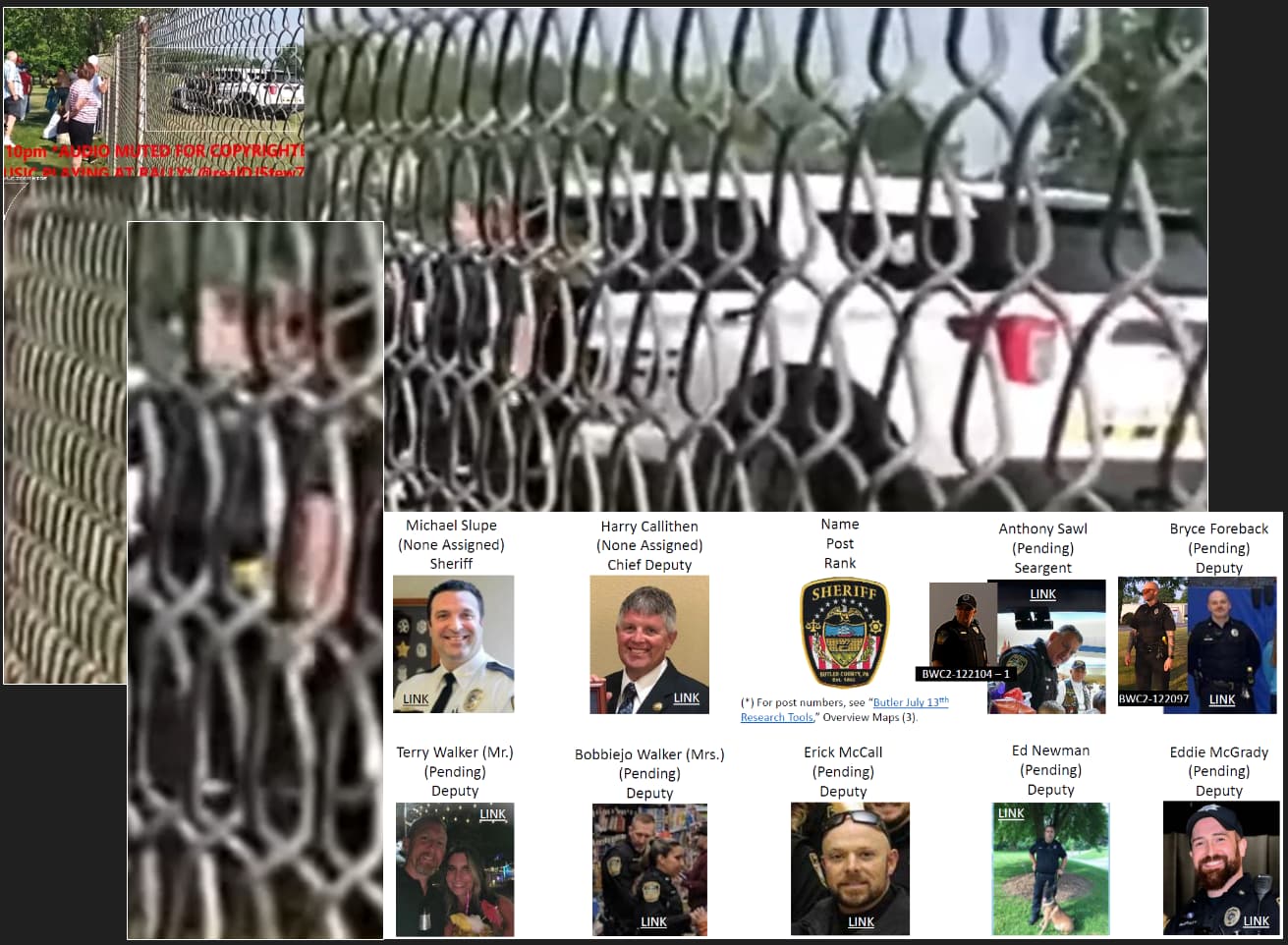
Minor recognition note, BuC Sheriff vehicle may not always wear a moustache, and instead sometimes displays their emblem:

This may be due to a left vs. right side comparison, but I don’t quite know yet.
Minor recognition note, BuC Sheriff vehicle may not always wear a moustache, and instead sometimes displays their emblem:
This may be due to a left vs. right side comparison, but I don’t quite know yet.
Interesting way of describing it, a mustache. 
I’ll add the different versions to the tool. It’s like the recent change in PSP vehicle paint jobs. We saw some of the old and some of the new paint jobs. Good catch!
By the way, the ladder was partially extended (incidently?) when he got it into his hands, but wasn’t fixed in extended position. And the other ESU member was unable to realize what to do wit it. He just tried to climb up quickly.
Maybe not.
Jason Woods
Currently, sniper team leader.
Approximately 16 years.
My primary job is I’m a sergeant at Economy Borough Police Department. I have 20 years of service there.I guess the only thing that I – initially on the 7th, they were only asking for operators. I immediately texted and asked him if they needed any snipers. His response was no, not right now. They are only asking for overwatch from the BearCat. It wasn’t until Thursday the 11th somewhere around noon, I believe – I could look at my text thread – I received a text message that now they are requesting sniper assistance.
So one thing they asked us to keep an
7 eye on was for drone activity. And if we had seen
8 a drone, we were supposed to call out the location
9 per the map, the approximate size and height of the
10 drone, and that was going to be relayed to the
11 Department of Homeland Security that had some drone
12 – drone team that were going to disable it.
13 I had no contact them,
14 but that’s what was brought up in the briefing.
What?
My first impression was reading this they didn’t give the contact to be called. That should had been clarified in advance.
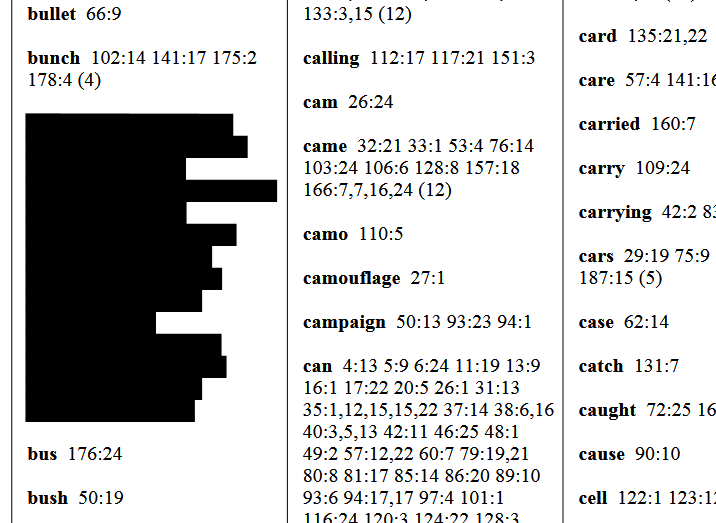
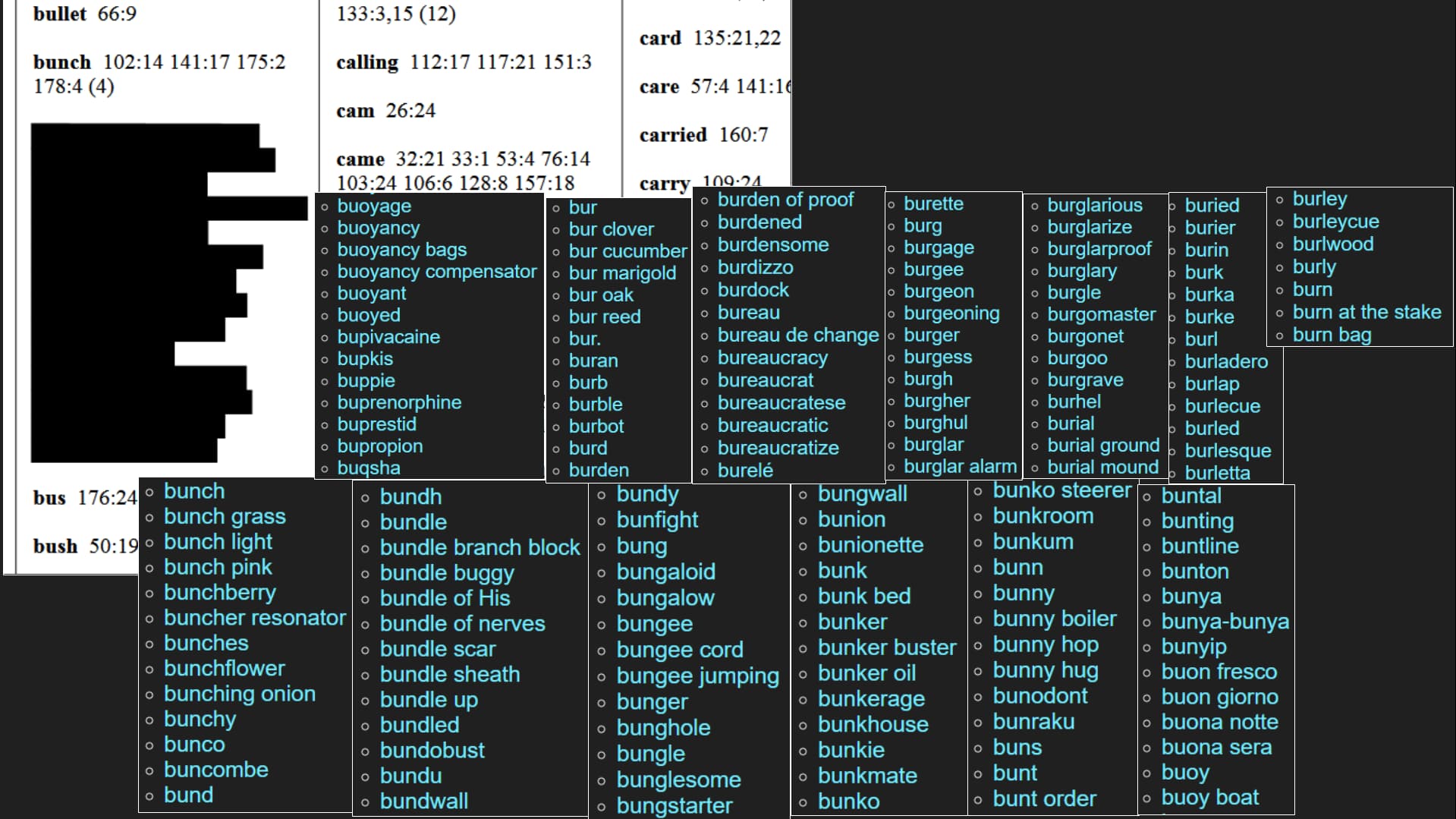
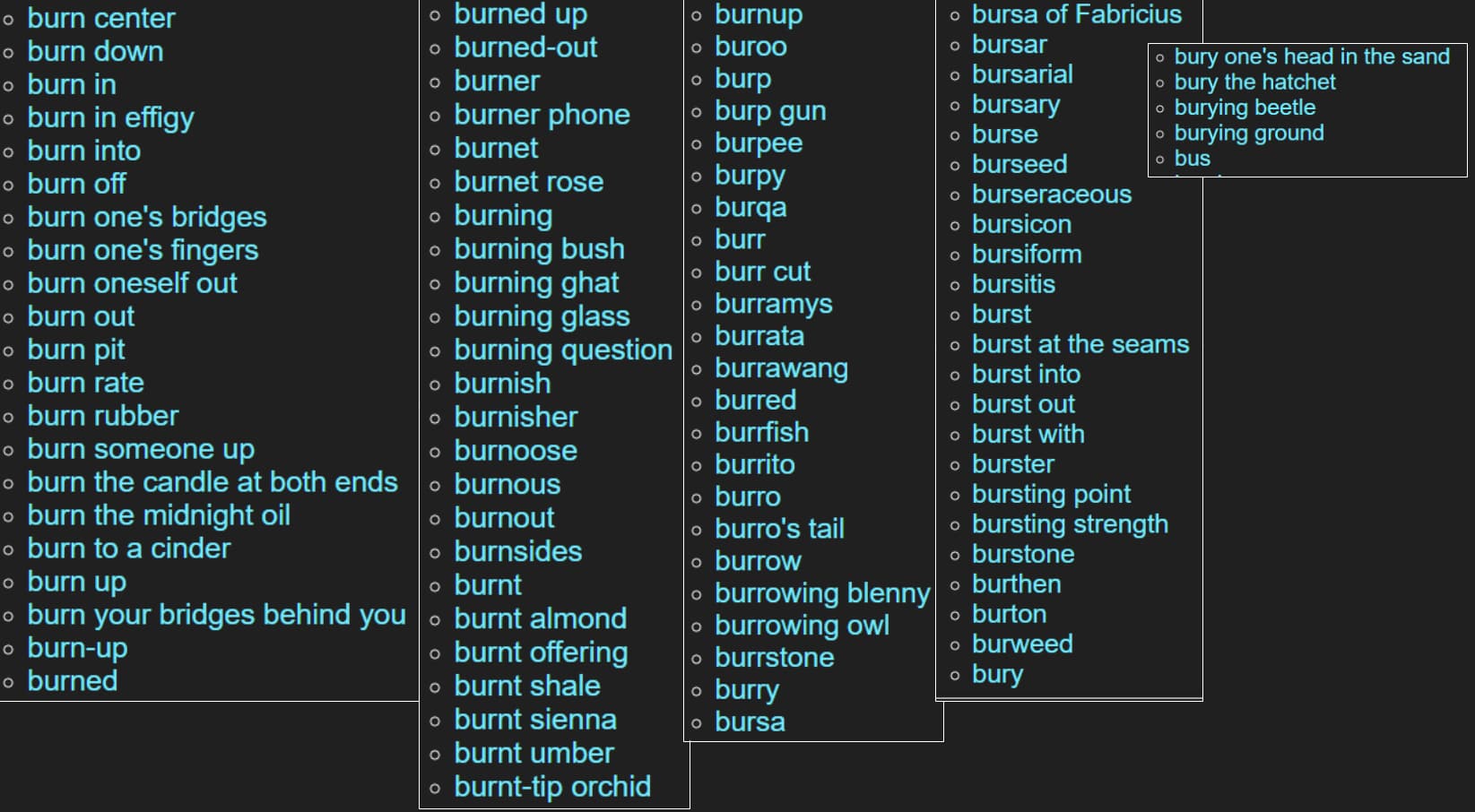
bun … bur
So the first 3 letters might be.
Well, there are more “suggestion” in alphabetic order.
So the briefing happened at the Brady Paul Memorial Lodge, which is the state police’s F.O.P. Lodge.
Greg:
My full-time job is I’m a police sergeant with the and a K-9 handler, and then I’m on our Beaver County Emergency Services Unit as an assistant team leader for the sniper unit.
I’ve been in law enforcement for 25 years, and I’ve been with the Emergency Services Unit for about 16 total, 17.
Q: And how long specifically have you had the role that you currently have?
A: Probably three years.Everybody has a full-time job, and then that’s kind of like you help out as you can.
Q: So you looked at your schedule, and you realized you could do the full day at some point?
A: Yeah, because originally I know – there were only two of our snipers from the team that could work, myself and , and had to leave early that day, and basically we were going to swap positionsI mean, our team really had no input in assignments at the event. We went wherever we were told or asked to by Butler County because we were an assisting agency. We were there as a support system, not as the overall command of the project.
Q: Was there any specific request that you knew about for snipers from ESU here?
A: Directly, I’m not sure, but my understanding is originally they had asked for operators and then a day or so later asked for snipers.So for the event, my understanding was that we were advised by Butler County to occupy a building which was the AGR building.
We were to occupy the second floor of the building and observe over basically the entrance of the event, through the crowd, to the rear of the event from an elevated position away from the event.
From my experience, I didn’t understand the purpose of what we were instructed to observe basically because in that type of role, I was assuming we’d be counter-sniper unit, not a sniper unit.
So like in this instance, Donald Trump would be a target. So as a counter-sniper, you’d be looking for somebody trying to assault him; to where the individual that’s trying to assault Mr. Trump would be the sniper because he has a target.
So you’re there to find somebody trying to assault the target.
And from the position and the responsibility that we were given and told to cover, it didn’t make sense to me, but…
Because we were – I mean, we were observing the crowd in front of the stage as opposed to looking out away from the event in toward – I don’t know how to explain that. But we were looking from back into the event instead of in the event out.
Q: I see. Understood. And the reason for that is because if you’re a counter-sniper, you’re looking for other snipers or shooters who are outside of that immediate area?
A: Yes.
Q: And you’d want to be able to identify them from away from the crowd?
A: Yes. And also the crowd was going through a secured entry point.
Q: Right. As far as you know, they had magnetometers and that kind of thing?
A: Yes. And like I said, it’s a secured entry point, which everybody was screened coming through, and, you know, we’re over-watching with lethal force.
Q: Right. It seemed like it was overdoing it?
A: I don’t want to say overdoing it. Just the assignment didn’t make sense to me.
So once we were taken into the location that we were to occupy, Butler County had pointed out a couple different positions that they identified as where they would like us to post. Once I posted on my position, I had a conversation with [ ], who is our sniper team leader, and I basically said to him that the position that they put us in didn’t make sense.
But we were there as a support unit. That’s where they asked us to be. So that’s where we stayed.Q: Right. Okay. Did you get the sense that he agreed that it didn’t make a lot of sense?
A: Yes.Q: And you were aware that the Secret Service was present, but at that point, you hadn’t had any contact with them; correct?
A: No. Yeah. I mean yes, I knew they were present. No, I did not have any contact with them.Q. You mentioned the briefing that morning, I guess. Generally speaking, not all the people, but who was present at that briefing?
A: Our unit was there, Beaver County Emergency Services Unit. Butler County Emergency Services Unit and then Washington CERT.
Q: Okay. And who was leading that briefing?
A: Butler County.Q: So in the course of the first briefing and then the sort of second briefing with Butler County, were you told that your job was to focus on the crowd?
A: Yes.Q: Understood. Did the Butler people who were telling you that’s your assignment, did they express any views about whether that made sense?
A: No. They told us – they took us into the AGR building. We had a site map. And they basically gave us areas of responsibility.
So the briefing happened at the Brady Paul Memorial Lodge, which is the state police’s F.O.P. Lodge.
In that sniper briefing there was basically when we were given maps and told that, “This is your area of responsibility.”
And then they had said, “You guys are going over to the AGR building.” I had never been to that site prior to. I live an hour away from Butler.
I don’t know anything up there. So I’m like, “Where’s the AGR building?”
And they were like, “One of our guys will take you over there.”
So we then went across to the barn that was directly behind the stage, and that’s where one of the Butler sniper team leader guys had some of his equipment and he gave us two radios and then told us what channel we were operating off of, and then they said, “Okay. We’ll meet you over at the AGR building.”
So then we drove over to the AGR building and met there outside. We then went in.
They gave a keycard access to get into the building.
And said, “I’m going to stop at Sheetz and get a drink real quick and then we’ll head over.”
So I followed him over. We went to Sheetz. He got a drink. We then drove over to the AGR building and parked in the lot, and we were the only two there at the time.
So and I backed our cars up to the door, took our equipment out, set it on the first floor and waited. And then Butler, a team leader and then one of their operators – or one of their snipers – had shown up.Q: You said that you got two walkie-talkies?
A: Yes.
Q: And that you were told which channels you were on?
A: Yes.
So it was Butler 4.
Butler 4 was going to be the tactical channel; Butler 3 was going to be the patrol channel; and I think 5 was the medics or something like that.
But we were specifically told we were operating off of Channel 4, which was a tactical channel.Q: And did you have any understanding as to whether or not the Secret Service had access to Butler 4?
A: No, I didn’t.
Q: No one told you they did or did not?
A: No.
Q: And then you mentioned Sheetz. Can you just tell us what that means?
A: Oh, Sheetz. You’re not from around here. Sheetz is basically a gas station.Q: How many people from Butler do you recall came over?
A: Two. One sniper and then their team leader. So there were three of us positioned in the building: myself, , and then from Butler.
And then their team leader came over basically to show us the building because I had never been there and had never been there.
But he basically walked us through the building up to the second floor, the team leader.Q: And did you or say anything about your concern about, “Why are we doing that?”
A: No. Not to them.
Q: Not to them, right. To each other, but not to them?
A: Yes.So when we got – when we were taken up to the second floor of the building, we were told that – you know, all the windows in the building, there were several that were open and some that weren’t. The windows that weren’t open, they couldn’t open.
There were – I don’t know – three or four different positions – I want to say four – that Butler basically said, “These are the positions that we have identified that we think offer the best observation of what we would like you to cover. You guys go ahead and get wherever you feel is necessary.”
So my sniper rifle was set up in this second window here (indicating).
Q: And this was roughly around 10:30 to 11:00 that morning?
A: Yes.Q: And then did stay, as well, or station himself somewhere else?
A: So there’s a hallway that runs down the middle of this structure (indicating). He was set up – I don’t know how to mark this on here – but he was set up on the side of the building in a top window.: And for the record, the witness is putting an X on the building he was at, and then he’s putting a circle around the general location he was in the building.
Like I said, he was in this hallway window (indicating); I was in this side window (indicating).
So he was watching the entry point, basically.Yeah. When we were given the map, we were basically told that our over-watch was from the entrance point, which was up here (indicating), I believe.
From the entrance point to the stage and the general crowd area.Q: Now, I notice on the overview here that field of vision took him much further away from the stage – than yours did.
A: Yes.
Q: Did have a similar concern that his field of vision didn’t make a lot of sense?
A: Actually, from where he was at, his wasn’t – it made more sense than what mine and were, , because he had the entry point.
So he had people actually coming in to the entry point, you know, prior to going through a secured location. Like this (indicating) is secured, and then it’s all fenced in.
Once people entered in here, it’s almost a guarantee, but it’s assumed, you know, that they have been cleared. And they’re not carrying a weapon.Q: Where was he located? Do you know?
A: Yeah. He was in one of these – these two windows (indicating) are in the same room. I’m not sure exactly which window he was in, but he was roughly right here (indicating).
So his field of view was pretty much the same as mine with a little bit more – he was able to see to the back of the stage or back of the building.Q: What was your job at that point since the event wasn’t going to start until much later in the afternoon?
A: Just observation. I mean, that was about basically it.Q: So your job was to observe people outside of the perimeter – who had not yet entered?
A: Basically, yeah. – Well, I mean, mine, no, because I couldn’t see them.
I mean, we were put in place in the morning so we’re in place and, you know, we’re in place prior to people coming.
And then also so we’re in place when they enter. So we were just in place observing at that point.
p45 of 200 (Majority finished.)
--------------- 8< ---------------
Many options, not sure of those that would apply here. It is odd, what would be the reason for the redaction here? Which does this actually come from, maybe that may give us a clue?
It could be more than one word redacted, as well.
p45 Minority
there’s two operator units out from Bravo. Then there’s a sniper unit, which is a Sierra unit; and then there’s a TENS unit, which is our medics; and then there is a negotiator unit.
Each of them have a team leader and assistant team leader, and then you have your commander and a deputy commander.
So, like, technically we’re employees of the District Attorney’s office. That’s ESU officers.Q:
you felt was put in place prior to the event, similar levels? Less organized? More organized?
A: It wasn’t well organized.
I mean, you guys have the OPS plan, but the OPS plan is not what was discussed in the briefing. The briefing basically was a PowerPoint presentation, and it was a slideshow.A: So like I said, when we set up inside on an interior of the building, we set up so we’re not easily able to be seen. So, you know, you don’t want your muzzle hanging out at the end of the window or anything.
I have a 16-inch barrel with a four- or five-inch suppressor on the front of it, and my barrel being the tip of my suppressor was about a foot off of the window.
So, yeah, we sit back in a room to hide us and also to give a little bit of distance between the shot being taken and if there’s a window or a screen or anything else.
So people aren’t sitting there saying, “Hey, there’s a sniper.” you know, so people don’t know where you’re at, basically.Q: So when you got there, what was your understanding of that area? Was the AGR complex inside or outside the security perimeter for the Secret Service?
A: Outside.
Q: Did you have any understanding of who would be patrolling that area?
A: No.
Q: Any understanding of, like, who would be, you know, watching, let’s say, the rooftop?
A: No.
Q: Did anyone ever talk about being up on the roof?
A: No.
Q: If someone had –
A: Not to us.
Q: If someone had asked you to be on the roof, would you have been able to do that?
A: Absolutely. I mean, we went there that day with the expectations and understanding that we were going to be on a rooftop all day long because it was a hot day.
And, you know, , our commander, made a joke and he said, “I hope you brought a couple bottles of sunscreen,” because it was an understanding that we were going to be on the rooftop outside all day.
Q: Sure, yeah. And let’s walk through that. Why was that your understanding? Why did you think that would be the case?
A: I mean because of the type of event, and to be deployed in a counter-sniper role, that would be one of the best locations.
Q: And which rooftop, let’s say, would you think – just looking at this map and your decades of expertise in this area, which rooftop do you think would have been the ideal placement for your duties that day?
A: In that complex?
Q: Yes, sir.
A: Probably on – I mean, if it were to be in that complex, it would have been on top of the building that we were sitting in.
Q: Do you know how you would access that rooftop?
A: We would’ve probably had a ladder, but…
Q: And you would have been willing to do that that day?
A: Yeah.
Q: In fact, you were prepared to do that that day?
A: Yes.
Q:
along the south side of that second building where you were stationed, how many rooms do you remember were on that south side?
There were, let’s say, a half a dozen windows. How many rooms were there?
A: In the southern portion of it, there was one, two, three… I think four and a bathroom.
Q: Which windows – so you all were stationed in the westernmost room; is that right?
A: I was, yeah. So these first two windows here (indicating), that’s one room. That’s one office.
Then these two windows here (indicating) is a second office. And then this single window here (indicating), I believe, is a third. And then I think there’s a bathroom. And then this last room is like a break room.
There’s a bathroom somewhere. I’m not sure if it’s exactly on that wall, but there’s a bathroom right there (indicating).
would have been in the hallway. So if you look at the top of the structure, there’s a hallway that runs down the middle of the building and then a set of stairs.
So there’s, like, a hallway that runs down here (indicating). There’s offices on this side (indicating); offices on this side (indicating).
There’s a window directly at the end of the hallway, yes.
Q: Got it. Where was ?
A: He would have been where the dot is. He was in the room beside me.
Q: Do you recall which windows opened, offhand?
A: I think the first four, maybe, opened or the first three. I know the window to the far east of the building that we were in didn’t open, the very first one.
Q: You said might be in the break room?
A: Yes. That window did not open. And then there was one other one on that side of the building that didn’t open.
It was maybe one of the ones in the room that was in.
Q: Would it impair – let’s say there was a window that didn’t open.
How much of an impact would that have on a shot you would take if, you know, within the first two feet, a bullet has to go through a window?
A: I mean, it’s hard to say. There would be – there’s too much ballistics involved in it. Depending on the angles, the distance, it could dramatically affect it or very little affect it. There’s too many.
Q: What are you looking for at that point?
A: At that point we were just observing the crowd, looking for anything that seemed odd.
But I will say 95 percent, if not more of the job of a sniper, is observation. It’s not taking a shot.
I mean, Secret Service is a prime example here. Those guys are on a detail like that, and I think this is the first counter-sniper shooting in the history of them.
So it’s very rare that, in a law enforcement capacity, a sniper takes a shot in this type of an event. Military is different.
Q: You had a local radio?
A: Yes.
Q: What was it set to?
A: It was the Butler – I think it was Butler Police 4, which was the tactical channel I was assigned for that day.
Q: And were you guys told to just be on that? Were you told to scan? Was there anything else going on?
A: No. We were told that we were running tactical operations off of OPS 4, Channel 4, and that’s what we were on.Q: I also understand there were some text messaging exchanges?
A: Yes.
Q: Do you recall who were on those text messages?
A: So there was – the thread that was out that day was there was a thread, a text thread, between the snipers that were on scene, excluding Secret Service.
It was just the local snipers on the team, being Butler, Washington and Beaver, and then we had a separate text chain that was just for our Beaver folks that were on scene.Q: What about Signal or any other types of apps? Did you use those that day?
A: No. I don’t even know what that is.
Q: Fair enough. FirstNet: Do you have access – have you heard of FirstNet?
A: Yes.
Q: Do you have access to it, or did any of the people, to your knowledge, have access to FirstNet?
A: To my knowledge, I don’t know. That’s my personal phone. I don’t think I have FirstNet. I know on my work phone I do, but I was using my personal phone that day.
Q: How was tech service that day?
A: It was okay to a point just prior to the president arriving.
Q: And then what happened?
A: I don’t know if they put up a net on it or what, but there was some delayed response, especially with Verizon. AT&T, not so much, but Verizon there was some delay.Q: The last thing with text messages, did you ever have any communication or were you aware of any communication with the U.S. Secret Service via text message?
A: I had none and – I mean, I guess I could say now I do.
Q: Do you know who was doing that?
A: I believe the Pennsylvania State Police sent a text. I’m not positive.Q: To the extent that Secret Service was aware including their sniper teams, were aware of anything going on around AGR via text message, do you know of anyone within your local sniper community who would have been texting with them?
A: No, I don’t. Not that I’m aware of.
Q: Did you ever see a drone that day?
A: No.
Q: What would you have thought if, at any point, you’re seeing a drone flying around on your side of the Secret Service perimeter?
A: So, actually, in the briefing, one of the things that was brought up was drone surveillance; that if any were spotted, they would be reported and that somebody had capabilities of intercepting the drones.
I mean, throughout the day, through the observations, it was part of the thing to look around for, but I didn’t see any drones that day.
--------------- 8< ---------------
Woods:
Q: Did you receive any resource requests from the U.S. Secret Service or other law enforcement agencies related to the July 13 rally?
A: Not from the Secret Service. I guess the only thing that I – initially on the 7th, they were only asking for operators. I immediately texted and asked him if they needed any snipers. His response was no, not right now. They are only asking for overwatch from the BearCat.
Q: Okay. We’ll stick with questions. What questions did you ask during the briefing?
A: So I have to give you the full picture of – during the briefing, they put out a picture of where everyone was supposed to be, and they really didn’t even have us on there. They had to pull up a second one. And they had mentioned – and I don’t know who gave the briefing. It was one of the Butler guys. But this was the first time that the Secret Service snipers were ever going to be deployed for a noncandidate. That resonated with me because I thought there might be a threat.
At the end of the briefing, I raised my hand because nobody asked the question, and I said, “Hey,” you know, “what is the threat” – and this is the first time in history of the Secret Service snipers coming out – “What is the threat?” Their response was, “Well, we asked the same question, but the Secret Service said there’s always a threat but nothing in particular.” They said at the conclusion of this brief the snipers were going to get their own briefing altogether,
Interesting. First he offered snipers, then he didn’know why.
(Onece I saw something worse: password teaching sysem. You pressed a button, but only the next valid one was accepted. So you could be able to figure it out - one by one. Whitin two minutes.)
Q: I was going to go into sort of the initial sighting of Crooks.
let’s say, 1600, which was around when left, I believe?
A: No. Nothing.
Q. When does leave?
A: He leaves about a quarter after, 20 after 4.
Q. And was that scheduled?
A: Yes.
Q: Any reason, or just he had to go?
A: He had a family event that was scheduled.Q: What did he alert you of after he left?
A: So when he had left, he had sent a text message.
So the parking lot in the AGR building was empty with the exception of car, my car, and car. Those were the only three cars that were in the lot when we went into the building.
So when left, he had noticed a vehicle parked in the lot and a gentleman sitting outside, and at that point he had sent a text message to us that basically said, “Hey, somebody followed our lead.”
What he meant by that was the parking lot was blocked off, and we had to go around the cones to get up in there to park.
(By the way, someone in Germany snaked into the motorcade and took handshake with the protectee.)
They were both blocked off, but we came in this first one here (indicating).
: Let the record reflect the officer has drawn an X on the easternmost entry point into the AGR complex.Q: What about milling around AGR in front of the fence line, to the north side of the fence line?
A: There were probably a couple hundred that were around the outside of the building throughout the day.Q: And when left, he’s leaving through the eastern side of AGR, and then he sees someone in the car, says, “They’re onto us,” kind of?
A: I don’t know if he seen somebody in a car, but he seen a car.
And then I know there was – I think there was a picnic table or something over there that he seen somebody was sitting at, and that’s who I think he was referring to as when he said he seen me come out of the building with my rifle.
Q: To your understanding today, do you understand that he saw Mr. Crooks?
A: Today, yes.
Q: Yeah.
A: That day, absolutely not.Q: I want to take you then forward. When do you first observe Mr. Crooks?
A: I’m not exactly sure on the time. A little after 5 maybe after had left.
So I was kind of moving around the building a little bit on binocular glass and doing the observation, and I had moved from the room that I was in into the hallway and was standing where was positioned prior.
As I was just looking out at the crowd,
I noticed an individual that was walking pretty close to the building, kind of looking up and down the building, and just thought it was odd.
I, like, looked down at him and then didn’t pay no attention to it. He then walked, it would have been, to the front of the building, which would have been southeast, I guess, and then around the building, and when he did that is when I lost sight of him.
I didn’t think nothing of it at that time. I just continued about my business. And then after a few minutes, I was s going back into the room that I was in and I seen standing there, and me and him were having conversation.
He was like, “Hey, I just seen this kid out here walking around, looking up and down the building. I think he knows we’re in here.”
I said, “Did the kid have long hair and a gray tee shirt?” He’s like, “Yeah.”
I said, “I seen him on the side of the building, too, doing the same thing.”
So at that point we then separated, and then we were basically looking for him again. And after a little bit of looking around, I was standing in the room that I was positioned in but I was in the first window in the room, not the second window where my rifle was, because it was easier.
So I was looking out that window –
I don’t remember exactly what time I sent the text out.
Q: But when you sent the text is when –
A: Well, it would have been prior. It’s about 15 minutes prior to when I sent the text.
Yeah. 1725, 1730, something like that.
Q: And I want to be clear. When you first see him, you and Officer , see him, he’s not doing anything illegal?
A: No.
Q: Anything else, just on the initial observations, that kind of triggered you to then take these pictures of him sitting on the fence?
A: No. So like I said, after and I had talked and it was like he noticed it and I noticed it, we were like, “Okay. Let’s see if we can find this kid again.”
So like I said, I had been going back into the room that I was in, and then the first window, I was looking out, looking out. I couldn’t see nothing. Couldn’t see nothing. And I’m like, “Man, where is this kid?”
And I brought my binoculars down, and as I brought them down, I looked down because like I was up pretty close to the window at this point. We’re on the second floor.
And as I brought my binoculars down, I just happened to look down and I was like, “There he is.” He was sitting directly below me.
Q. This is from the southwestern corner of that second building?
A: Yes. And there is, like, a little wall that’s about two and a half, three feet high, and he was just sitting on it. I’m like, “Well, there he is.”
So I don’t know why. Maybe the opportunity and because he was so close. I’m like, I got my phone. I just pulled out the picture. The first one is the one of his back. That was the first picture that I took. And then the second picture is the one – because I took the first one. I’m like, “Come on, man. Turn your head. Turn your head.” And then, finally, he turned, and then I took that second one, which was the side view.
my weapon was on a tripod, and then I had an office chair that basically I was sitting in. That’s how it was set up.
Q: So when you’re observing, you’re, in fact, not carrying your weapon around with you?
A: No.Q: From one side of the building – so again, the, let’s say, north side of that second building across the hall – how far would it take or how long would it take to get from, let’s say, the opposite side of that building, north side, down into the south building to your rifle?
A: 15 seconds.
p84 of 200
--------------- 8< ---------------
Q: You were talking a little bit about the cellphone issues earlier.
A: I mean, there weren’t a lot of texts going out through the day, but it seemed like when we started the text messaging, it was when the president was en route to the site.
I was trying to send them – not to the group because these pictures were sent out twice.
It was sent out to the sniper group and then sent out to our Beaver County group the same, and then they were sending them to the command. So that was all about the time that the president was en route to the site.
Q: And would you be able to say like who would do that jamming?
A: It’s typically the Secret Service or the FBI. One of those two.
Q: So I’m going to go back to when you first became aware of Crooks, the person you understood to be Crooks.
So Exhibit 5, it’s a text exchange between and . is you?
A: Yeah. So this is a text message sent from to -- is me, , and is . A. We were the three guys that were in the AGR building.
Q: And the blue here, you understand that to be ?
A: Yes.
Q: And then those two texts were at 4:26 p.m. and 4:27 p.m.
And then you respond with a thumbs up at 4:27, and responds at 4:39 with a, “Roger that.”
And then at the bottom it says, “That bike was not there when I pulled out.” That’s from . “Maybe have them check that car…” And it’s cut off at 5:52 p.m.
A: So that one at 5:52, that response is to the text I sent to the group. That’s what that is. That was a response to that.
I was just acknowledging that he was letting us know.Q: Okay. Got it. And then what you were going to do at that point was go and try to see if you can identify this person?
A: Not really.
Q: No?
A: I was just acknowledging that he said, “Hey, this guy was sitting out there.”
Q: Got it. Okay.
A: Like I said, there were hundreds of people sitting outside the building.Q: When you received these text messages from , did they cause you to think, “Oh, this person’s a threat”?
A: No, because I had no idea who he was referring to. I’ll be honest with you: Until about three weeks ago maybe, I hadn’t even known that actually seen Mr. Crooks sitting at that table.
I didn’t know that that’s who he was referring to.
(Well, actually I don’t think he was that, I don’t think he drowe into the parking lot with his car. But, the individual with car might be someone else, it is not clear for me.)
Q. You only learned that subsequently. At the time you did not know?
A: Yeah. Like I said, only three weeks ago.
Q: And even at the time of the shooting, you did not know that that was Mr. Crooks?
A: No. I had no clue.
Q: Okay. So at that time, you only learned that subsequently from reports or from After-Action or things like that?
A: Yes.Q: [Woods] is also an experienced law enforcement officer; correct?
A: Yes.
Q: And these texts don’t say this person is a threat or a potential threat; right?
A: Not at all.
Q: And these texts don’t say this person is a threat or a potential threat; right?
A: Not at all
Q: And you would expect that he would say that if he saw somebody that he thought was a threat from looking at it?
A: Yeah. I mean, I would expect him to encounter that person.
Q: Right, okay. So you had no reason to believe at that point that he was saying anything other than what he was saying here, that “Somebody has spotted us”?
A: Absolutely. I assumed that was just a, “Hey, dude’s out here, just so you know.”
(Hey, decades ago some someone told me: we write the important thing into the contract. Therefore no "(“parenthesis’)” should be.)
Q: why would he tell you that? What was the reason why he would tell you that?
A: It’s just a safety thing. You know, you’re leaving. I’m sure he wasn’t thrilled that he hadto leave. I mean, maybe he was. But, you know, you don’t like to leave in the middle of an operation.
If you see something, you say, “Hey, just so you guys know.” The last thing you want is somebody you know to get hurt, you know.
Q: You previously had testified that the way you set up your weapon, you don’t have the barrel hanging out the window, and you didn’t want people to see you; right?
A: Because then it’s known where you’re at, and I mean if somebody is going to do something, they know they can get rid of you first.
So, you know, it’s a safety thing and a tactical advantage.
Q: Did anybody suggest to you that the Secret Service or the campaign or anyone else had said, “Hey, we want to make sure that no one knows there’s snipers out there because it’s not a good look at a campaign event”?
A: Not to me.
Q: So then let’s go to – I think hat was Exhibit B, Beta.
we don’t know who it’s from. “Game time,” 5:34 p.m.
A: So my interpretation of that “Game time” text was we were notified that – I forget what the code name was – but that he was en route to the site.
Q: “He” being Trump?
A: “He” being Trump, yes. “Game time” waslike, “Okay, get your shit together.”
Q: “Let’s get ready. Now it’s on.” Right?
A: Yeah. “Black Hawk Down, Irene.” Right?
Q: Did the photos --again, this is just to the best of your recollection – did you take those photos and immediately send them?
A: No.
Q: So tell us more about when did you notice this person that turned out to be Crooks? Was it before you were notified that Trump was on his way, or was it after?
A: So I had taken these pictures. There were these two pictures.
I think the next one is the bike and the backpack.
So I had taken these two pictures (indicating), I want to say, at 5:13 and 5:14 or 5:14 and 5:15, roughly.
Like I said, if you let me grab my phone, I’ll tell you. That’s when I had taken these pictures. And then that one, that bike picture, was taken at about 5:25-ish.
So I took these two pictures first. Like I said, the picture of his back was taken first.
Like 5:14. The picture of him was taken 5:15, whatever.
Roughly around that time. And then I took a picture of a bike and a backpack at about 5:25, 5:26.So I’m going to give you exhibits here. 6, that’s the photo that you took at about 5:28 of a bike and a backpack, and that was about ten minutes or more, a little bit more than after the two photos that are B.
A: Yes.
Q: Why did you take the photos of that person?
A: I think it was just opportunity and because he was so close, and he just seemed like an out-of-place character, you know, especially because I had noticed him, had noticed him, you know. We’re both experienced guys. So it was like, “Eh.”
Q: Something set off your antenna?
A: “I’m just going to take this picture.”
Q: But at that point you did not know this was the same person that had texted about?
A: No. Not at all. I had taken those pictures and sat there and, you know, was watching him for a little bit. Then he had got up and moved and I lost sight of him.
But he had got up and moved. We lost sight of him.
So I had then got up, and I started to move to different windows within the building, and when I got to – it would have been the opposite side of the building.
I went into this building (indicating). I got into the window, first window, over here (indicating).: The witness, just for the record, has put a circle around the area that he went to where he observed the bicycle and the backpack on 4.
A. So I went over there and was still looking around for this individual, and I had noticed over across the property there was a bike sitting there with a backpack and it was underneath the tree. And just from moving around earlier in the day, I didn’t remember seeing that.
So after seeing him and then after seeing that, it was like, eh. I thought it was kind of strange, so I took a picture of it.Q: And from your vantage point when you were looking at him, one of the things that alerted youto him was the fact that he seemed to be looking into the building –
A: Yeah. He was looking.
Q: – and trying to find you guys?
A: Well, he was looking – it was – like I said, most of the building is a one-story building.
So as he was walking, you could see he was looking in the single story of the rest of the complex, you know.
And then when he got to our building, he was looking in there first and then also up and down the building, and that’s kind of what – that’s what made him stand out to me.
Because like I said, other people came up to the building, but it was more – you could tell they were there to gather shade or something. They weren’t, like, looking in windows.Q: Okay. And then when he left and you lost sight of him, did he leave in a way that he seemed to be trying to hide from you?
A: No. He just got up and walked. And like I said, when he walked around the building, I couldn’t see where he went because of, you know the view that we had.
Q. And there’s about 10 minutes or so, 12 minutes between when you first – or 14 minutes, I guess – between the first photo and then the photo of the bike. During that time, were you looking for him the whole time?
A: Yeah. I was moving around the west side of the building that we were in.
Because it’s all – it’s office, hallway, and then an office, and I was basically going back and forth between those three areas, looking out the window, trying to see if I could locate him.Q: And then at around 5:28 you saw this bike, the backpack, and you decided to take a picture of it?
A: Yes.
Q: And you said that you did that because you were like maybe this bike and backpack is connected to this guy?
A: Yeah. I mean, not that I was looking for him, but I had noticed him throughout the day.
And then noticed him looking up and down.
It seemed like he came out of nowhere, and then all of a sudden I noticed his bike.
So I thought maybe he rode his bike here. Two backpacks or a backpack and a bag strapped to the bike.It seemed out of place, so that’s why I took a picture of it.
Q: And when you say “it’s out of place,” is it because you didn’t see any other bikes and backpacks?
A: No.
Q: It wasn’t a bike area, for example?
A: Yes.
It was sitting underneath here (indicating), yeah.Q: So fair to say that because you had seen this potentially suspicious character, you saw this bike that you hadn’t noticed before, and there were no other bikes or vehicles around it that had stood out to you?
A: Yeah.
Q: So you took that photo at 5:28, okay. And then going back to B, the “Game Time” at 5:34, this is about when you guys were notified that Trump was coming.
Then you send the photos, the first two photos from 5:14 and 5:15, at 5:38 p.m. to this group.
Why did you send the photos at that point?
A: So after I had taken the picture of the bike, I was still looking to try to locate Mr. Crooks.
I then went – I made my way. I was back in the original window that I was in on the south side of the building.
On the south side of the building in the first window there, that’s when I noticed that he had been sitting back on the stoop down there where I originally had seen him.
And at that point, I noticed he was on a cellphone, and I was sitting there with binoculars. So I zoom in on his cellphone, and I could tell that he’s looking at news feeds. Which particular ones, I don’t know, but he he’s scrolling through news feeds on his phone.
So then he takes his phone and he puts it in his pocket, and he pulls out – it’s a range finder, but he pulls out a range finder and he starts looking.
I grabbed my binoculars and I zoomed in again, and I noticed – I’m like that’s a range finder.
So, you know, when I noticed him looking through this range finder he was looking towards the stage and kind of just in different areas, general areas, looking out but in the direction of the stage. I was like, yeah, this is not right.
I said, “A dude’s out with a range finder looking through it.”That’s why I said at first, eh, maybe it’s a monocular.
Because I carry one in my bag, you know. in my sniper bag because it’s easier to use.
But when I zoomed in on it, I knew it, you know, was a – I don’t want to say multi-cam, but it was like a Realtree camo.
I’m like that’s a range finder.
Q: Could you tell where he was looking?
A: Like I said, it looked to me like he was looking at the stage because he was like looking in that general area.
And then, just, he was looking towards the stage, and then it looked like he was at a couple different points but it was towards the stage.
Q: So when you saw that, that also gave you concern?
A: Absolutely.
Q: Now, going back to the text messages.
why did you decide to send the photos at 5:38, you know, about 10 minutes after you – 10 to 20 minutes after you took them?
A: Because until I had seen him with the range finder, it was just he was an odd person.
But once the range finder, now he’s a very, very suspicious person to me.Q: So then now we know Trump’s coming. You see he has a range finder. You send the photos you’ve taken of him. And then in 7, you sent a text message at 5:38 and you say, “Kid ‘learning’ around”
A: It’s supposed to be lurking.
Apple doesn’t do a good job on autocorrect.
Q: And SS, of course, refers to Secret Service?
A: Yes.
Q: By the way, do you know where the Secret Service snipers are located at this point?
A: Yes.
Q: Where were they located?
A: They were on the two little barns, I guess they’re calling them.Q: When you sent out the text message at 5:38 and you send it to this group, you’re obviously alerting the people on the team who had tactical responsibilities?
A: Snipers.
Q: Snipers?
A: This is just the snipers.
Q: It was just snipers, okay. So this is the sniper group.
Were you expecting anyone in particular to respond, or did you expect to respond?
A: I just was putting it out there as this is information.Q: Okay. All right. And then writes at 5:40 p.m., “Call in to command and have a uniform check it out.” Right?
A: Yes.
Butler had a command post set up. So that would have been like the radio communication through our tactical channel to them.
Q: Butler 4?
A: Butler 4, to say hey… Basically the same thing.
Basically, I just notified the command that I had seen the kid out there with a range finder and he was suspicious and needed checked on.
p115 of 200 (I don’t want to compress it more. I don’t wamt to reword apperant the ambiguity.)
--------------- 8< ---------------
So first he notified the CS team. All right, we shoot first then ask questions. The only problem, they didn’t see the target to be shot.
Soon I will post the Door 9 or 13 contest results.
So that’s why I ran through the building because like I said, I thought the buildings were open. So my thought was if I go back to this door, I could watch him running around the building. I thought he was running around the building.
So here comes the mystery of “which door” event:
Q: Like when you call this in, you do it on Butler 4, and somebody answers and you tell them this information; is that right?
A: Yes.
Q: And do you know who it was, or was it justa person on the other line?
A: A dispatcher, yeah.
Q: Dispatcher; right?
A: I have no idea.Q: And was there any kind of reaction that you got from the dispatcher, or did they just basically say, “We’ll pass it on”?
A: Basically, they acknowledged it and said that they’d send somebody out to check on it.
Q: They didn’t ask you to do anything?
A: No.
Q: And also that wasn’t your role; right? You weren’t supposed to leave your post and go search around for them?
A: No.Q: So at that point when you’ve called it in, do you see Crooks again at any point?
A: When I called it in, no.Q: So the last time you saw him before the actual shooting was when you took the photos – or, actually, no. When you saw the range finder?
A: I seen him with a range finder and then a couple minutes before the shooting.
Q: So you call it in. As far as you know at that point, you’ve called it in. They’re going to send somebody out to check it out?
A: Yes.
Q: All right. Are you still looking for him at this point?
A: Yes, yeah, because I’m trying to keep eyes on him, you know. He’s suspicious. He looked suspicious.
Q: Right.
A: But, yeah, trying to keep an eye on him, yeah. So moving kind of around, looking for him, trying to see if I can see him.
Q: Did you talk to [Murcko] about the fact that you were looking for him?
A: So he – I don’t want to say – I didn’t directly say, “Hey, I’m looking for this kid.”
But I assumed, you know, we both are doing the same job. I’m assuming he knows we’re looking for him because, you know, he knew I seen him with a range finder.
Because I had mentioned it to him.
I said, “Hey, the kid’s got a range finder over here.” Because , actually, one of the ones that like, you know, said, “Send a text,” because I was going to call it in over the radio originally. I’m not a big radio guy.
And then was like, “Well, maybe send out a text to the group.” I was like, “Okay.”
So that’s what I did, and then I get one back from the group essentially calling command, anyway. But, yeah.
(Huh, not a big radio guy. I can imagine that. Actually my manager is so with the phone - not technically.)
Q: Right. Now, so after this text exchange
and after you call command, you’ve reported this, how much later was it from that point did you see any police officers or law enforcement coming around looking for him?
A: At that point I hadn’t.
You know, see, originally when we got put into that building, I assumed there was going to be somebody on the exterior of the building.
I mean, typically you don’t put guys in a building that is not secured.
But, you know, we didn’t – it was several – I mean 10, 15 minutes – before I had seen anybody.
: So 10, 15 minutes from 1738?
A: Yeah. It was just after 6 before I seen anybody.
: I asked the witness a question, and to make sure it’s on the record, he said originally 10 to 15 minutes from when he sent the text.
But then on considering it, you said it’s around 1800 when you first saw local law enforcement respond?
A: Yeah. It was a little bit after six. It was after I had seen him go around the building, which I’m sure you’re going to get into.
When I followed or went down to the first floor, that’s the first time I seen the –Q: Right. Right. So, actually, we have some further texts here. I don’t think we have a printout of this.
A: That’s our Beaver County personnel that were on scene. That’s a group text for them.
Q: This is a text exchange that you’re on. Just, again, tell us for the record what text group is this?
A: So this is Beaver County personnel that are on scene. At the rally.
So I had sent this picture to our group.
(Boy. you need a communication training, how to initiate conversation.)
A: And that’s why it says in here – because I sent pictures and then I sent it – “, if you want to send this to whoever at command, if you have their cellphone number.”
Because like I said, I don’t know them guys. They do. So I figured – you know, I got pictures of the kid. Who needs it.
This is with Butler, Beaver, and Washington snipers.
Q: Got it. And you called it into command, and that was at 5:40?
A: Yeah. That’s through a radio communication.
Q: And you send the photos about five minutes after you called it in to your colleagues?
A: Yes.Q: Just for the record, why did you decide to send it again to just your colleagues?
A: Because I wanted to get the pictures of this individual to , who is our deputy commander, who I know has their commander’s phone numbers.
So I wanted to get the pictures to him so he could send it to the command.
And the command could distribute them to whoever.Q: Got it. And so when you write, “, if you want to send this to whoever at command,” you have a cell number.
Why did you send that text if you already called command?
A: I called command via radio.
So I sent these pictures via text to so he could send them to command because I don’t have anybody’s number in command.
I don’t even know who is in command.
Q: Right. You wanted to make sure that – you wanted redundancy? Make sure people were, like, focusing on this?
A: Yes, because I know is going to send these.
Q: Right. So then six minutes later sends it. It says Sent?
A: Yes.Q: Okay. And says, "They’re asking for direction of travel."Did you understand what that meant?
A: Yes.
Q: What did that mean?
A: They’re asking if I had a direction of travel of Crooks.
Q: Who’s “they”?
A: Command.Q: And then you write – and that’s at 5:59. So it’s about eight minutes after sent it, reports back. They’re asking for direction of travel.
A: So started to text. This is where the cell communication gets –
started to text because was sending texts. has Verizon Wireless, and was sending texts and they were like – they weren’t going through and they were taking forever.
So then started because his texts were going through no problem. He had FirstNet.
A: And that’s kind of when got involved.
Q: Right. So getting involved.
A: And, plus, they were sitting right next to each other.
Q: So during this eight-minute period there, they are trying to talk to command. texts are not going through because he has Verizon.
And then you respond, “Not sure. He was up against the building.”
A minute later you said, “Not sure. He’s up against the building. If I had to guess, towards the back away from the event”; right?
A: Yeah.
Q: So now we’re at 6:00. You reported this in. At this point have you seen any kind of law enforcement on foot outside the building looking for this guy?
A: No.
Q: When do you first see people start looking for this guy?
A: So at about 6:06, 6:07-ish, as I was moving around the building that I was in, I seen Crooks. He would have been – can I see this one here (indicating)?
So I was in that back corner of the second building. (Indicating.) So I was in the back corner of that – it would have been in that top window, the same one I took the picture of the bike from.
I got to that window, and when I looked out – and in this picture here (indicating) where this sidewalk is on that building – there was a picnic table sitting there.
And when I looked out, I noticed that Crooks was standing out beside that picnic table and there was a backpack sitting on the ground.
When I looked, I seen him. He grabbed that backpack, and then he took off running.
: This is oriented north?
A: North.
So he started to run south, away from the building I was in, and then in between the building –
North, away from the building I was in. He was in between these buildings here (indicating).
?
Q: Why don’t you draw on this just like a – write what you recall as to where he started and where he ran to.
A: He was here with a picnic table. When I seen him, he grabbed the backpack and he took off running and went in between these buildings here (indicating).
: For the record, the witness has put an X where he saw Mr. Cooks and then drew a line to where he saw him run.
A: And then from that position that I was in – and like I said earlier with these pictures, you can’t really tell the view that you had – but from here (indicating), once he got in between the buildings there, I had no sight of him. The only thing I could see was the top of the building.
Q: So you saw him at the picnic table, and you saw him run with the backpack?
A: Yes.
Q: But then when he turned the corner, you couldn’t see him any longer?
A: Yeah. Once he went in between the buildings, I could not see him anymore. And at that point I had then radioed in to communication command. I said, “Hey, suspect spotted rear of building. Grabbed the backpack and ran in between the buildings.”
Q: Right. And that was roughly at about 6:06, 6:07?
A: Yeah. 6:08, something like that.
So from where I was – and like I said, I’ve never been on this property before – I thought that this building, the area that he ran in between, I thought that it wrapped all the way around.
I didn’t know this building was connected here.
So when he took off running and I lost sight of him, I had moved from that corner of that building on the second floor, and then I made my way downstairs to the first floor.
Q: Can you mark with, let’s say, a filled-in circle where in the building you went to, the first floor?
A: So this right here (indicating) was the door on the first floor. That was the one that we came in.
So pretty much the only door I knew.
So I left at that point and I went down to that door because like I said, I had thought that that was open up here (indicating).
I thought he was just running around the building.
I figure if I make my way down there, I’m going to run into him; right?
: Sorry to interject. Do you mind if he just draws a path?
A: I’m going to have him draw a path.
Q: Can you draw –
A: Do you need an exact path?
(Boy, this is a crime scene.)
Q: Yeah. To the extent you recall.
A: Yeah. So it would have been down the hallway, and then steps went down.The steps are like right here (indicating), and then I went through it like that (indicating).
Q: How long did it take you, would you say, to get down there?
A: I’m not –
Q: Like a minute?
A: Maybe.
Q: A minute, okay. But it didn’t take you ten minutes?
A: No.Q. And at this point, your job had been to watch the crowd from that spot. You had seen Crooks earlier now?
A: Yes, sir.
Q: But now you’ve left and have gone to the first floor?
A: Yes.
Q: Is that because you were very concerned that there was a security threat that this guy represented?
A: Yes.Q: And is it that protocol that if you see something like that, that you can’t do anything from your vantage? That you need to go down and figure out what’s going on?
A: So I don’t want to go as far as protocol –
but it’s an understanding that if there is something suspicious that I’m tracking, that you go with it until you can prove otherwise.
Q: And fair to say that you would not leave that post that you were at unless you thought it was a serious threat?
A: Absolutely. And like I said, prior to, like, when I seen him and then command said they were going to send somebody over to check on him, I had not seen anybody at this point.
So it was like when I picked him up again and spotted him for the last time, I took off around the building. I was like, “I’m not losing this guy again.”
(But the kid knew the site better than you.)
Q: Right.
A: So that’s why I ran through the building because like I said, I thought the buildings were open.
So my thought was if I go back to this door, I could watch him running around the building.
Q: Right. You thought that he would circle around and you would catch him?
A: I thought he was running around the building.
Q: And you mentioned that you had not seen at that point any law enforcement outside looking for this guy?
A: Yes.
Q: Is that one of the reasons why you decided to leave your post and run down to see if you could intercept him?
A: Yes.
Q: And let me ask you a hypothetical: Had you seen law enforcement around the building looking for him, would you have left your post to go find him?
A: It depends. If I would have seen him run around the building but I seen uniforms down there, I would have probably stayed up there and been like, “No, around the building there.”
But the strange thing with this was is because of the communications being siloed, I had no contact with patrol.
And I was given a radio that I typically don’t use.
Because it wasn’t our radios. So I was on 4, OPS 4, and patrol. So all them guys that were down there would have been on Channel 3.
So we had no direct communications. It would have had to have gone through –
Because, you know, communications were siloed.
Q: So if you had access to 3, right, would you have called it in first and said, “Hey, listen. This is where the guy is. Can somebody go over there and find him?”
A: So I did. When I seen him, I called that in to command.
Q: Right. In to command; right?
A: Yes. On the channel that I was on. I /(would?)/ called that in and said, “Hey, you know, he was spotted here. He ran around the building.”
But there was no uniforms at that point that I had seen. So it was like – you know, a decision at that point had to be made.
And I made it to go and look for him. You know, the cop in me kicked in, I guess.
I was like, “I’m not losing this guy again.”
Q: Right. And were you surprised that you called this in at 5:38, I think, based on the text messages? Now we’re talking it’s 6:07, 6:08, and now you spotted the guy and he’s running. Were you surprised at that point that you didn’t see any law enforcement out there looking for him?
A: Yeah, because like I said originally, I had assumed that there were some uniforms in the area.
Because we were in this building. The snipers are deployed inside the building, so I just assumed. I never asked the question. I guess I should have. I never asked the question of who’s got our security on the outside of the building.
I don’t want to say frustrated. It was more like what the heck is going on, you know.
Like I said, it’s one of the reasons that I had left at that point and went down to try to find him.
Q: Would [Murcko] have seen you leave, or did you tell him, “I’m leaving to go find this guy”?
A: I didn’t tell him. You know, I really didn’t have any communication with him at that point. I don’t want to say I didn’t have communication.
I didn’t talk to him at that point.
When he took off running, I took off running.
You know, , I’m assuming, because I don’t remember seeing . The next time I seen him was after the shots were fired, you know.
But he was where he was positioned, and that’s why I went. I went. I didn’t say, “, I’m taking off after him.” I just went.
Q: Okay. And then when you got down to the first floor and you got to the entrance, what happened next?
A: So when I got down to the first floor, I knew that the door was locked.
You needed a key card to get in. I didn’t have a key card.
So when I got down to the first floor, I opened the door, and I was kind of holding the door open with my foot, like looking.
And when I looked out, I noticed that two patrol units had pulled into the parking lot.
There was a marked patrol unit. I’m not sure who it was. And then there was an unmarked patrol unit. But they were both uniformed officers.
They had pulled up into the area where I put the P on 2, and there was an unmarked car and a marked car.
They stopped there, and then the officer in the marked car had got out and started walking towards me.
And I was leaning out the door, like my foot holding the door open, and I was pointing. I said, “He ran around the building down there.”
And he goes – he looks at me and he’s like, “It’s all one building.”
I said, “Well, then he’s on the other side because he went in between the buildings over there.”
He was like, “Okay.” Well, he kept walking, and then walked around past me and then went around the front of the building, of the –
Complex, yeah.
And then the individual in the unmarked car, he had kind of like started to roll down in his car towards me, and I’m like, “He went around the building down there.” And he goes, “It’s all one building.” I said, “I know that now, but he’s on the other side.”
So he was like, “Okay.” So he then pulled out of the lot and went around. Went back out into the lot.
And then I don’t know where he went from there.
So at that point I went back into the building.
So it was door 9, and he managed to keep open that door to get bacj in the building.
--------------- 8< ---------------
p138 of 200
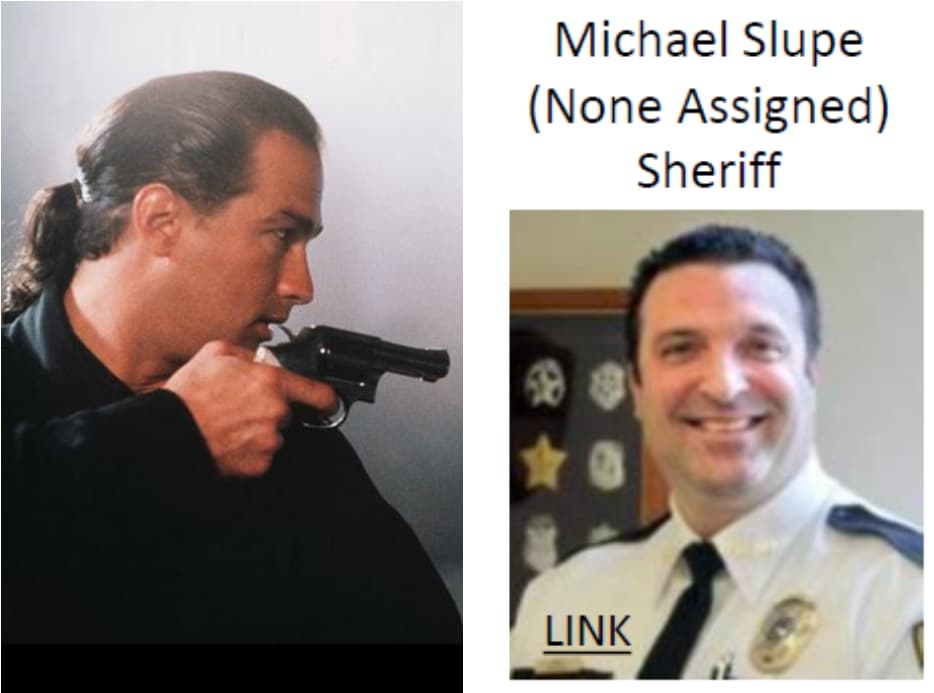
So that’s gotta be Slupe with the ponytail, right?? 
Stabilized video is nice! 
Trump Rally - Butler, PA. 07/13/24 Extended Cut - Stabilized
He had white uniform top.
That was meant to be sarcastic, sorry. The only one that would possibly have a ponytail would be BobbieJo, though I think Slupe could totally rock a ponytail! Probably would be reminiscent of a younger Seagal!
That’s right. My inference based evidence available at the time was well-reasoned, just based on soft evidence that proved to be inaccurate by Nicol’s more formal interview. In my analysis, I did conclude that Door 8 or 9 were possibilities, but figured Door 8 to be more logical, if Nicol could actually see it while traveling down the first floor hall of the two story building. As it turns out, Nicol took the same route he did when he first entered the AGR buildings since he was familiar with it.
My assumption regarding Nicol having little or no knowledge of the layout of the AGR complex proved to be a fair and correct assumption. He did not know at the time that Crooks couldn’t get to the east side from where Nicol saw him running between the two buildings. Many thought he had to know, and claimed that even if he didn’t, he had maps with him. Maps that I pointed out did not include that portion of the AGR complex.
So it goes with investigations, sometimes your inferences and assumptions are supported or confirmed by new evidence, and sometimes they are not.
My analysis regarding the AAR timeline map showing Nicol in the NW corner of Building 4 being erroneous appears to be supported by Nicol’s testimony. Those who assumed it to be an accurate map are thus likely proven wrong.
Now, with the new evidence in hand, my timeline analyses continue with course corrections being made as needed based on that evidence. That’s all part of the process.