You can see Trump’s ear in that video?
I can’t see Trump’s ear!
I can hear Trump say “OHHhhh” as Copenhaver’s arm flips:
Copenhaver heard “OHHhhh”, I guess:
Congrats @phasefive on posting this back in September!

This animated GIF really backs up your point.

1 Like
And let the court know that Roger Knight claimed to see Trump’s ear, in a video which obviously shows no part of Trump, nor Trump’s ear.
I would appreciate an accurate 3D model.
But it should include the entire AGR building complex and the red harvester should also be included.
And the raw data should be published.
However, I would prefer a reconstruction on site. The railing of the left grandstand could simply be replaced with a taut rope and cloths laid over it. Then just point a laser pointer at the vents from where Trump’s head was.
And you could also check whether Trump’s head could have been hit from the rear two-story building.
The effort for such a reconstruction shouldn’t be too great, but since I don’t live in the US, someone else would have to do it.
2 Likes
I’d be happy to share everything I have, and if you need more, I’d also be glad to add additional data if you need it. However, before we move forward, we need to agree on some basic methods and assumptions.
What I was trying to show you regarding the sea levels is that Gary’s drone measurements confirm the accuracy of the data from RandyMajors.org. Both sources are giving us reliable sea level information.
Can we agree on this point so that we can continue?
1 Like
I can’t check that.
Just keep going and maybe someone will come forward in the end to refute your point of view.
To assess the ball’s trajectory, do you consider it to be straight?
If so, the trajectory is incorrect because it is parabolic!
2 Likes
thank you for your input… yes, wind and gravaty are considered in this simulation, but let us continue step by step and get to that later…
1 Like
copilot’s answer:
VLC isn’t built for that level of control. What you’re running into is a combination of keyframe alignment, buffering delay, and container structure (like RIFF chunk sizes in AVI or moov atoms in MP4). But there’s a better way.
 Best Tool for the Job: LosslessCut This tool is purpose-built for exactly what you want:
- Cut video segments without re-encoding
- Snap to keyframes for perfect lossless export
- Export individual frames as lossless PNGs or JPEGs
oh, i believe jpeg is lossy.
well, I don’t know that information is from who. Someone stated that the boots guy is the Dimmic junior. But I cannot recognize from low esolution picture. This information must be checked.
1 Like
copilot:
 Why VLC fails here VLC’s recording feature:
- Doesn’t align to keyframes
- Buffers before writing to disk
- Can’t guarantee frame-accurate start times
 About RIFF chunks You’re right—some formats like AVI use RIFF, which stores data in chunks. If the chunk size doesn’t align with your desired cut point, you’ll get extra frames. MP4 uses a different structure (moov atoms), but the same principle applies: you need to cut on keyframes unless you re-encode.
If you want, I can walk you through using LosslessCut or ffmpeg to extract those frames exactly. Want to give it a go?
1 Like
OK, let’s continue and have others verify this.
The next point we’re checking is Crook’s position as measured by Gary’s drone:
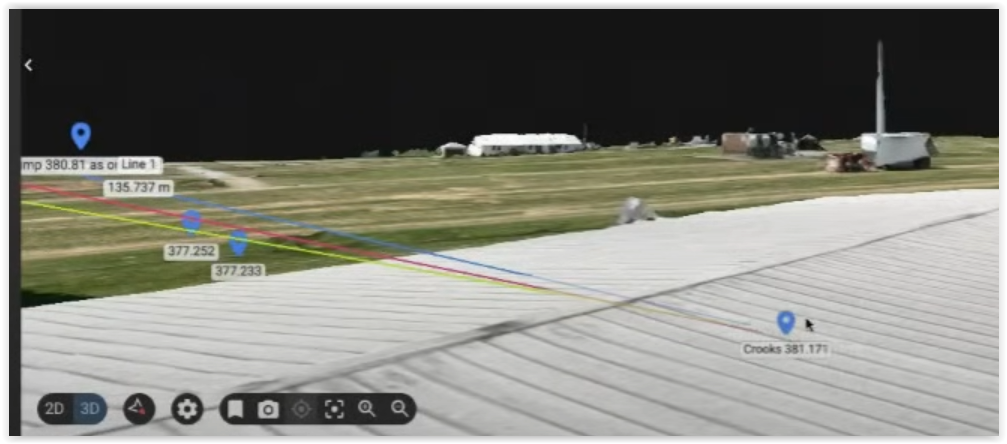
Converted into feet:
381.171 meters = 1,250.56 ft → plus 100 = 1,350.56 ft.
In my 3D CAD model, I set the zero height reference to AGR Building 6, which is at 1,335.27 ft. All components added to the 3D model are referenced to this height.
I also took the time to double-check all sea levels using RandyMajors, which is why the bullet line has shifted slightly — we will discuss that in more detail later.
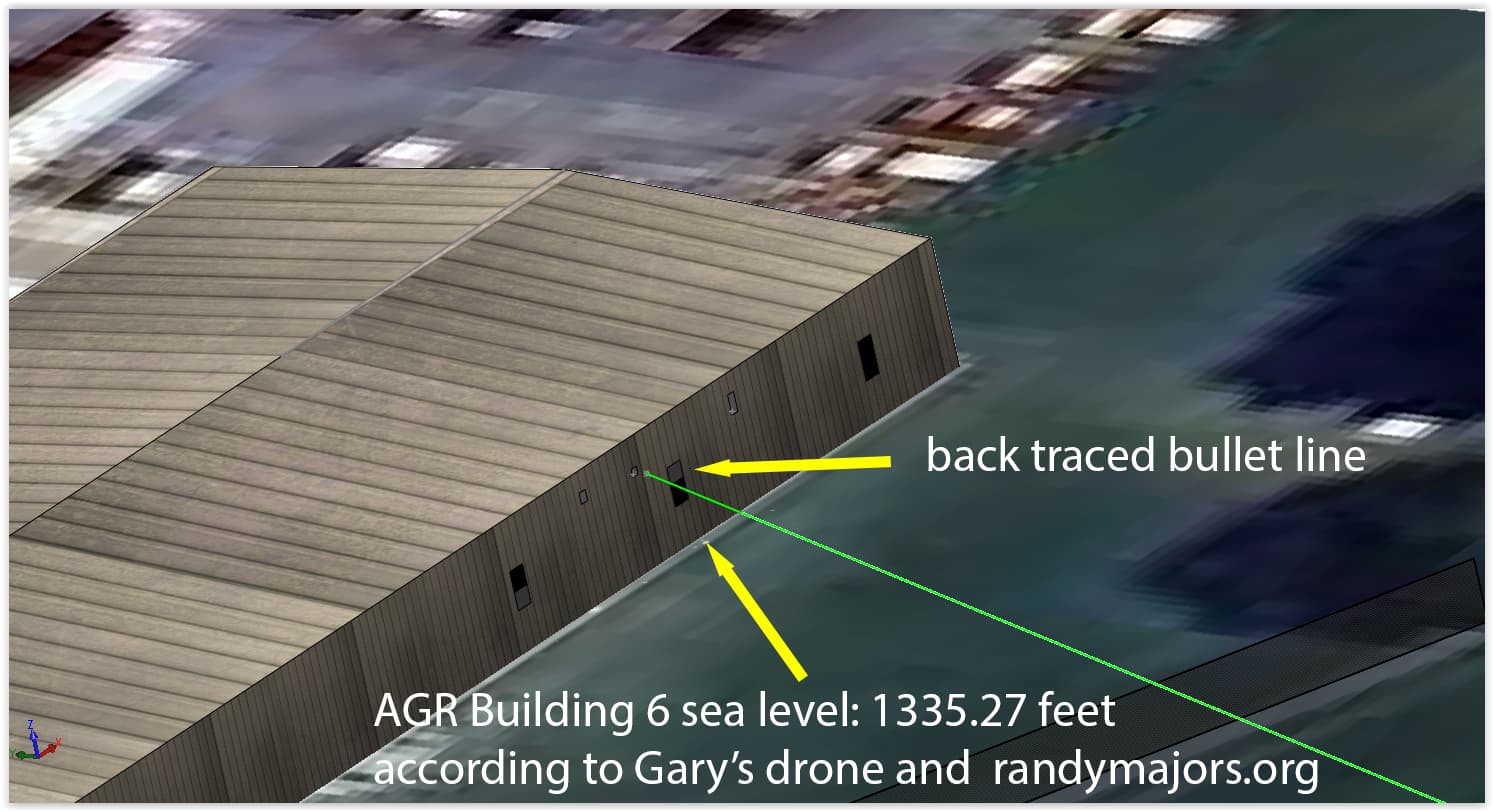
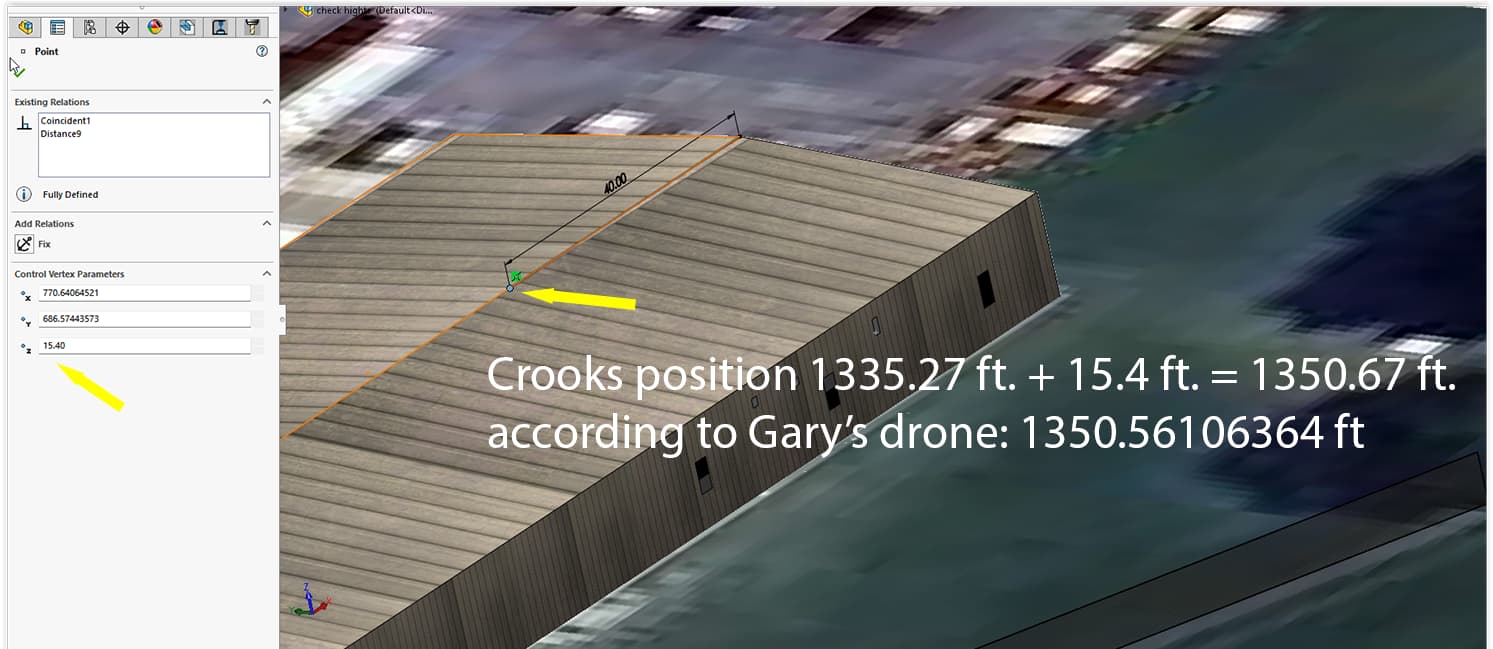
Therefore, we have:
1,335.27 ft + 15.4 ft = 1,350.67 ft.
This aligns with Gary’s drone measurement. Gary’s position was slightly below the ridge, which likely accounts for the small difference.
Shall we continue, or is there anything that needs further clarification?
3 Likes
She said she wanted to shot some pictures or video at the fence line. (But most possibly she didn’t.) From other sources she had only her smartphone.
Seconds before she was filming around the stage. (Anyone saw those photos?)
Remember: someone (operator Graham?) was bleeding in the restroom. If he is the one of the two LEOs first jumped over the gate. From other bodycam footages his wound does not look serious. (But maybe another “desk pop” case? Someone injured by shooting through the vent?)
I don’t want to walk into a dream world, but…
There is a possibility of active sound suppression. It is, however, doesn’t work well in a large room. But it is quite possible inside a small chamber.
Active sound suppression, also known as active noise cancellation (ANC), is a technology that reduces unwanted ambient noise by generating an anti-noise signal that cancels out the original sound waves. This is achieved through microphones that capture external noise and then, through sophisticated electronics, produce an inverted sound wave that effectively cancels out the original noise.
1 Like
I don’t see how you can get the true parabolic trajectory because it depends on the speed of the bullet which you don’t know precisely or even approximately.
2 Likes
But how on Earth the imact could reach the corner of railings?
(Just to mention: My “best” engineer was an extra in some movies - when he was a student. They got some bonus when a phoney bullet was attached to their clothes and detonated remotely.)
1 Like
Now I’m started to believe what @rob-banks says about planted explosives.
Except one thing, adjust the beam by the deflection of bullet trajectory. We should know the round type. (They know the casings found on the rooftop. But probably it is not the entire story.)
Mostly, but if there were no air drag.
Additionally the royal astronomer Sir Arthur Eddington has figured out that air drag to high speed object even increase the free fall acceleration toward the ground.
copilot:
As air drag reduces the satellite’s kinetic energy, the orbit decays:
- The satellite spirals inward.
This is why the satellite speeds up as it falls—its orbital velocity increases even though its total energy decreases. It’s a beautiful paradox of orbital dynamics.
 So, does drag increase downward acceleration?
Not quite in the same way as with satellites. Here’s why:
- In orbital decay, drag reduces tangential velocity, allowing gravity to pull the object into a lower, faster orbit—so radial acceleration increases.
- For a projectile, drag slows all components of motion—both horizontal and vertical.
- However, if the projectile is initially moving at a shallow angle, drag can reduce horizontal speed more than vertical, making the trajectory steepen. This might look like increased downward acceleration, but it’s really a change in direction, not an actual boost in gravitational pull.
Yes, go ahead
Of course, but for now it’s just about finding out whether there was a line of sight.
2 Likes