So It's Back To First Principles (Part 2)

We got a little distracted from your comment:

It has since been clarified that you were not up to date with the latest findings. Recent first-hand video evidence shows that a flash of light inside the open vent 1 is clearly visible at the moment of shot 3. This flash, along with the matching rectangle appearing in the position of the vent at the same time of shot 3, makes it virtually impossible for it to be a random artifact over multiple frames— I would give it about a 1 in 100,000 chance.

That said, as you mention, we’ve reached the point where continuing to debate this topic is a waste of time.

Let’s return to the original question: the distinct echo patterns in Shots 1–3 versus Shots 4–8. We can define an echo footprint using Source 4 on the west side of the building:
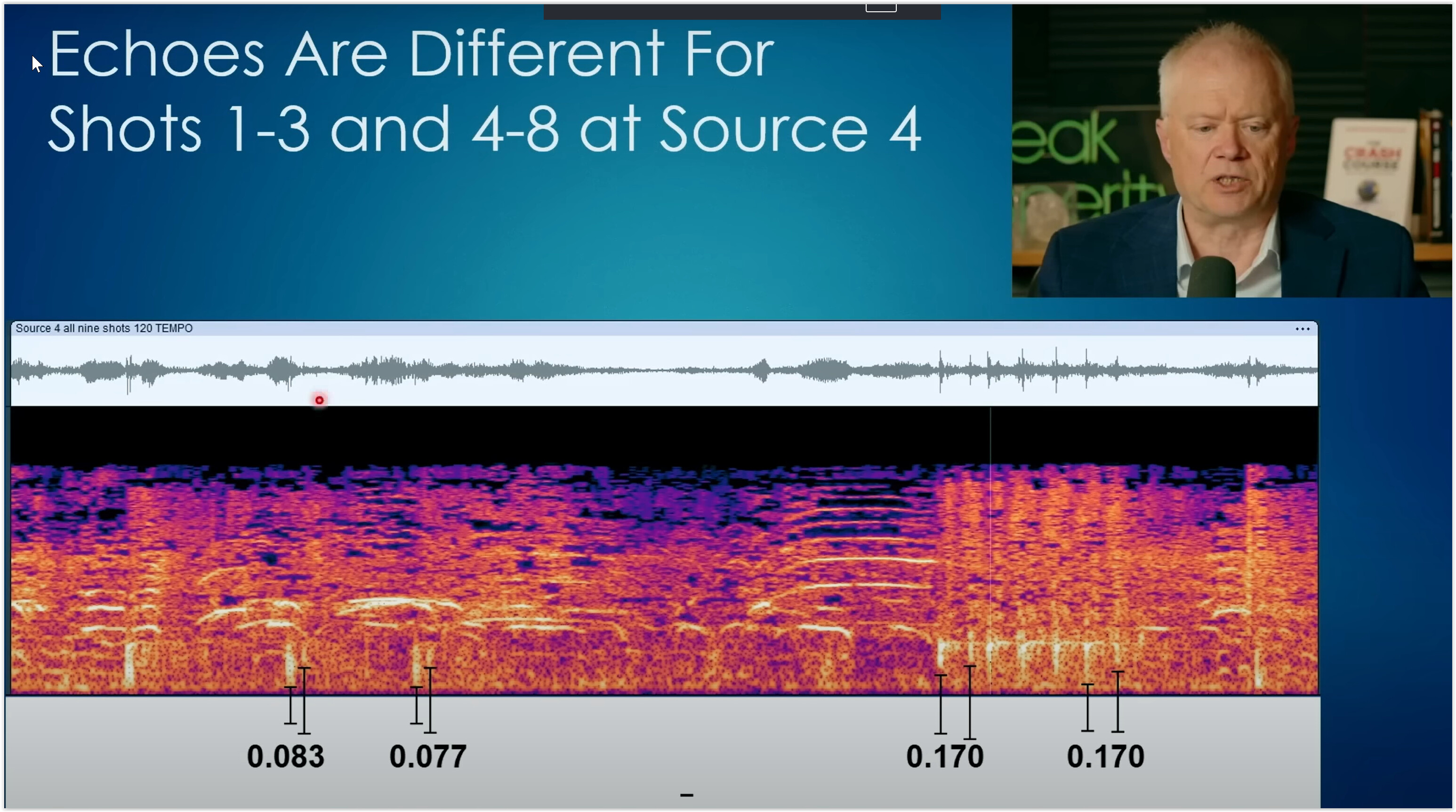
Here is the source:

Source 4 - Shots 1 - 8 original.wav

  • Shots 1–3: early reflection present but less consistent and generally weaker (0.077s).
  • Shots 4–8: a consistent late echo around ~1.7 s.

And in Steward’s recording from the southeast of AGR Building 6:

Here is the source:

steward shots 1 - 8 original.wav

  • Shots 1–3: clear ~0.25 s echos.
  • Shots 4–8: no comparable echo detected.

Acoustic Report — Shot Origins ( Roof vs Vent)

This is a simple explanation of where the shots came from (vent or roof) using the two microphones (“Source 4” and “Steward”).

Files used:

  • steward shots 1 - 8 original.wav
  • Source 4 - Shots 1 - 8 original.wav

1) The basic idea (no math)

Loud sounds bounce off big walls and come back as echoes.

Each mic can “see” only one big wall:

Source 4 sees Wall 1 (to the northwest of the roof position) and not Wall 2.

Steward sees Wall 2 (to the south) and not Wall 1.

If a shot is on the roof (in the open), the sound reaches the big wall 1 and we get strong, clear echoes at the mic that can see them. However, the roof ridge blocks the path to Wall 2 and is in a higher position, redirecting energy toward Wall 1.

If a shot is coming from the vent (recessed), the vent blocks and muffles; and because Wall 1 is behind the building, only Wall 2 is visible to the shot.


2) What we saw in the audio

A) Source 4 (looks at Wall 1)

Shots 1–3: we see short echoes around 0.077–0.083 s. These are from a nearby surface (like the vent mouth). The big Wall‑1 echo is weak or missing.

Shots 4–8: no big Wall‑2 echo shows up. That fits a roof shot where the roof ridge blocks the path to Wall 2; another reason is that the roof position is higher than the vent, preventing sound from reaching Wall 2. However 4 - 8 shows the clear ~0.170 s Wall‑1 echo on each shot in this recording

B) Steward (looks at Wall 2)

Shots 1–3: we see a big echo, roughly a quarter to a third of a second after the shot:

Shot 1: ~0.243 s

Shot 2: ~0.244 s

Shot 3: ~0.331 s (mic was moving during shots 1–3, this explains the shot 3 differance) This tells us the sound went strongly toward Wall 2.

Shots 4–8: no big Wall‑2 echo shows up. That fits a roof shot where the roof ridge blocks the path to Wall 2.

C) Audio differences between the two shot groups

Loudness at Source 4: Shots 1–3 are noticeably quieter at Source 4, while shots 4–8 are much louder. This is because the mic is on the west side of the building with an almost direct line of sight to the roof; roof shots project strongly toward Source 4, but vent shots are partly blocked/muffled, so they arrive weaker.

Tone (high‑frequency content): Vent shots (1–3) sound duller (less top‑end above ~2–3 kHz). Roof shots (4–8) sound brighter/cleaner.

Early reflections: Vent shots show a short, nearby reflection at ~0.077–0.083 s (not the big wall). Roof shots show a consistent big Wall‑1 echo at ~0.170 s.


3) Putting it together (easy conclusion)

  • Shots 1–3 came from the vent.
    Why: Source 4 gets only a small, early echo (~0.08 s) instead of the big Wall‑1 echo, while Steward gets a strong, later echo from Wall 2. That’s exactly what you expect if the shot is recessed inside a vent, which points energy away from Wall 1 and more toward Wall 2.
  • Shots 4–8 came from the roof.
    Why: Source 4 shows the clear ~0.170 s Wall‑1 echo on each shot, while Steward shows no Wall‑2 echo (the ridge blocks that direction). That’s the open‑air roof pattern.

C) Mobility constraint (prone on the roof)

The roof shooter was lying down (prone). In that posture, a ~2‑second relocation between roof and vent is not feasible . Other positions wouldn’t change the echo footprint.

Therefore the abrupt echo change between shots 3 → 4 is best explained by two fixed positions (vent then roof) or different operators, not motion between shots.


4) Quick reference tables

Source 4 (Wall 1):

Shot group Echo time(s) at Source 4 What it means
1–3 ~0.077–0.083 s (short/near) Not the big wall 1; consistent with vent shots
4–8 ~0.170 s (repeatable) Classic Wall‑1 echo; consistent with roof shots

Steward (Wall 2):

Shot Echo time at Steward What it means
1 ~0.243 s Big Wall‑2 echo → supports vent
2 ~0.244 s Big Wall‑2 echo → supports vent
3 ~0.331 s (mic moving during shots 1–3;) Big Wall‑2 echo → supports vent
4–8 none Roof ridge blocks the path to Wall 2 and is generally in a higher position → roof

Here are the two recordings compared at 25% speed (sounds like a Halloween ghost recording):

compare echoes shots 1 - 8 - source 4 and steward.wav

5) Plain‑English bottom line

The first three shots have the vent signature (small echos (from the vent mouth) at Source 4, big late echos from wall 2 at Steward).

The last five shots have the roof signature (strong ~0.17 s wall echo at Source 4, nothing big at Steward).

If we put it very straightforwardly: assuming all 8 shots were fired from the roof, then in the recording from Source 4 you should consistently see a 0.17-second echo from Wall 1 on all 8 shots, and in the recording from Steward you should consistently see a 0.25-second echo from Wall 2 on all 8 shots. The fact that shots 1–3 and shots 4–8 do not follow this echo footprint confirms—across two independent videos—that firing all 8 shots from the roof is completely inconsistent.

So: Shots 1–3 = VENT. Shots 4–8 = ROOF.

1 Like

As I mentioned previously, the video compression artifact that you believe to be a muzzle flash happens 1.034 seconds after shot 1. So, it definitely falls between shots 2 and 3. I tell you these important things, and then you just ignore them, making it impossible to teach you anything. That’s why I am forced to give up.

Also, this is the first frame in which the vent artifact appears:

The frame just prior to that has no vent at all. This proves that the limited bandwidth of the video compression algorithm just can’t show all of the details on the building wall. That is true for this frame and the dozens of frames leading up to it.

How did you determine the time of shot 1?

I already told you how I determined that:

I took a lot of time to compose a very detailed response to you that day, but you obviously didn’t pay any attention to what I said. Very frustrating.

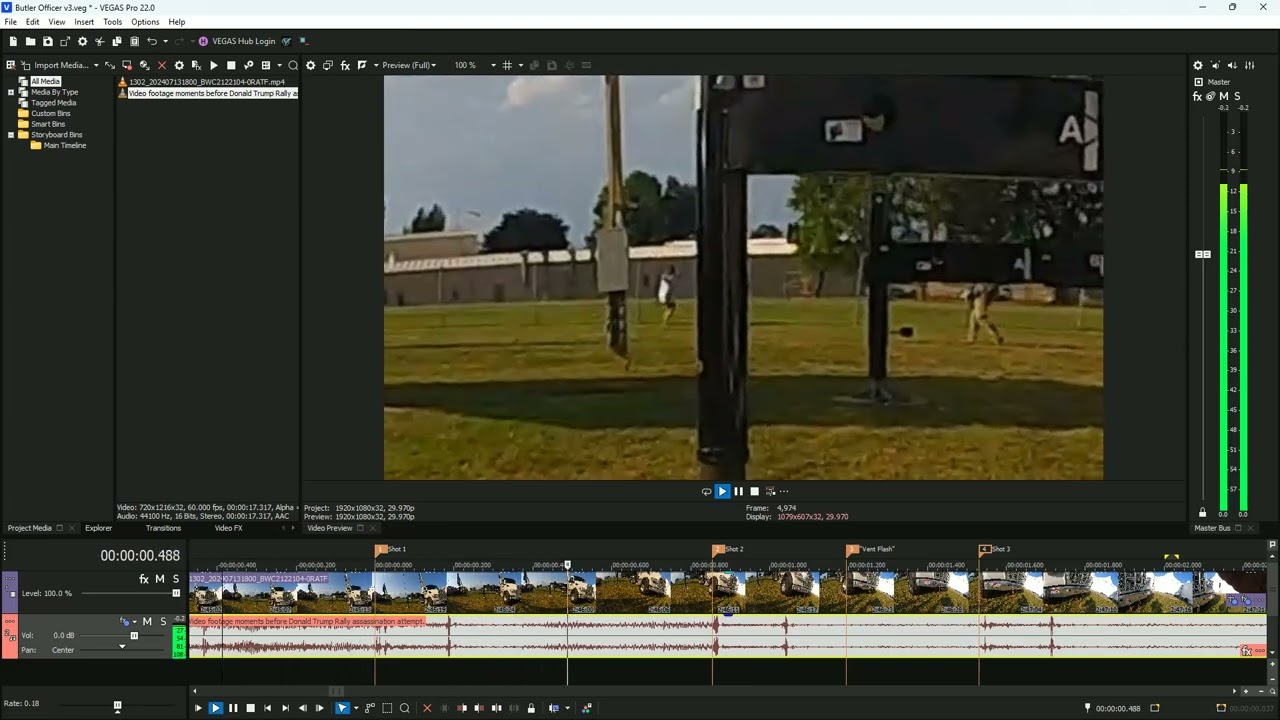
Here is a slowed-down video that proves that the lady’s flinch happens in response to the first gunshot:

This is taken from a video called “Video footage moments before Donald Trump Rally assassination attempt…mp4” that I believe I downloaded from the Peak Prosperity data folder.

This video also does a pretty good job on its own of dispelling your ridiculous “vent flash” theory. You can see the vent fading in and out a bit due to video compression limitations, but in this video it maintains a fairly uniform rectangular shape throughout with no light gray blob appearing in the middle of the vent.

Yes. (But the “bird” was my mouse. Sorry.)

It could be an artifact. But what if it isn’t?
As I earlier said: it is more sophisticated game. Probany the game of “we know that you know that we know”. From this perspective there are 3 possibilities.

  1. It was a real thing.
  2. It is a rendom artifact.
    (Now you might ask, what the hell else could it be besides?)
  3. It is a deceptional artifact.

How to deal with this problem? We should find similar artifacts all along the footage.

It seems very strange that an artifact would appear at a particular place and at a crucial moment of time. And never else. It is a bizarre coincidence.
I don’t know - but I cannot exclude that possibility.
If I should prioritize, most probably it was deceptive. But almost equal chance to it that was real.

There are a few ways to break down the possibilities:

  1. Video Compression Artifact: It’s plausible that it’s an artifact, especially if the video was compressed or encoded poorly. Compression algorithms can cause strange visual effects, especially in areas of high contrast or complex detail. However, it would be unusual for this artifact to appear only at a critical moment and in a very specific place unless the compression was exceptionally flawed at that point.
  2. Real Thing: If it’s something tangible that occurred at the scene, such as a person or object, it would be worth analyzing the footage in detail, possibly using higher-quality frames or different types of software to see if it appears consistently or if it matches the timing. The fact that it only shows up at that specific moment, though, makes it feel suspicious. Natural occurrences like light reflections or shadows could be the cause, but they’d typically be consistent.
  3. Deceptive Planted Artifact: This is an interesting angle. If someone were trying to overwhelm the investigation with fake evidence, causing confusion and doubt could be a deliberate strategy. Light flashes or manipulated objects (like the balloon) might distract from real evidence or complicate the analysis. It’s also possible that while they couldn’t manipulate the surveillance footage directly, they could introduce these artifacts by triggering external events in the real world.

Chances:

  • Compression Artifact: Likely, but seems less probable if it’s only at that specific moment and location.
  • Real Thing: Possible, but the timing makes it less likely.
  • Deceptive Artifact: Most likely, especially if there was a deliberate attempt to create confusion or misdirection. The balloon incident supports this, as something like that could be staged or timed intentionally.

So, I’d lean towards the third possibility: a deceptive planted artifact, especially if there was a motive to confuse or distract from real evidence.

How about overwhelming deception? @sonjax6

== https://youtu.be/gW0YM8uI7kg?t=1153

video syc:

==https://youtu.be/gW0YM8uI7kg?t=1241

+Edit:
Right footage: he nods after “political expression”. 2108 mark
Left footage: he nods after jufge said next sentece “That concludes reading the information”. 2111 mark

Sorry, you are right—I missed that you were using the lady’s knee as a reference.

However, we have analyzed this topic in depth. Please refer back here, where you can see how we evaluated shot 3 from vent 1:

If you still believe the above to be inaccurate, I will be glad to take the time to verify it again on my side.

2 Likes

I’m sorry. I wasn’t able to follow the logic in the prior post that you referenced. However, I think the approach I am using is very simple and easy to understand.

Taking a close look at “Video footage moments before Donald Trump Rally assassination attempt…mp4” we can see that Margo Martin:

  • Flinches 0.2 second after shot 1. (Normal human reaction time.)
  • Halfway between shots 2 and 3 her left heel is up and her toe is pointed to the grass.
  • At shot 3 she has just about completed the long stride with her left leg.

Using those visual cues, I pasted the audio from that clip onto the Butler officer bodycam video and aligned it via the visual cues.

This shows that the vent artifact begins about halfway between shots 2 and 3.

However, you did not address the elephant in the room. Looking at the “Video footage moments before Donald Trump Rally assassination attempt…mp4” we do not see any sign of the “vent flash” artifact that is present in the bodycam video. So, this case is closed. We are done here.

As a professional elephant trainer, I saw no elephants in any 13 July video.
I did see a bald man on an AGR roof, and the picture was made into a T Shirt image:

I’m sorry to insist, but the claim that the flash out of the vent occurs between shots 2 and 3 is incorrect. I can prove this using a very simple and straightforward method.

Using the software tool Shotcut, we can analyze the video frame by frame with milliseconds accuracy, as it displays both precise timestamps and the audio waveform. This allows us to pinpoint exactly what we are looking for.

In the three-flag video, the visual “crack” of shot 3 occurs at 14.250 s:

while the corresponding boom is recorded at 14.417 s:

Since the microphone is approximately 405 feet away, the sound delay is expected to be about 0.36 seconds. Subtracting this from the boom timestamp (14.417 – 0.36), we determine that shot 3 was actually fired at 14.057 s.

To synchronize with the bodycam footage, we need a common reference point. Using your method (Margo’s knee) is far too inaccurate. In the three-flag video, we have a much more precise synchronization point: St. Tylor’s left foot leaves the ground at 12.517 s:

So we can state that the time difference between 12.517 s (left foot airborne) and 14.057 s (shot 3) is 1.54 seconds. Let us keep this time difference in mind.

In the bodycam video, Tylor’s foot is airborne at 2:44.211.

Adding 1.54 seconds, we calculate that shot 3 should occur at 2:45.751. Fast-forwarding to this point in the bodycam video, we see that at the next available frame 2:45.746:


The vent is already open, perfectly aligned with the calculated firing time of shot 3. This confirms that the flash from the vent occurs exactly when shot 3 was fired!

I understand why you are eager to close this case. As a supporter of the “lone 8-shot shooter” theory, you must recognize that this first-hand video evidence is profoundly damaging—it completely debunks the 8-shot claim. Having now established clear, direct evidence that shot 3 occurred precisely when the flash appears in vent 1, we can confidently state:

Recent first-hand video evidence shows a flash of light inside open vent 1 at the exact moment of shot 3. This flash, together with the corresponding rectangular shape appearing precisely at the location of vent 1, makes it highly unlikely that the phenomenon can be dismissed as a random artifact. The number of coincidences involved renders it, from a probability standpoint, almost impossible.

1 Like

Actually I don’t buy the lone wolf story.
Before I explaining why…
There is not only the formal logic that matematicians use. There are several other ways of thinking - especially strategic thinking.

If a lone shooter - without military training - can outsmart and outmaneuver several law enforcement organisations; what if it would be a multilateral organized attack by professionals? That is a big problem.

@sonjax6
** https://youtu.be/cmp14tGz9FY?t=529
Cullen here says something about Butler.
(Sorry, I don’t know the persons he refers to.)

Oh, the other shooter, apparently had strategic planning capacities and and tactical skills. These pictures talk for themselves.

Additionally, what body language experts say: treachery made big pain for the alleged shooter.

1 Like

The Roger’s theory:

As likely as finding butter on a stick!

Okay, @roger-knight. I am willing to examine the two videos to see whether there is a significant change if I use Tyler’s footsteps to sync them instead of Margo’s movements. But first I’d like you to answer these three questions:

  • What is the duration of the muzzle flash that you see coming from vent 1, i.e., how many frames does it persist?

  • What is the duration of typical muzzle flash from a rifle?

  • If you zoom in on the Many Flags video by a small amount, you can easily see vent 1. During the time that the “vent flash” is visible, what do you see happening with that same vent in the Four Flags video? Do they both look approximately the same? If they don’t, why don’t they?

One of my X dot com followers asked Cullen for his opinion of my video of a bald man in an (apparent) action scene.
Cullen replied with his 14 month old Butler site diagram, with colored lines from AGR and from trees to the podium and bleachers…Cullen had no words, no emoji, no animated GIF…just his 20 July 2024 diagram, with no changes.
My follower accepted Cullen’s reply.
I blocked my follower today, for a thoughtless remark she made about hydrogen vehicles.

Thanks for the link to John Cullen. I’m not currently a paying subscriber right now.

What he said about the interest he’s starting to get from high level people in the Trump administration (about both Butler and the murder of Charlie Kirk) is more than a little interesting. He has NEVER lied or even exaggerated about that kind of stuff before.

I also think he’s at least 80% correct in his hypothesis that that Las Vegas Route 91 mass shooting was carried out by rogue Saudis as part of an attempt on a Saudi prince’s life.

1 Like

There are several factors. Collins was already prepared to hear gunshots, Margo did not. (Look at slow reactions of people being interviewed at the moment when Kirk was shot, more than a second.)
As I mentioned earlier, the sound propagation needs time. The distance of bleacher footage from alleged shooting position is around the stage position, maybe 3-4 yards less. Pearson was about 10 yards closer I guess - but his bodycam if deaf. Margo was about half way between the bleacher cam and the shooter.

The problem is, we don’t have authentic high quality footages - since the attitude “there will be nothing there, no need to record”. And the accountability holds, even if Bukre says “hey, I was actually not doing my tasks”. Accountability does not need to be guilty - some experts say.

Actually I would need to develop better tools, since I realized - despite what simplified textbooks say - what weaknesses are there.

I was about to find the surveillance cam, when another video appeared - with a lot of information.
** https://youtu.be/P-UtipJUu7c?t=57

in his pants?

in his hands

cam can see the entire rooftop

I appreciate your professionalism on this topic.

As you have correctly pointed out, a muzzle flash only appears for a couple of milliseconds. You may have noticed that I changed my wording in the final statement from “muzzle flash” to “flash of light.” If we put ourselves in the position of a possible shooter in a sniper’s nest above the interior ceiling of AGR building 6, we have to assume that there would be no light in that space.

To maneuver properly, a mounted headlamp would be necessary. In that sense, can we agree on using the term “flash of light” (potentially from a headlamp)? This would make everything add up, since at the moment a shot is fired, the brief muzzle flash would be masked by the headlamp beam.

We can consider the bodycam video, where the flash is seen in vent 1, as primary source footage (first-hand), meaning it was captured directly by the person who shared or published it.

Unfortunately, the three-flag video has to be considered secondary source footage (second-hand).

The unusual part is that, to my knowledge, the person who originally filmed this video has never come forward or shared their first-hand version. It is assumed that the man in the red checkered shirt is the person who filmed it, and I believe @sonjax6 knows his name. I have been searching for an HD version of this video since last year, without success.

The best quality copy I am using is titled “Conflict Dispatch - Yet another new video of the attempted assassination of form.mp4” and has a size of 2.08 MB. Perhaps someone has a better-quality version — ideally the primary source?

That being said, since it is not first-hand, we must carefully check it for possible editing, re-encoding, or context changes.

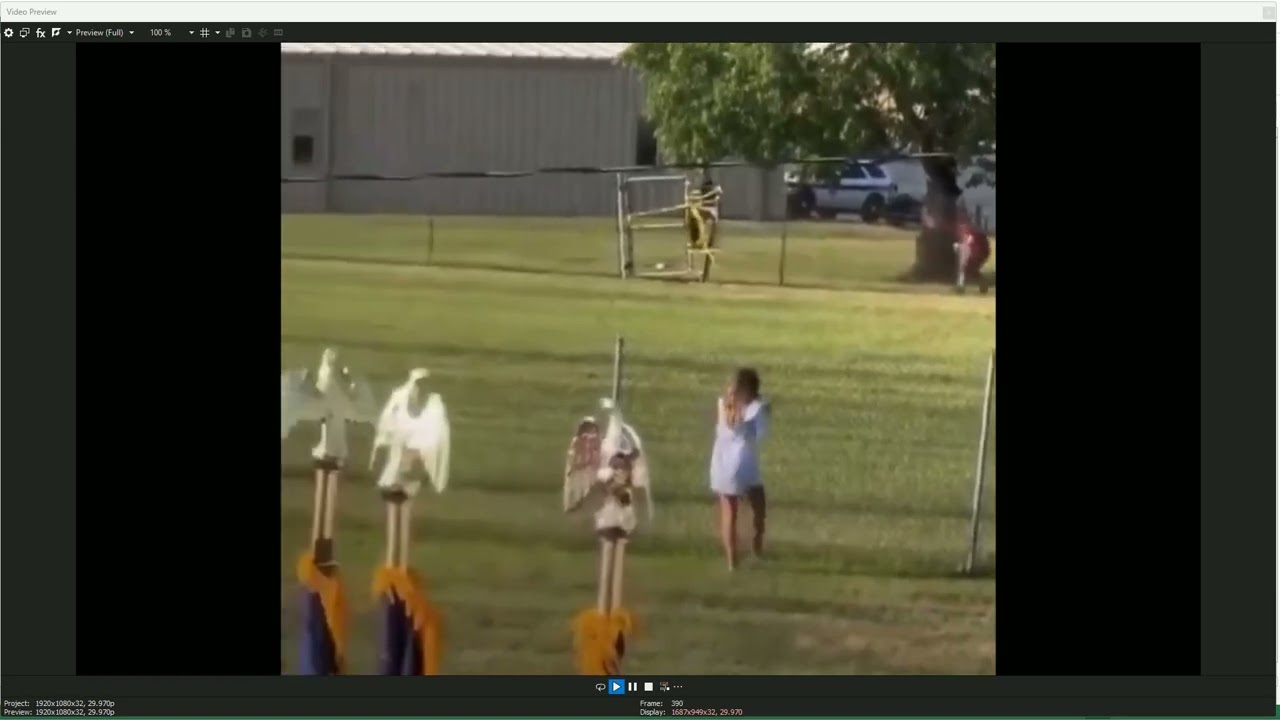
Simply by taking four screenshots raises significant doubts about this video:

The first two frames show Steward running toward the tree while the camera is moving, and the vertical lines of the AGR building 6 wall and vent 1 are clearly visible. Yet, at the most critical moment — when shot 3 is fired at 14.017 — the wall suddenly grays out, and all the vertical lines, including vent 1, vanish.

I put together a GIF for better comparison.

shot-3-wall-fade

Looking at this GIF, it is clear that the effect is highly suspicious. I would have accepted the footage as more credible if the vent and the vertical lines had remained consistent with the earlier frames. But the fact that they fade precisely at that moment of shot 3 suggests, in my view, stronger support for the two-shooter theory rather than the lone eight-shot shooter theory.

1 Like

Yes, I noticed too that the vent disappears.
If it was intentional, we should not think they are idiots. The entire wall got blurred out.
Possibly as the result of the cam focuses on flags. But maybe…

Roger is so good!
He always lands on his feet, like a cat falling from a building, changing his version of events based on the pertinent objections made to him, leading to increasingly implausible stories. What an artist!

What you are observing here is nothing nefarious. It is simply the result of video compression. We also see the vertical lines come and go in the bodycam video.

Please look at these five consecutive frames from the bodycam, and notice that both the vent and a small area of the vertical lines appear suddenly in the second frame. The vertical lines are only present for two frames and then disappear.


Is it suspicious to see the vertical lines come and go or to see the vent suddenly appear when it was just a smooth wall in the previous frame? No, this is not suspicious at all. I see no reason to think that either the bodycam or the Flags video have been altered. In both cases the artifacts we observe are merely the result of video compression.

1 Like