Sovereign Bonds Are Flashing an Urgent Warning

Originally published at: https://peakprosperity.com/sovereign-bonds-are-flashing-an-urgent-warning/

There are creakings and popping and various groanings emitting from the global financial system. While precious equities seem to constantly catch bids as they move ‘up and to the right,’ bonds are behaving very differently.

They are selling off. And have been for long enough that even the WSJ has taken notice:
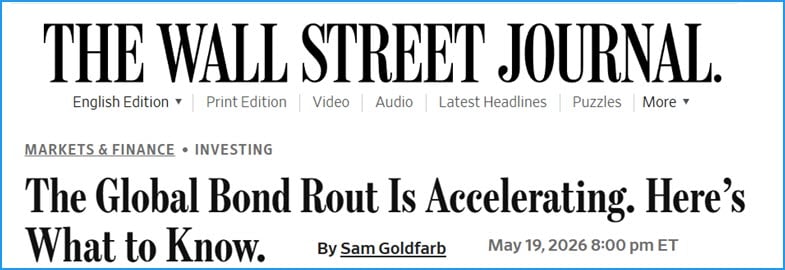
The US 10-year yield recently hit 4.69% up from a low of 3.95% before the Iran War started.

But the rout in bond prices is not contained to the US, it exists across Europe and Japan too.

Japan, is in what appears to be deep trouble at the moment. Not only is the yen under tremendous pressure due to heavy fiscal deficits proposed by the current administration, but Japan imports 100% of its oil and oil products from abroad. As oil becomes more expensive, the outflow of yen accelerates.

Coupled to that dynamic are Japanese bonds which have been selling off viciously, as exemplified by their 30-year bond:
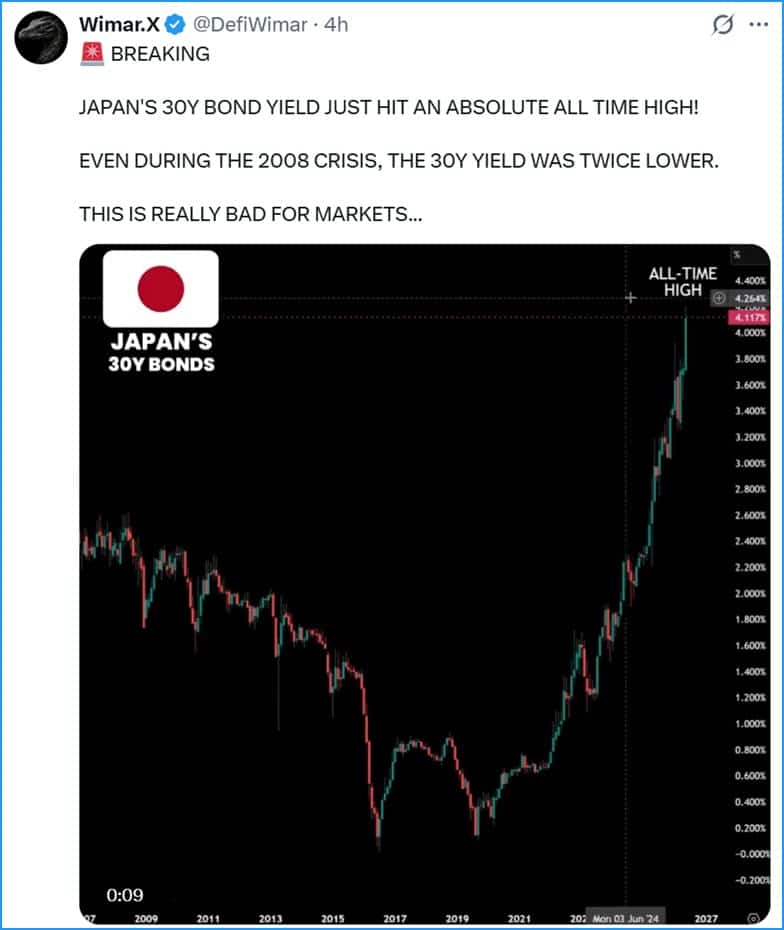
Higher government bond yields, of course, mean higher government interest costs which is another source of pressure on the yen.

But Japan is not alone. The UK is under quite comparable pressures, and its own 30-year bond is absolutely screaming distress.
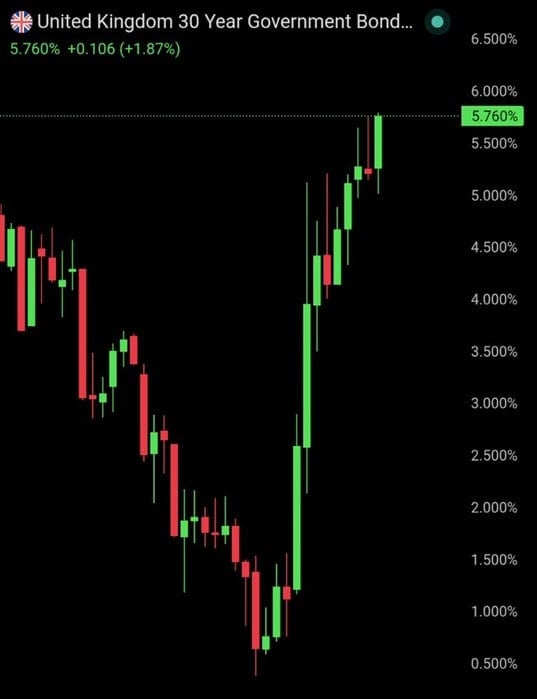
While there are several factors at play, Paul and I believe the biggest of them is the resurgence of inflation. Every indication points to inflation both heading higher and picking up speed.

In the US, producer price index (PPI) is heading north rapidly and now stands at 6%(!).
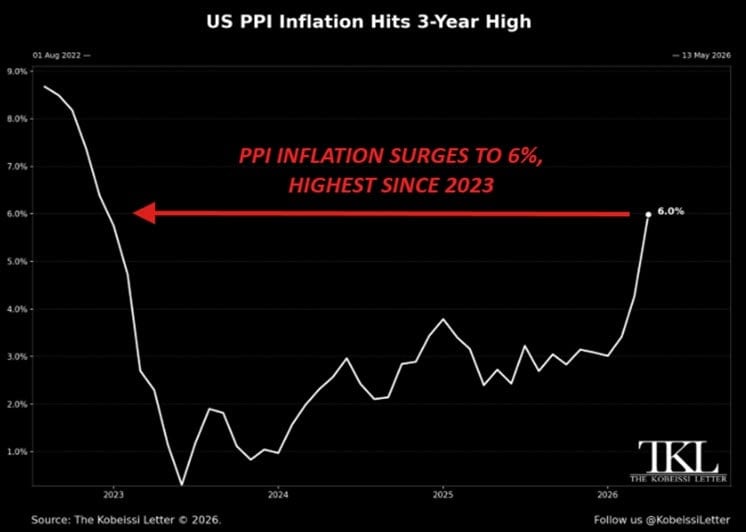
With history as our guide, the means that the headline consumer price index (CPI) will be flirting with 6% in about 3-4 months.

Obviously, nobody wants to hold bonds paying 4% is a world of 6% inflation. That’s just a guaranteed loss of purchasing power. Which explains why bonds are selling off.

But it could get a hwole lot worse, and both Paul and I expect it to because (a) input prices are already in high to very high double digits and (b) the Strait of Hormuz is not open, and the negotiations are going poorly.

Ouch!
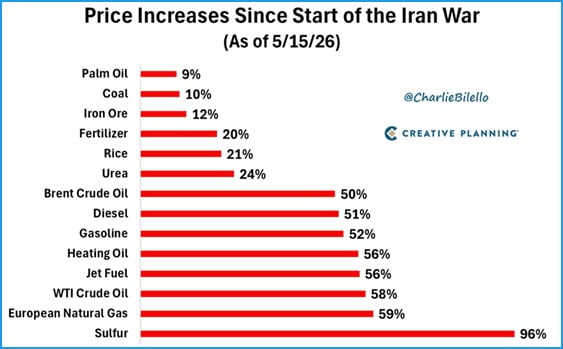
What the even…?
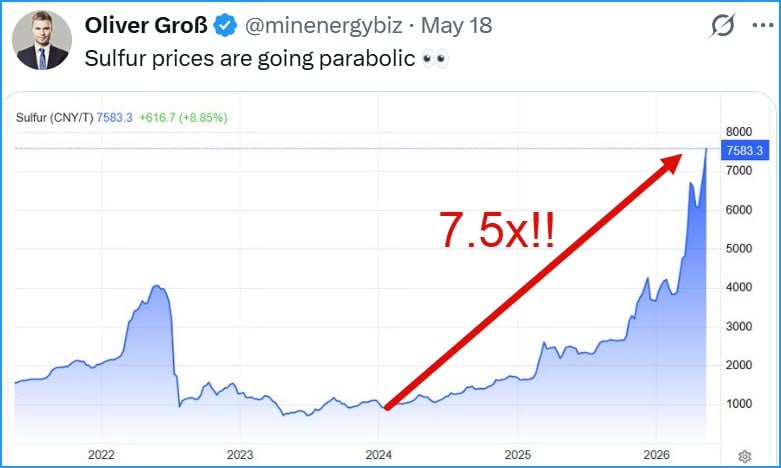
Add it all up, and it’s clear that a set of major regime changes are underway; the 40-year downtrend in interest rates has been broken and sustained, we’re in a structural energy crisis, and US leadership seems either unable to address the core predicaments, or are unwilling for some reason.

Despite all that, opportunities do exist for adaptive investors in undervalued areas (commodities, energy, emerging markets), but passive strategies and long bonds face what we feel are underappreciated risks.

That’s where having a strong financial plan, a good strategy, and a disciplined risk-managed approach are going to be vital to your future success.



Timestamps
00:34 The Bond Market’s Current Landscape
05:58 Inflation’s Impact on Retirement Planning
10:15 The Changing Dynamics of Real Estate Investment
15:23 Insurance Challenges in Property Management
19:45 Global Bond Market Trends and Their Implications
23:25 The Role of Inflation in Economic Predictions
31:34 Navigating the Yield Curve and Inflation Risks
36:37 Understanding the Debt Bubble and Market Predictions
43:40 The Impact of Oil Prices on the Economy
56:40 Energy Demand and Future Projections
01:01:40 Long-Term Energy Strategies and Market Trends
01:04:55 Market Valuations and Historical Context
01:06:56 Margin Debt and Market Risks
01:08:34 Investor Psychology and Market Discipline
01:12:17 The Role of Government and Central Banks


FINANCIAL DISCLAIMER:

The information contained in this video and the resources available for download through our affiliated website are not intended as and shall not be understood or construed as financial advice, nor should be interpreted as a solicitation to sell or offer to sell investment advisory services. No person who currently works for or contracts with Peak Prosperity or Peak Financial Investing is an attorney or accountant, nor are we holding ourselves out to be, and the information contained in the video and on the website is not a substitute for legal or tax advice from a professional who is aware of the facts and circumstances of your individual situation. While Peak Financial Investing is a registered investment advisor, please note that this podcast is not intended to be investment advice.

All information has been obtained from sources believed to be reliable, but its accuracy is not guaranteed. There is no representation or warranty as to the current accuracy, reliability or completeness of, nor liability for, decisions based on such information and it should not be relied on as such. We have done our best to ensure that the information provided is accurate and provides what we feel is valuable information. The views expressed are subject to change based on market and other conditions.<

No guests or clients appearing on the podcast receive any form of compensation for their appearance and obtained no other benefit from either Peak Prosperity or Peak Financial Investing.

All investing involves risks including the possible loss of capital. Asset allocation and diversification does not ensure a profit or protect against loss. Please note that out- performance does not necessarily represent positive total returns for a period. There is no assurance that any investment strategy will be successful. All investments carry a certain degree of risk. Dividends are not guaranteed, and a company’s future ability to pay dividends may be limited.

Additional important disclosures for Peak Financial Investing may be found in our Form ADV Part 2A, which can be found at https://adviserinfo.sec.gov/firm/summary/319672.
1 Like

The download link gives an error. Can it be reloaded?

1 Like

This phrasing belies a misinterpretation of facts.

Are we in a structural energy crisis? Yes.

Is US leadership unable or unwilling to address the crisis? No, US leadership is driving the crisis. US leadership is the source of the crisis. On top of frozen Hormuz traffic, on top of tit-for-tat Gulf energy infrastructure destruction, the US is boarding Russian tankers around the globe and stealing oil and the ships. The US is attacking, via proxies, Russian energy infrastructure.

US leadership is confident in its control of finance, mass media, etc. that we are in a catastrophic energy crisis, and they like their chances heading into the rigged elections of 2026. There is no opposition party to this crisis in the US, only questiona about who gets to run the aftermath and profit along the way.

As a citizen and wannabe “investor” about to have my meager wealth devalued, I have to recognize the game being played.

Investing in Chevron and Exxon seems like a great hedge. Investing in the public firms contracted to build out US controlled LNG terminals seems like a good hedge. Collecting small denomination physical precious metal minted coins seems like a good hedge. But, what do I know? I am great at losing money, social capital, faith - been doing it my whole life.

Anyway, just want to pound this point: the US ruling elite are driving this structural energy crisis.

14 Likes

Something dawned on me last night - Bessent & He Lifeng might have already structured a path forward. Here’s the overview: (Don’t shoot me down too hard if you think this is rubbish, it’s just a hunch I have)

US debt is $36.5 trillion with interest approaching $1.3 trillion a year. China exceeds 300% debt-to-GDP once you include local government and the property sector. Neither can grow, tax, or cut their way out. Gold revaluation is one of very few tools that works at the required scale, and there’s genuinely no alternative — central banks already hold it, it’s nobody’s liability, and it has 5,000 years of track record. At $20,000/oz, US gold provides ~25% M2 backing ($5.2T), China’s estimated 10,000 tonnes provides $6.4T of balance sheet capacity, and the Eurozone’s 10,800 tonnes (the largest collective bloc) would make them enthusiastic participants. The arithmetic converges on $20,000-25,000 as the zone where everyone’s needs are met.

The Smoking Gun

CFTC Bank Participation Reports show US banks went from 145 million ounces net short silver to ~4 million ounces net long in five months ending around December 2025. This is unprecedented — US banks have never been net long silver in the entire history of CFTC reporting. They didn’t just cover, they went through flat to long. European banks absorbed the transferred shorts. The covering began ~July 2025, roughly six months after Bessent took office. Gold’s rally from $2,400 to $5,000 maps precisely onto this period. The rally everyone attributed to inflation fears was primarily driven by the largest structural sellers in the market switching sides.

The Architect

Bessent is ex-Soros. A macro investor who’s spent his career navigating currency regime transitions. He’s had 16 months to design the financial architecture. His comment “judge us on the 10-year” makes no sense as conventional policy confidence — the 10-year has risen. It makes perfect sense if he meant: judge us on where it ends up after we execute the plan. The Paris meetings with He Lifeng in March 2026 weren’t initial exploration — they were advanced technical alignment of a framework already designed.

The Beijing Summit

Trump flew TO Beijing, May 14-15. Brought Fink (BlackRock, $10T), Musk, Cook, Huang, Ortberg. Every major bank CEO absent — consistent with compartmentalised briefing through separate Treasury channels. Xi referenced the Thucydides trap publicly during the summit. You don’t raise the historical pattern of great-power conflict at a meeting about soybeans. Meanwhile, China holds every card: Iran/Hormuz influence, rare earths (60-70% of processing), reshoring cooperation, $800B of Treasuries, and an estimated 5,000-10,000 tonnes of gold. The Supreme Court killed Trump’s tariff authority, removing his only coercive tool. China has five strong cards. The US has none. And the US flew to Beijing.

Fort Knox

Trump and Musk promised a gold audit. It never happened. Then silence. If the gold was there, the headline writes itself. If it was missing, the fallout would’ve leaked. The silence is most consistent with active accumulation through the Exchange Stabilisation Fund — an audit would reveal the programme before completion.

The Behavioural Evidence

Trump’s treatment of European allies has shifted from transactional pressure to genuine indifference. That’s not someone who needs his allies — that’s someone who’s secured an alternative partnership that makes them optional. His broader shift from chaotic disruptor to confident imperial actor is proportional to believing you’re about to execute the biggest deal in history. Trump wants to be the greatest dealmaker ever. Xi wants to complete China’s “great rejuvenation” — joining Mao and Deng as the third transformative leader. Each needs the other. Neither can get what they want alone.

Why Smart Money Is Confused

Druckenmiller cautious. Dalio uncertain. Buffett sitting on $330B cash — the most defensive positioning of his career. Gold rising alongside equities. Yields rising without breaking stocks. Gold smashing through every technical level. Dollar weakening despite rising yields. None of this makes sense under normal frameworks. All of it makes sense if the largest structural repositioning in gold market history is underway, driven by advance knowledge the market doesn’t have.

The transition happens regardless — voluntarily through coordination or involuntarily through market forces. Coordination gives both leaders control over price, timing, narrative, and legacy. The involuntary path gives them chaos and blame. It’s a Nash equilibrium: both lose more from defection than cooperation. Everything to gain. Nothing to lose. Because it has to happen anyway.

The Preparation Is Largely Behind Us

If the architecture was designed by early 2025 and bank repositioning began mid-2025, the preparation has been running ~12 months. Beijing was the assembly of the full package, not the beginning. US-side derivative unwinding appears 70%+ complete. What remains is the crisis reaching sufficient intensity for political cover — and it’s arriving through bond yields (Japan 10yr approaching 3%, UK gilts 5.8%+), Hormuz, the credit cycle, and equity markets beginning to crack from 7,512. The preparation itself accelerates the instability. The timeline may be shorter than anyone outside the inner circle expects.

12 Likes

This is a good complementary read from No01 . . .

So. You asking me does the whole thing finally come down. Lean in. I’ll tell you straight.

Not from Korea. Korea screams first and loudest and you’ll hear it across the sea. But the thing that kills is in the walls and the thing in the walls doesn’t scream, it works slow. A rate creeps. A loan goes unrenewed. A lender stops pretending and holds his breath for the quarter to turn. Korea gets the sad song sung about it, because the hocked-up always make the prettiest ruin, while the thing that actually did it sat in a wall, in a back room, in a deal that just quietly never closed.

And then. Then. There’s the third one. Down the cellar. The slow cold one’s been down there since before any of this, eating, and it’s the one decides how long the house stands at all.

https://no01.substack.com/p/last-call

2 Likes

I agree with Paul on his short term thoughts in the stock market. I listen to an experienced “expert”? who only trades short term and is not always right. He just put a short on the Spy yesterday, with all kinds of technical’s to back it up. AND his belief is the bond prices are at longer cycle low. He issued the TLT long at just a little bit lower price. I don’t trade but pay and listen to his thoughts. Paul would be correct in his thinking, if that does pan out. Maybe this is the beginning of bond yields going to near zero again? I think it sounds crazy too.

1 Like

For anyone who wants a brief primer on how it all comes down….. Let’s follow the money. Interest rates affect bond prices and compete with equity dividends which, in turn, support equity prices. They also compete with savings/capital production/investment. How do equities fare in that maelstrom?
Equity prices are driven by the lure of dividends and dividends are driven by corporate operating expenses vs costs. Following the chain, all product prices rise to cover rising operating costs that rise with general inflation. The higher prices then are passed along to customers in the form of take-it-or-leave-it. Meanwhile, the ultimate customer, the final consumer, is finding the higher costs unaffordable. Net sales fall while the costs to produce products increase and “profit” margins see, not a straight-line decline, but a geometric fall. Holders of equities decide to take their money elsewhere which defines why equity prices to fall.
How about unnatural shortages like petroleum and sulfur fare? Obviously, sales fall first but maintenance costs remain fixed or rise. Yes, the ability of resource producers to raise prices increases but at the expense of selling less. Selling less while costs increase may initially result in higher profits but eventually the customers buy too little and a profit squeeze is the result. How about ones that appear protected? Well, prices depend upon sales. So even the profits of the oil giants eventually fall as the general economy swallows generally declining profits.
No matter how you explain it, rising interest rates eventually make everyone poorer, even those who are invested in bonds. All that money being paid in interest is non-productive. It just feeds consumption without increasing investment in production facilities.
One last point. Price inflation has a serious adverse effect on cultural norms. That was seen in the dramatic decline in product quality in the 1970s and 1980s. Money is one thing but changing cultural norms always ends up in social conflict.
I am sure Chris can put it better than I, but that is an outline of what I think all of us are facing.

1 Like

Well put, Alex D.

Regarding rental property, like adult diapers, it depends.

Location, is key. Not all markets are the same. I will agree it would be hard if holding mortgages in a bubble area. It’s also hard if you expect rent alone to be your yeild. Even harder of you have to employ others.

I guess I am part landlord part real estate investor. Part of my success has been identifying property that has value not realized due to having a flaw that prevents it from being mortgaged. Paying cash then renovating these is where most of the increase I made. Rents give me cash flow / income and pays the costs of ownership and maintenance and update I let the real estate market and time make me money. I make more than CD interest along the way even after setting aside for expenses and maintenance, and have the property value increase to look forward to when I retire and sell.

The idea of being close to your rentals is very true for me. While I am not at them as much as many might imagine it comes in batches. I fixed a samsung washer for my mother yesterday. I replaced an old toilet at one two weeks ago and will do another and a vanity in June. I try to update something every year so the places are getting better all the time. Then when it’s time to sell and take profit, there will be no big out go of time and money. Just clean and repaint as needed and let realtors do their thing.

Beware the trees. Tree removal has trippled in recent years. Seriously rethink any home that has large old oaks. Also notice English ivy as a risk signal. Older omes downhill of the road are at high risk for foundation problems.

I plan to rent RV slots on my agricultural land post rental house retirement.

6 Likes

The podcast touched upon home insurance and home insurer’s requirements for new roofs.

Here is a story a friend of mine from Pennsylvania told me.

He got a letter from his homeowner’s insurance company. They told him that they would not renew coverage unless he replaced his roof. They gave him the name of their “approved roofer.” He checked out the cost with the “approved roofer” and it was substantially higher than the prevailing cost charged by other roofers in the area. I think he said that it was twice the going cost.

He had to act quickly since his notice of potential cancellation came pretty close to his renewal date. But he was able to find a new insurer and switched coverage.

The whole thing made him suspicious. There was nothing wrong with his roof. It didn’t leak, no tiles were loose or missing and it had an oak (not plywood) sub-roof. The roof looked older but that was all.

So he did some digging.

It turns out that his insurance company had sent out drones to view the roofs of all of its customers. The new roof requirement was based upon drone photos and that was all. And it turned out that the “insurance company” itself wasn’t even an insurance company at all. It was a broker that “farmed out” contracts to real insurers. He couldn’t find out if the “insurer” was connected to the “approved roofer” but he suspects that it was.

It’s like everything else today. Everything is a scam.

15 Likes

Korea is going to build our merchant marine ships that will do double duty as naval drone platforms. Korea manufactures a lot of Grain Oriented Steel which goes into the multi-year backlog of electrical power transformers the world cannot get enough of. I just don’t know that Korea will be economically collapsed - they will be heavily taxed by our energy supply costs, but it would be too big of a loss to the builders of the coming global order to “lose” Korea. The U.S. has no equivalent industrial capacity for ship building and power transformers.

Korea is angling to build submarines for Canada also – they are manufacturing powerhouse. I do not believe that will disintegrate any time soon – provided they can secure enough oily energy. The article by No01 explains about the ridiculous ponzi circlejerky financial schemes that are ballooning their stock market which sucks in the lay FOMO masses who will be the bag holders when the kospi explodes/reverts to the mean.

A friend in Florida had a branch fall on her roof during a storm. It was only a few days later that she got a letter with a picture of the branch information on ng her that she needed to have it removed or her policy would be dropped. The next year they forced her to put a roof on.

3 Likes

Part of the problem is people still I think in terms of borders. “The US” as we knew it is over, and one could argue never really existed as we thought.

God damn, again I can’t seem to leave a comment even though I’m a paid subscriber. This is the only thing that works, sorry Jennifer.
Chris I gotta be blunt. I’m not a bond professional, or any other kind of finance professional, but would you consider making these talks a little less useless? I’ve listened to your discussions with Kiker for years now and have never gotten even one piece of “actionable” advice. The code-speak you seem to inhabit is gibberish, basically, to those of us without business degrees. I’m not stupid - I’ve followed all your medical / Covid stuff without much trouble. But I’m just an average investor whose holdings aren’t worth the attention of a large advisor. I need to know what events and trends mean for people like me.
Could you please explain, for dummies, what a rise in Fed interest rates means? (for example) It would be appreciated.

2 Likes

Thanks for sharing your thoughts. There is much to ponder here!

Chris is busy. Here’s what I think he would say that a relatively small investor needs to know and do. In fact he’s been saying these things for years.

  1. Rising rates = inflation is happening. Prepare for it to continue. If you don’t know how, do a simple internet search. Come back here with follow up questions.
  2. Get out of the stock and bond markets (learn here about The Great Taking). With the proceeds invest in physical assets you possess and control (like gold and silver). Soon possession will be ten tenths of the law.
  3. Plant a garden to supplement your diet and save money in the food inflation and shortages.
  4. Social disorder is rising and will continue to do so. You may have to defend yourself from violent crime. Educate, equip and train for that kind of future.
  5. Knowledge, practical skills, mental agility, spiritual depth, adjusting rapidly to trends and changes, emotional stability, social and family relationships, etc. will be more important than ever. Invest in them.
  6. If you can’t afford or don’t need a professional paid advisor, then educate yourself to make your own decisions. Learn, read, research. In the moment: trust yourself and act.

My input: “Happy Hunger Games! And may the odds be ever in your favor.”

6 Likes

This may not be true upcoming. Hitachi is ramping up it’s transformer building capacity and building new factories in the USA.

The USA also has a lot of ship yards at minimal capacity that could be ramped up for wartime.

1 Like

Well put @thc0655 . I’ll add one other bullet-point to your list. Invest in infrastructure. A garden might need a fence if you don’t want an unlimited buffet for local wildlife. We’re personally not into raising animals, but even a couple of chickens need a place to live and protection from predators. Solar with battery backup. Helps with keeping electric bills down and keeping the basics running if the grid doesn’t work as well as it should.

My current favorite is my immediate project - a basement root cellar. No point growing what can’t be properly used. Now I’m fully down the rabbit hole of planting a fall garden (which begins in May) to harvest in order to fill that root cellar. Did the research and have a pretty good grasp on how much to store. I think I’m going to ask a local farmer if I can buy their beets and carrots by the bushel. So add, building local resilience relationships to the list. Support the people who will keep the community fed if you want them to be there.

5 Likes

The following is one dummy to another.

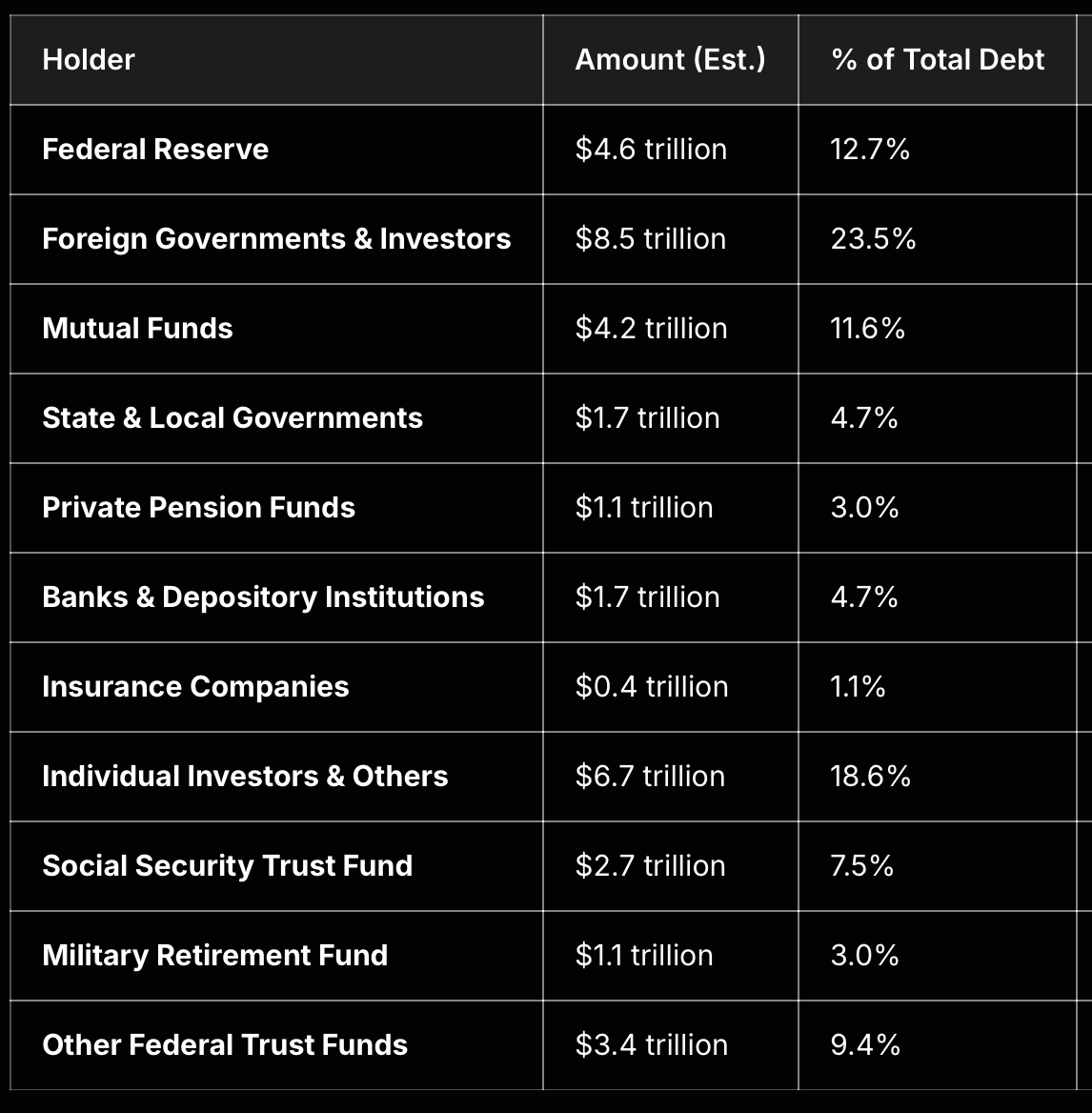
The products of the US Treasury are basically IOUs. Not unlike when you deposit your money at a bank and they give you interest at the account or access to services in return. In both cases, you have LOANED your money to someone else in expectation of something else in return.

Per AI a request to be terse on US Treasury debt products:


Treasury Bills (T-Bills)

  • Maturity: Short-term (4, 8, 13, 26, and 52 weeks).
  • Mechanism: Sold at a discount to face value; return is the difference between purchase price and par value. No periodic interest payments.

Treasury Notes (T-Notes)

  • Maturity: Intermediate-term (2, 3, 5, 7, and 10 years).
  • Mechanism: Fixed interest rate paid semi-annually. Face value returned at maturity.

Treasury Bonds (T-Bonds)

  • Maturity: Long-term (typically 20 or 30 years).
  • Mechanism: Fixed interest rate paid semi-annually. Face value returned at maturity.

Treasury Inflation-Protected Securities (TIPS)

  • Maturity: Fixed terms (usually 5, 10, or 30 years).
  • Mechanism: Principal adjusts based on the Consumer Price Index (CPI). Interest payments fluctuate based on the adjusted principal.

Savings Bonds

  • Series I: Non-marketable; combines a fixed rate and an inflation-adjusted rate.
  • Series EE: Non-marketable; guaranteed to double in value if held for 20 years.

These products are sold at auctions which the US Government regularly schedules. If demand is good, the effective interest rate the government pays will be low. If it’s bad, the effective rate will be high.

Why does the US Government get good trust? In the end, people buying believe they will be repaid and there’s nothing better to invest in (or they’re required to by law). Why wouldn’t they get trust? Investors aren’t happy with what they’re getting - pretty much like anything else.

As of 2026 source

Giving actionable advice needs to be done carefully, because advice that causes you to lose money can come with liability. That’s why almost no one wants to give specific advice.

If you cannot afford to be zeroed out if you are wrong, don’t buy it. It’s as simple as that. However, it’s also worth noting that historically, the US Dollar loses buying power over time, so just holding cash alone is a decision, too.

If you want free advice on what to specifically do, I suggest you just ask yourself this one simple question, “Would I rather have the thing I’m buying instead of the money, even though it’s possible the price of purchase may go up, down, or stay the same in the future?”

If the answer is yes, buy it, if no, look for something else.

To give some ideas, I have found for myself, buying skills (tools, time to practice, transportation, lessons, etc) are often very rewarding and worth it to me. Whether or not these skills have a known financial reward above their input costs is a separable question for me. Chris, like Robert Kiyosaki, would rather own the thing, than a promise to the thing. Wood, oil, metals, water, food, etc. He in fact says this over and over. It’s not code, but it’s also not advice to make a specific purchase.

As someone who isn’t that good with money, I know it can be frustrating to hear a lot of discussion about something that seems like you should be getting clearer on, but yet it comes very slowly.

I’ll share something that took a long time for me to figure out, even though Chris has said it many times. Money is a promise for a thing to be given in the future. This means money isn’t just cash. It’s the prediction that you will be repaid. In this sense, anything you do which accumulates the reasonable expectation that you will be repaid is also money. This might be building up a network of friends, investing time and effort in a healthier body, or any number of other abstract ideas where the reward is not today, but sometime later.

I’m working on an idea which I hope to use for helping job seekers find a job better than they do, now. If I can help just 100 people annually, it’s likely my value impact will be something like ~$45M/yr. I have no specific plan on how I will be paid. As long as I can build and execute fast enough, I still have an expectation that I will in fact be paid for it by someone in the value chain. In my smooth brain way of thinking, this is earning money.

In my experience some things are an information problem and some are not. What I mean is just knowing a fact can solve the entire issue. Eg. Your car won’t start. I tell you it’s out of gas.

I don’t think internalizing an understanding of money is one of those. It’s because it’s not a fact. It’s an intuition about repayment in the future when you give up something today to get it. I’m starting to learn that the only real way to do that is through practice and risking mistakes.

You specifically mentioned Fed interest rates. Most people mean the overnight rate. If I understand correctly, it’s a bit of a scam. They give the banks interest for sweeping money into the Fed’s control and back for like 1 minute and give them free interest. But this means the money was not tied up doing something else. It is assumed that the rate will “eventually” set the other longer term rates, and it sort of does. Think of it as the interest the bank gets for doing nothing else with the money.

One dummy to another, I hope this helped.

5 Likes