Originally published at: https://peakprosperity.com/stop-feeding-your-children-to-the-beast/
This year’s Peak Prosperity Annual Summit happened just one day after Charlie Kirk’s assassination. Many showed up with feelings of shock and helplessness. The shock was not just that Charlie had been murdered, but also how people on the left were reacting to it. Twitter feeds were clogged with grotesque posts of people joyously celebrating the murder of a husband and father who had done nothing more than exercise his supposedly inalienable freedom of speech. It was a gut-wrenching, sobering realization of just how far gone many on America’s political left had become. This led to the second feeling: helplessness. The gap between the left and right – which many had hoped could be repaired – had been suddenly laid bare as irreconcilable. If the left had progressed to the point of celebrating murder, how could we possibly bridge the divide and fix American culture? In the battleground for moral identity, there is simply too big a gap between “us” (defend to the death your right to speech) and “them” (murder you for your speech).
As shock and helplessness gave way to conversation and analysis, a striking realization came. Many of those disturbing public displays of celebration seemed to be coming from government employees, nurses, and teachers. One similarity between these professions is their service to the common good, a commitment to collective welfare over individual profit. Another is that these are credentialed, state-regulated professions built on standardized academic pipelines, sharing an “institutional DNA” often very distinct from private-sector professions. If that’s the case, what could any one of us do to effectively combat the institutionalized, collectivist thinking that inevitably leads to prioritizing the “greater good” over the sovereignty of the individual?
What can you do? More than you think – and it starts with refusing to institutionalize your children, refusing to feed the beast the one thing it cannot survive without: your children.
By “your children,” I also mean your grandchildren, your nieces and nephews, the kids next door, or any young lives you can touch. This revolution needs every single one of us.
The Enemy in Plain Sight
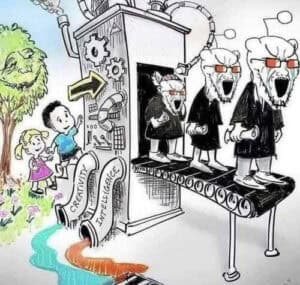
Perhaps Charlie Kirk understood all too well something most Americans don’t yet fully appreciate: that the enemy has been hiding in plain sight – our educational institutions.
Charlie Kirk focused his attention on our colleges and universities, but the foundation is laid far earlier in our public schools. The K-12 years are the most formative, during which children are slowly forged into “functional” adults. The question then becomes, “Whose definition of ‘functional’ is being used?” It certainly isn’t the parents’. As soon as a parent surrenders their child to the school system, they have delegated most of their child-rearing responsibilities to that system. Since the public school system is run by the government, this means the raising of children has been effectively outsourced to the government. Therefore, they will become “functional” based on the government’s definition of the word.
If you’re the conspiratorial type, you might think the government’s primary definition of “functional” is an obedient and/or productive worker. If you’re the cynical type, you might think they’ve never actually defined “functional,” and therefore they produce dysfunctional adults. And, if you’re the pessimistic type, you might have already figured out they’re simply producing dysfunctional, obedient adults.
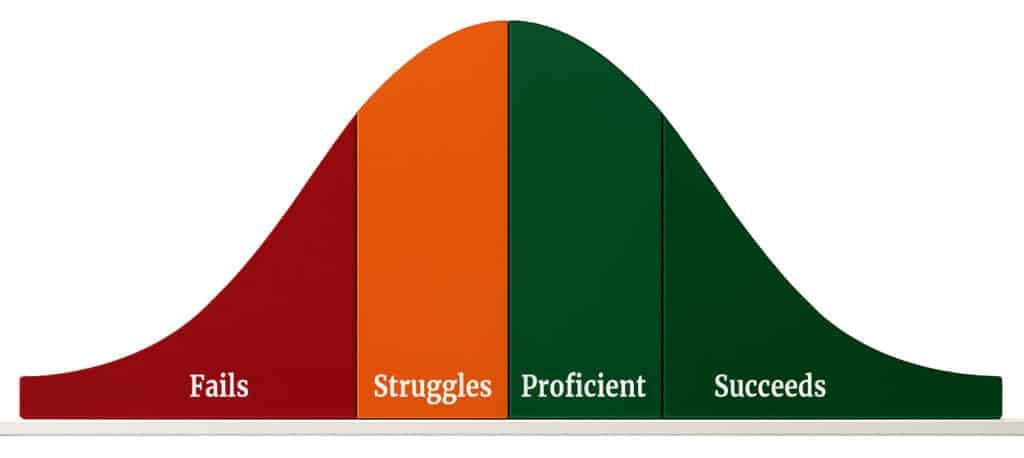
Of course, some students do great! This, of course, is the nature of bell curves. A small percentage of kids succeed, and the rest do not. That said, I would argue these kids do well despite the system, not because of the system.
Stop Letting the Government Raise Your Children
Still feeling helpless? Let’s fix that.
Charles Franklin Kettering once said, “A problem well-defined is a problem half-solved.” If we can agree that public schools are a problem, then you’re halfway to solving it. The first half of the solution is easy. Stated bluntly because of its importance: get your children out of the school system. It’s that simple. The first half of the solution is the “what,” and the second half of the solution is the “how.” This is the greater challenge, but it’s not as hard as you think. For now, pause right here and accept what needs to be done, so that you can start focusing on how.
You Win the Moment You Walk Away
What you will do is gain a huge increase in parenting time. Between the ages of 5 and 18, children will spend about 19,200 hours away from home based on average bell-to-bell and transportation times across 180 days per year. Out of 57,000 remaining waking hours during the K-12 years, that represents a minimum 34% increase in parenting time, assuming 100% of those hours are actually available to the parents. In reality, the percentage increase is significantly higher. Regardless, this has many implications:
- More time together: Families that spend more time together end up having better relationships with each other.
- No more one-size-fits-all: Multiple alternative options become available, allowing the child to be paired with the option that makes the most sense for them.
- Proper pacing: Children are able to go at the right pace for each subject, meaning they’re neither held back nor left behind.
- Interest-led: Parents can tailor content to the individual interests of the child, allowing for a high level of educational engagement.
- No homework: When not in a classroom setting, children learn concepts faster and typically do not need homework.
- Less wasted time: Less time lost to bus rides, hallway time, settling down the class, and giving out homework means more productive use of time.
- More control: The parent can choose what to include and exclude from their child’s education. Don’t want gender studies? No problem.
- Better socialization: Homeschool children are typically better socialized because they routinely interact with many walks of life (young people, old people, more mature, less mature, etc.). When in real life are you only surrounded by people your own age and maturity level?
- Less bullying: An increasingly big reason people homeschool is to avoid bullying and other bad influences that come with public schools
How to Pull Your Kids Out (It’s Easier Than You Think)
How you will do it is the tougher nut to crack, but it’s surprisingly not as hard as you might think. Once you decide you must remove your child from the school system, your mindset switches from “Why can’t I do this?” to “How do I do this?” Now, the second half of the solution comes more easily.
First, start by understanding your state or country’s homeschool laws. If in the U.S., visit the Homeschool Legal Defense Association (HSLDA) and look up your state. Their information on individual state requirements is free and always up to date. Also, consider joining once you get going. The HSLDA is to homeschoolers what the NRA is to gun owners. If you ever run into trouble with your local school district, their legal team will swoop in to the rescue.
Second, find local homeschoolers in your area. They are almost everywhere. Facebook is a great place to start, but you may also find regional organizations by searching the web. Connecting with a homeschooler will give you a person who can serve as local encouragement. More importantly, they will help you begin developing your social networks, which will be important for learning outside the home. Homeschoolers will often do their core learning at home but then participate in group activities (field trips, outings, learning groups, etc.).
Third, determine if there are any public resources available that you would like to use. Notwithstanding all the talk of how corrupt “the system” is, there are some state-level programs that can be quite empowering. Many states now have educational savings accounts (or something by a similar name) that make state funds available with minimal strings attached. For example, an attached string might be a required annual standardized assessment. The available programs, benefits, and obligations will vary by state.

Fourth, find basic core materials to get you started. This is going to vary wildly from family to family and is typically the most overwhelming part. There are so many options that it can feel impossible to sift, sort, and select what works for you and your child. Don’t let this stop you! You may spend days/weeks/months researching options until your hair is on fire, then finally pick something only to find out it doesn’t work for you. Don’t despair – there are plenty of buy/swap/sell groups for this sort of turnover. It may take some trial and error at first, but this is a good thing because it means you’re tailoring the program to exactly what your child needs. This would not happen in a public school. Eventually, you will hit your stride.
Start with the basics, especially when they’re young. For the young kids in my household (ages 5-8), we use Logic of English for literacy and Beast Academy for math. For the older kids (10+) we use Beast Academy and Art of Problem-Solving for math, Oak Meadow for English, history, and science, Rosetta Stone for foreign language, and Institute of Excellence in Writing for… well, writing. That said, don’t take these as prescriptive – it’s just to get the gears turning. Other families swear by Acellus Academy, local co-ops, Outschool, road-schooling, or game-schooling. Be open and adaptable, but keep it simple when you start, building and modifying as you gain experience.
Fifth, and most importantly, just do it. Don’t let perfect become the enemy of good. Even homeschoolers who do the bare minimum will often find their kids test out better than the public school average. Here are some common excuses to get out of the way:
- I won’t have time. It doesn’t take nearly as much time as you think. Piece it into your schedule wherever it makes sense for you. Make time as needed – it’s important.
- What about sports? Children can usually join sports teams at public schools even if not attending. You can also join private gyms. If you use educational savings accounts, those will typically pay for sports.
- I can’t teach [insert subject here]. If you can read, write, and do basic math, you can teach a young child. As older students, they will typically transition to independent learning, and you can also find programs that do the “teaching” for you. Regardless, nearly all good homeschool resources provide guidebooks for the parent. One-on-one with a parent is nearly always better than 15-on-one with a public school teacher.
- What about high school? Most people have the parental commitment level backwards. It’s the youngest kids who require the most time. Older kids are far more capable of being self-driven and independent learners. Your job is to figure out their interests and help align them with the best tool for how they like to learn.
- I want them to go to college. Good! This isn’t a problem and, in fact, many homeschoolers discover they are at a competitive advantage over public school students.
- I can’t afford it. It’s entirely possible to homeschool on a shoestring budget. It just means you may have to do extra work (i.e., print from PDFs instead of ordering books already printed, etc.). As mentioned, look into educational savings accounts, which can help tremendously.
Reclaim Child-Rearing, and Reclaim Our Culture
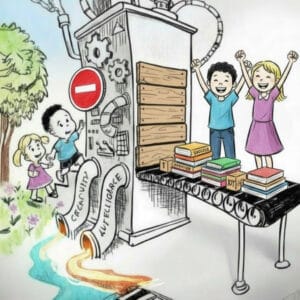
Here is the call to action: it’s time to reclaim the child-rearing of our future generations. If you’re a parent, take back and embrace your most sacred duty. Do not relinquish this to the government. If you’re a grandparent, aunt, uncle, etc., figure out how you can help enable homeschooling for your family.
You are not helpless. You may not be able to control what they do, but you can still control what you do. Make the decision today.
Many Americans view our government as a modern-day hydra, hopeless to defeat it because every chopped head grows two more. The belly of the beast is the public education system, and while it still feeds on the youth of our nation, the system will continue to destroy our life, liberty, and happiness until there are no more youth left to feed it. You are not helpless to stop it, and you are not alone. In 1999, only 1.7% of American students were homeschooled. In 2019, it moved to 3.0%. By 2024, it was 6.73%. That sounds a lot like an exponential curve. Join the revolution, save the children, and save our future.