Originally published at: https://peakprosperity.com/the-capron-the-case-for-a-local-currency/
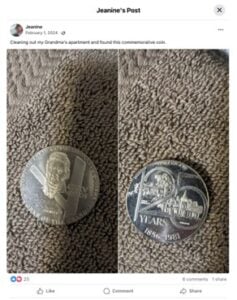
A Facebook user shares the rediscovery of a 40-year-old coin that may have spent most of its life in the back of a drawer. Over 12,000 of these tokens were produced.
I grew up in Paris, a small town at the confluence of the Grand and Nith rivers in Ontario, Canada. Known as “the Prettiest Little Town in Canada” at that time, it had a population of about 6,000 people in the early ’80s. It had been established 170 years earlier on gypsum deposits — used to make plaster of Paris — and on the rivers that lent themselves to several grist and textile mills.
In 1981, to celebrate the town’s 125th anniversary of incorporation, a one-dollar token was issued by the municipality. It featured an image of the town’s founder, Hiram Capron, along with his signature. The flipside of the “coin” displayed the Capron homestead, another town landmark known as Penmarvian, and a prominent “125.” It was also inscribed with: “Expires Sept. 18, 1981”. These municipal trade tokens were released in three versions: 12,000 pieces nickel-plated, 600 pieces gold-plated, and 52 in .999 silver. The tokens could be redeemed for a limited time at area businesses for one dollar in goods or services.
Decades passed, and the coins faded into Paris’ history. But in the last few years, I’ve noticed photos of these tokens showing up on Facebook groups with captions such as, “If you grew up in Paris, you remember!” Members of these groups frequently respond with an enthusiastic “I have one!”
I have one too, still housed in its dried-out plastic sleeve. I keep it in a drawer in my nightstand, and every time I look at it I’m inspired by its potential as a local currency.
Why We Need a Local Currency
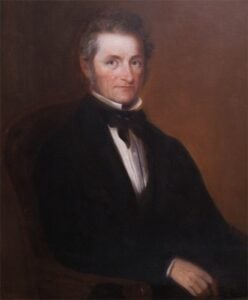
In 1822, Hiram “King” Capron immigrated to Upper Canada, where he built an iron furnace, a grist mill, and developed gypsum quarries.
As Peak Prosperity members, we should already have good reasons to want a system of local money. Our fiat currencies are victims of inflation, and their eventual collapse is built in. A local currency keeps wealth within the community and promotes local business and economic resilience. And with the looming threat of Central Bank Digital Currencies (CBDC), a decentralized currency offers an alternative, even if it’s limited in scope.
What I’ll propose here is a model for a local currency unit that I’ve dubbed the “Capron.” Hiram Capron was an industrious businessman from Vermont who founded our town. History records him as “a man so well loved he was good-humouredly known as ‘King Capron’ in his day.” I call it the Capron to avoid any legal issues related to anything called money, coins, or currency. It might be better to think of it as a coupon or gift certificate. In this case, as you’ll see, it’s a gift that keeps on giving.
Meet the Capron: A Silver-Backed Experiment
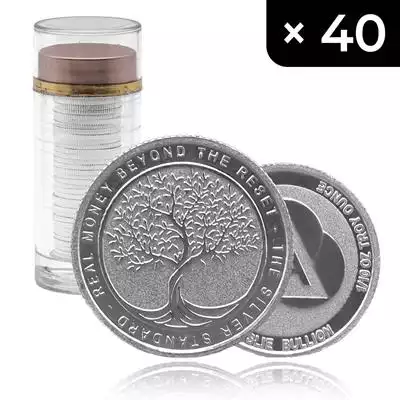
So, what is the Capron? Picture a one-ounce, .999-pure silver round. It’s sold by the Chamber of Commerce to businesses, who in turn sell it to their customers as a collectible. However, it’s a collectible that doubles as a gift certificate they can redeem at any participating business in town. They buy it for, say, $70, take it home, and put it in a drawer. But they can also spend it on $70 worth of goods or services – dinner at the local restaurant, a haircut, or a new pair of boots from the hardware store. No expiry date, no fine print.
And here’s the kicker: because it’s silver, its value could climb. If you leave this coupon in your drawer, you might wake up one day to find it’s got $100 worth of silver in it instead of $70. Unlike a gift certificate that loses value to inflation, the Capron holds its own. Silver’s been on an upward trajectory, and if you’ve got one tucked away, you might be able to cash it in for more than you paid. It’s a hedge against inflation, a collectible, and a way to support local businesses, all in one. Plus, it’s tangible — none of the digital nonsense that can get frozen or hacked. It’s a trading device that’s immune to digital currencies or government overreach. It has real, physical value.
How It Would Work
Getting the Capron off the ground would take a bit of hustle, and local business leaders would need to buy into the idea. First, you need someone to fund the minting. Each Capron costs under $7 to mint, so a batch of 1,000 pieces would run about $60,000-$70,000, depending on silver prices. Local investors could step up, supplying the silver on consignment in tranches to the Chamber of Commerce or Business Improvement Association (BIA). They’d earn a small premium on each sale, making it worth their investment.
The Chamber or BIA would sell Caprons to residents and visitors, pitching them as both collectibles and convertible currency. Local businesses can buy smaller batches to sell or use as promotions, getting the tokens into circulation. Chamber members can agree to accept Capron gift certificates at face value (e.g., $70) or negotiate based on silver’s market price. If a hardware store takes your Capron, the owner can use it at the local tea shop for $70 worth of Earl Grey. It’s universal within town, so if your favorite business closes, you can still spend it elsewhere.
Marketing is a breeze with the BIA on board. Picture posters in shop windows: “Spend a Capron, Support Our Town!” Tie it to the town’s history — in my case, Hiram Capron, the gypsum mines, and the rivers — and you’ve got a story that sells itself. For a town with an active BIA and a knack for community spirit, the Capron could become a point of pride, like those 1981 coins from Paris that still spark interest.
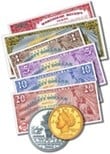 A local currency should never be referred to as a “dollar.” The Liberty Dollar was a private, precious metal-backed alternative currency created in 1998 by Bernard von NotHaus and the National Organization for the Repeal of the Federal Reserve Act and Internal Revenue Code (NORFED). In 2006, NORFED dissolved amid federal scrutiny. The U.S. government raided its Evansville, Indiana, headquarters in November 2007, seizing millions in assets and arresting von NotHaus for counterfeiting and related charges, citing the use of “dollar” markings as misleading and illegal. Von NotHaus was convicted in 2011, sentenced to probation and time served, and released in 2014. The program ended, with remaining coins treated as bullion rather than currency.
No plan’s perfect. What if a business goes bust? What if people hoard the Caprons? Is this even legal? Let’s break it down:
Legal Stuff — Don’t call it a coin, and you should be in the clear. Governments don’t tolerate private currencies, but a “coupon” or “token” is just a fancy gift certificate. A quick chat with a lawyer would help keep things legit.
Business Closures — If a shop shuts down, no worries — universal Caprons are redeemable at any participating business. Businesses can buy small batches to limit risk, and the BIA can ensure new shops join the program. And the Capron will always have intrinsic value as bullion.
Hoarding — With silver prices climbing, some folks might stash Caprons under the mattress like gold bars. Business owners could complain, “Our customers are hoarding them.” That’s okay. They’re growing in value as fiat currencies inflate. Holders have insurance they can use on a rainy day. But to keep them circulating, you nudge people to spend, maybe for a special anniversary dinner at a local restaurant. And if enough people hoard them, there’s good reason to mint more of them.
Public Confusion — To a layperson, this might sound like some kind of sketchy Ponzi scheme. Clear messaging: “A Capron is a silver-backed gift certificate that supports our businesses and grows in value.” Done.
Scalability — Start in town, but why stop there? Nearby municipalities could join, putting up signs saying, “We accept Caprons!” A broader local currency could emerge, but the Capron’s unique branding keeps it special and keeps it local.
So… skeptics assemble! Can you find holes in this plan? Let me know in the comments.
The Big Picture
Imagine this: You’re at your favorite local restaurant with a friend. You reach into your pocket and slide a gleaming Capron across the table to pay for dinner. The server smiles, recognizing the town’s silver symbol of pride. It’s not just payment — it’s a story, a piece of history, and a vote for your community’s future.
Tourists snatch them up as unique souvenirs, only to return years later to spend them, injecting fresh wealth into local shops. Businesses thrive as every Capron spent circulates within town, building a self-sustaining loop. And when the global financial system stumbles — as it inevitably will — it helps keep your community humming, shielded by tangible silver that no bank freeze or digital glitch can touch.
The Capron isn’t a world-changer on its own. It won’t topple fiat currencies or outmaneuver CBDCs. But it can rally a town around resilience, keeping wealth local, sidestepping corporate drain, and hedging against inflation with real metal. Remember those 1981 anniversary tokens from Paris? If they’d been silver-backed, buyers would’ve paid $12 each — and today, tucked in a drawer, they’d be worth $60 or more, laughing at decades of inflation.
What if your town launched its own Capron? It could spark a wave, towns across the country minting their own silver-backed coupons, weaving a grassroots safety net. It’s a throwback to money’s true roots: something you can hold, trust, and trade when everything else fails. It’s a middle finger to fiat’s fragility and a nod to the days when money meant something real, like silver or gold. This is the definition of money going back 5,000 years.
That’s the kind of covert revolution Peak Prosperity is built for. One silver round at a time, communities reclaim control. Could yours be one of them?