Both THEORIES are from MODELING. And we know how well that has been going.
70% comes from vaccine model of pandemic cure
20-25% Comes from the theory with model that diffuse population variables reduces the number that is needed for herd immunity. Superspreaders get out and infect everyone and as their contacts get sick and everybody else is social distancing, wearing masks, improving their health, etc
"
Individual variation in susceptibility or exposure to SARS-CoV-2 lowers the herd immunity threshold" https://www.medrxiv.org/content/10.1101/2020.04.27.20081893v1.full.pdf
As SARS-CoV-2 spreads, susceptible subpopulations are depleted causing the rate of new cases to decline.
Variation in individual susceptibility or exposure to infection exacerbates this effect.
Frailer individuals + more susceptible or more exposed, have higher probabilities of infection. Depleting the susceptible, intensifies the deceleration in occurrence of new cases.
Eventually, susceptible numbers become low enough to prevent epidemic growth or, in other words, herd immunity is attained.
It is currently believed that herd immunity to SARS-CoV-2 requires 60-70% of the population to be immune.
Variation in susceptibility or exposure to infection can reduce these estimates.
Eannao wrote:
The question of herd immunity is a critical one. Chris seems to still be of the opinion that 60-70% seroprevalence is needed, whereas DaveFairtex put forward a strong case that only 15-20% is needed. I'd love to know Chris's take on this theory and perhaps some discourse between the two great men on the topic!!
Here's an article on Zerohedge authored by Mike Whitney via The Unz Review: https://www.zerohedge.com/political/whitney-looks-sweden-was-right-after-all
The author is obviously in DaveFairtex's camp. He points out several examples to support his thesis. The one that struck a chord with me was about The Diamond Princess cruise ship. Remember that it had early infections and was a floating human scale Petri dish. In a way, it was the first real test of the virus' infective capabilities in a controlled environment. Yet, only about 17% of the passengers (and crew) became infected. (Remember that cruise liners cater to older people so the majority were older and theoretically more susceptible.) With air circulation systems sharing ventilation and pushing the virus into every cabin, why didn't more people get infected?
He also says that we shouldn't be concerned as much with increasing cases of Covid. Instead, we should be focusing on deaths due to Covid as that is a better barometer of the future trend. It's good for herd immunity if the number of cases increase. It shouldn't be as big of a deal if the death rate decreases. He said, "The trajectory of infections was mapped out long ago by UK epidemiologist and statistician, William Farr." Then he included this snippet from another source (bolding his.)
“Farr shows us that once peak infection has been reached then it will roughly follow the same symmetrical pattern on the downward slope. However, under testing and variations in testing regimes means we have no way of knowing when the peak of infections occurred. In this situation, we should use the data on deaths to predict the peak. There is a predicted time lag from infection to COVID deaths of approximately 21 to 28 days.Once peak deaths have been reached we should be working on the assumption that the infection has already started falling in the same progressive steps. …
Farr, also illustrated that those who are the most ‘mortal die out’, and in a pandemic are those in most need of shielding….(So, Farr saw the wisdom of the Swedish approach a full 180 years ago!)
In the midst of a pandemic, it is easy to forget Farr’s Law, and think the number infected will just keep rising, it will not. Just as quick as measures were introduced to prevent the spread of infection we need to recognize the point at which to open up society and also the special measures due to ‘density’ that require special considerations. But most of all we must remember the message Farr left us: what goes up must come down.”
(“COVID-19: William Farr’s way out of the Pandemic”, The Centre for Evidence-Based Medicine)
Viruses have to infect living creatures in order to survive and propagate. Once a living creature (with a functioning immune system) becomes immune to the virus, the virus has lost a potential host ... unless it can mutate enough to bypass the immune system. As such, we may be subject to continuous infections from mutated coronavirus. If the body doesn't recognize the virus, it is essentially a new infective agent - even though it is closely related to the original virus.
Will the original virus cause a second wave of infections once herd immunity has been established? That is highly doubtful. It is more likely that we'll get another wave from a copy of the original virus that has changed enough to be unrecognized by the immune system. Once about 15-20% of the herd have been subjected to this virus version, it too will need to mutate or die out.
Grover
I’ve never understood why people have such a hard time groking we cannot fix all risk. Fact: We get old. We get weak. We die. So what?
But if you are worried: what CAN we do? We can eat zero processed foods & lost of wild meat & organic vegs. We can have a waist-to-height ratio of 0.45. We can sleep 8+ hrs. We can get lots of sun. We can Squat/Bench Press/Deadlift 500#. We can run 2 miles in 15 min. And we can do all these even at 70 yo. This sure beats the hell out of stressing about a virus! Focus on health, and then quit living in fear.
In fact, we are now seeing convincing evidence of people contracting covid-19 more than once. If indeed the case, that suggests we may never be able to reach herd immunity.
This is where the "it's just the flu, bro" guys are dead right. It is just like the flu in that there will probably never be much of a vaccine, and the best defense is NOT to hole up or wear masks or panic. Rather, the best defense is to be VERY FIT and learn to live with this new reality. If it's not C19, it will be something else. And the best test? To make sure you are healthy enough that you NEVER get the flu, no matter how many hands you shake or which party you go to. YMMV.
I have considered that Covid 19 might be the new common cold. Since kids either don’t get it or don’t get sick from it, is it possible they are building immunity? Just like we all did when we were five to the existing cold viruses. Once the young people grow up will this be just another cold virus floating around.
I really want to know more about Ivermectin, which was in the previous video’s title yet only mentioned once. In this video, again, it was mentioned once, but no info at all. Please tell us what you know about Ivermectin! Thanks.
I 'd like to think so!
So I have adopted the protocol used in 3rd world countries for prophylaxis against parasitic infections: a yearly 150 mg dose of ivermectin (in my country drops from the on line vet store).
I still were a mask in crowded places, but am much more confident when someone bursts out coughing or suddenly collapses in front of me in the store (both have happened the past months).
There needs to be big time research into this method, as HCQ, ivermectin and Artemisia protocols could enable society to start function near normally.
I could be wrong of course, but feel I gained many more opportunities to function socially in a relatively smart way.
If I would be infected anyway, I would likely get only a very mild form. I was reluctant to take the ivermectin for a few months, because I was afraid it would prevent me from becoming immune. But since the antibodies don’t seem to last I worry about that less.
I might even continue this E 13.-/ year prophylaxis indefinitely for the rest of my life, as there are zero side effects. Of course I keep my D and zinc levels topped up and have a small home pharmacy with vitamins, minerals and herbal extracts like elder and artemisia annua and absinthum (still growing strong, young plants) .
Hi Chris:
The reinfection MAY be the relapse of the initial infection. More proper science needs to be done.
Some people are immune/near immune, others (increacing with age) less immune.
There are other pathways to immunity other than just antibodies, the cellular responce LEARNS from the antibody responce…(no need to waste energy forever producing antibodies.)
Keep topping up your immune system…this is the honey badger virus after all. It has a natural ability to attack nearly every system in our body.
A rushed virus cultured in animal tissue could make things worse…
ANTIBODIES are only part of our beautiful immune system…keep taking the vitamin C, especially if you have any health concerns.
Another study suggests that most cases could lose immunity within two or three months. It’s becoming likely that herd immunity can’t be reached or that a continual vaccine booster would be needed (if a vaccine is ever found).
As was true in January and February, we’re having to operate here in July on incomplete information concerning re-infections. Why? Simple numbers. If it takes 3-6 months for one’s antibodies to wane enough for re-infection to be ‘a thing’ AND someone has to be exposed again (when a low percentage of the population is infected at all), then we’re scraping around in a very shallow barrel of possible subjects.
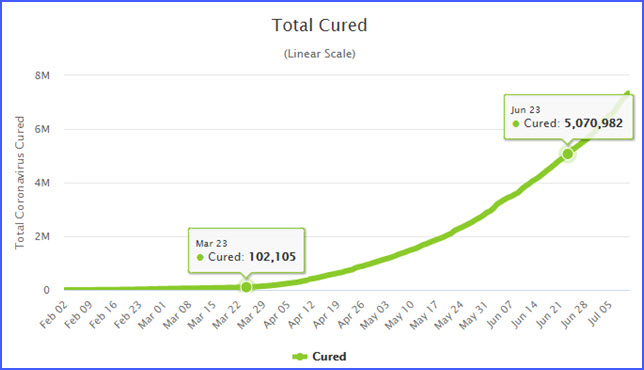
Consider that in March 23rd there were only 100k that had ‘recovered.’
No, there’s nothing special about March 23rd, I was just trying to find out when 100k people had recovered so we could start the clock for the pool of people who might be candidates for re-infection here ~4 months later.
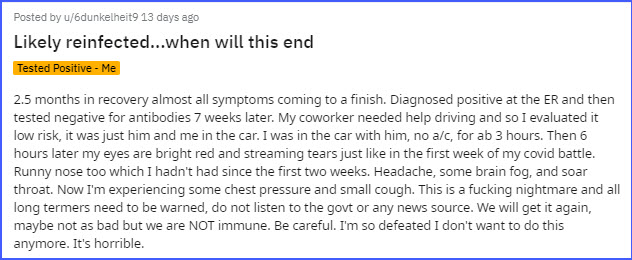
Presumably that 100k cohort is much less susceptible to being re-infected. First because some number of them have long(er) lasting immunity. Second because we might guess they’d be a bit more careful like this person:
That poor person! Took a rare chance and rolled snake eyes.
So if we estimate that anybody’s odds of being infected at all during a 4 month window are in the vicinity of 5% (Spain’s numbers), and that at least 50% of the formerly infected are immune (probably higher, but I’m being conservative) and that the formerly infected are a further 50% more careful than the average person, the math says 100k x 0.05 x 0.5 x 0.5 = 1250.
We’re going to be searching for a relatively small group of people here in the US.
Those stories are surprisingly easy to find. Here’s one, with testing.
My patient caught Covid-19 twice. So long to herd immunity hopes.
Emerging cases of Covid-19 reinfection suggest herd immunity is wishful thinking.
By D. Clay Ackerly Jul 12, 2020
“Wait. I can catch Covid twice?” my 50-year-old patient asked in disbelief. It was the beginning of July, and he had just tested positive for SARS-CoV-2, the virus that causes Covid-19, for a second time — three months after a previous infection.
While there’s still much we don’t understand about immunity to this new illness, a small but growing number of cases like his suggest the answer is “yes.”
Covid-19 may also be much worse the second time around. During his first infection, my patient experienced a mild cough and sore throat. His second infection, in contrast, was marked by a high fever, shortness of breath, and hypoxia, resulting in multiple trips to the hospital.
Recent reports and conversations with physician colleagues suggest my patient is not alone. Two patients in New Jersey, for instance, appear to have contracted Covid-19 a second time almost two months after fully recovering from their first infection. Daniel Griffin, a physician and researcher at Columbia in New York, recently described a case of presumed reinfection on the This Week in Virology podcast.
It is possible, but unlikely, that my patient had a single infection that lasted three months. Some Covid-19 patients (now dubbed “long haulers”) do appear to suffer persistent infections and symptoms.
My patient, however, cleared his infection — he had two negative PCR tests after his first infection — and felt healthy for nearly six weeks.
The emerging long-term complications of Covid-19, explained
I believe it is far more likely that my patient fully recovered from his first infection, then caught Covid-19 a second time after being exposed to a young adult family member with the virus. He was unable to get an antibody test after his first infection, so we do not know whether his immune system mounted an effective antibody response or not.
Regardless, the limited research so far on recovered Covid-19 patients shows that not all patients develop antibodies after infection. Some patients, and particularly those who never develop symptoms, mount an antibody response immediately after infection only to have it wane quickly afterward — an issue of increasing scientific concern.
What’s more, repeat infections in a short time period are a feature of many viruses, including other coronaviruses. So if some Covid-19 patients are getting reinfected after a second exposure, it would not be particularly unusual.
In general, the unknowns of immune responses to SARS-CoV-2 currently outweigh the knowns. We do not know how much immunity to expect once someone is infected with the virus, we do not know how long that immunity may last, and we do not know how many antibodies are needed to mount an effective response. And although there is some hope regarding cellular immunity (including T-cell responses) in the absence of a durable antibody response, the early evidence of reinfections puts the effectiveness of these immune responses in question as well.
Also troubling is that my patient’s case, and others like his, may dim the hope for natural herd immunity. Herd immunity depends on the theory that our immune systems, once exposed to a pathogen, will collectively protect us as a community from reinfection and further spread.
So, yes, a second infection is 'a thing.'
However I am, again, operating on thin information and making my best assessment of what's available to analyze. Such is the nature of the honey badger virus.
One of these days I'll get something big wrong, but so far my ability to parse the early data has been accurate.
The reason this is so important is because of the fact that my country has gone bonkers and is unable to process the logic behind masks or 'endure' a proper lockdown period. You know, gray hair roots, and the need to attend a buffet or a Disney ride and all that.
Which means herd immunity is the only way out of this nightmare. And reinfections imply that herd immunity isn't going to be 'a thing' which then implies that we either live with the nightmare possibility of being laid out by a super flu that can whollop us 2 times per year with the potential for life-long damage, or we actually go hard and lockdown for long enough to beat this thing (like China, Taiwan, Hong Kong, and so many other countries have actually done).
Either way, the hit to the economy hasn't really begun. If what I've laid out for reinfections is actually 'a thing.' Which I think it is.
I just had this conversation with a family member. He said (hopefully) that we may have immunity from having had a cold. I told him anything and I mean anything we say about this thing right now is largely speculation.
" get back with me in a year or two and we will know a lot more"
People just do not realize we are in the 2nd inning of a game that just might go into extra innings.
As far as your country going bonkers it should be remembered that Amerikaans are the only people on the planet who will stand in front of a microwave and scream at it because it takes too long.
We probably are just starting out with this SC2 thing. Then again, HIV used to be a death sentence back in the 1980s. It isn’t anymore. Neither will SC2 be, for the most part, a year or so down the road. We have so many hints about great treatments. They will - probably - be well known by then. Standard of care will nail it quickly in the outpatient setting. “COVID kits” might sell for $50.
Definitely, avoid getting it now if you have risk; it also looks thoroughly beatable if you treat it early. Terrain matters. It is too soon to tell if herd immunity (which I believe is 10-20%, depending on the population configuration) lasts forever, or just for this iteration.
Even in this first year of cluelessness, SC2 isn’t cancer, and its not heart disease. And in a year or two, it will drop below the radar because we’ll know how to treat it by then. “Oh yeah, that was bad initially. I remember - everyone was scared. And the news even told us that hydroxycholoroquine would kill you!”
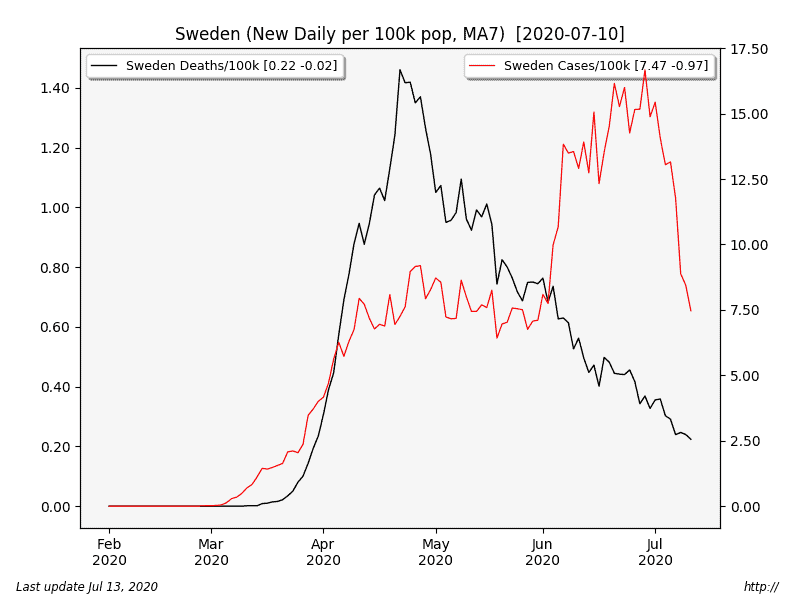
And FWIW, “big data” tells us that reinfections aren’t the standard thing. If it were common, we wouldn’t have declining cases and deaths in so many places. Especially Sweden. Can anyone tell me why the decline in both cases and especially deaths if “reinfections” were common? Especially with such a high R0?
The efforts in Bangladesh, India, Madagascar and some Latin countries might lead to some near fool proof prophylaxis protocols: Off- patent drugs, complemented with some common OTC supplements or some traditional as well as new innovative herbal preparations. This goes beyond preparing the terrain; if the rumors are even slightly true, protocols could be developed which might lower the R-0, the morbidity, and the mortality in a spectacular fashion!
If it holds true, completely new models or scenarios would have to be written, and policy as well.
I think lots of research needs to be dedicated to evaluate the possibility of this pseudo-vax/ ‘immunity’. Even if it would be only partial, it still looks like a silver bullet to me.
Chris,
I loved this video and especially that you interviewed the husband (Adam). I don’t trust the media at all but I trust you because I know how throughly you research everything. You have also been spot on with everything right along and what you are saying just makes sense. If you think about basic PPE from a medical perspective, masks for everyone is a no brainer. Pretty straight forward.
At any rate, it was very interesting to see the interview - you could see the pain in his eyes and worry on his face. In my opinion, Cheri was the picture of health before getting infected, so the fact that she’s had such a horrible time with the disease is very scary. They will definitely be in my prayers!
Thanks again for shaking it up… I think we need to see the human side sometimes and not just the data all the time.
thanks!
danielle
Yes, more information is coming out about second infections. But also, everyday more information in the alternative medical media about prevention and treatment is coming out. Dr. Mercola, Dr. Rhonda Patrick, Medcram, etc.
Are any of these second infection patients doing anything to boost their immune systems or treat the infection? Nothing is ever mentioned. It would even be nice if their doctors would even get a clue and treat them with HCQ and zinc, for gosh sakes. I bet these people are just following their old bad lifestyles, eating bad fats and carbs, etc. And not addressing their deficiencies of Zn, vitamin C, vitamin D, glutathion, omega 3 fats, etc.
If you continue to repeat the same habits that lead to you getting infected, the first time, then expect a different outcome, you are a fool.
I see the WHO (Dr. Tedros) has just been quoted: “If basics are not followed, the only way this pandemic is going to go, it is going to get worse and worse and worse. But it does not have to be this way.”
That last phrase - where have I heard that before? Take a bow Chris.
Good Morning to All,
I am most grateful for all of PP videos and articles. To me, both hard evidence and story - telling/anecdotal are important. Story telling is even perhaps inherent within humanity.
The science based information is wonderful as that is what is so lacking in the general arena, and also what is needed to make a case to others, for writing an article as references and so on. Thus it is absolutely vital. (Assuming the numbers are generated with integrity based on logic etc otherwise it is garbage in-garbage out.)
To me, the anecdotal, story telling- showing what happens to real people with faces, speaks to my heart and mind together simultaneously.
It also makes me more fully realize that this can happen to me, to my family to my friends too. Hits closer to home for me anyhow. Get’s me moving faster too. Seems somehow more real.
Of all the things I have read and viewed over months, the things which haunt me are a UK nurse crying on video, the young Chinese man telling us how serious it all was at the outset, risking his life if caught perhaps, the Italian hospital wards when it was terrible there and the other videos from real people.
All the other graphs and numbers even though I know beyond a shadow of a doubt that they are representing critical information in the best way possible, seem way down in the recesses of my mind jumbled together like overcooked spaghetti.
Thank you.
I want to comment on how good Chris’ interview was. If only we had a news media that could interview people like this!
I learned more about how C19 is effecting people in the real world from this interview than all the other news media combined. A really skilled interview. Thanks again.