AI's Energy and Resource Crisis with the Rebel Capitalist

Originally published at: https://peakprosperity.com/ais-energy-and-resource-crisis-with-the-rebel-capitalist/

I’m thrilled to share a recent podcast discussion with my friend George Gammon, otherwise known as the Rebel Capitalist. We dove deep into the explosive growth of AI and its massive resource demands, particularly energy and water, which I believe are not getting the attention they deserve at higher levels. As a resource guy, I’m always following the numbers, and what I see with AI is staggering. Data centers are consuming 2 to 5 gigawatts of power—Denver, by comparison, is a 1-gigawatt city. These Nvidia H100 and H200 chipsets are energy hogs, turning electricity into heat and, well, cute cat pictures on skates. But it’s not just energy; cooling these chips often requires vast amounts of pure water—Texas AI supercenters are on track to use 49 billion gallons this year, in a state already struggling with water scarcity.

I’m concerned about the exponential rise in energy and water needs for AI. We’re not ready for this demand. The U.S. grid can’t handle it, and while natural gas is the immediate go-to, production has been flat for over 16 months, and we’re exporting LNG while facing new domestic demands. Nuclear, especially small modular reactors, could be a solution, but regulatory hurdles and labor shortages mean it’s years away—maybe a decade. Meanwhile, China’s energy output has surged to 10,000 terawatt hours, 150% more than ours, with a clear plan involving coal, hydro, and nuclear. We lack such a strategy, and our flat energy growth since 2000 puts us at a disadvantage.

There’s a real risk of conflict between AI’s needs and human needs. I was shocked to learn of language in a recent bill—thankfully removed—that would have prioritized AI over people for energy and water, framing it as a national security issue. If we don’t increase energy capacity, we could face rolling blackouts or rationing, especially if AI is deemed critical to compete with China. Our shale oil boom, once hailed as “Saudi America,” is peaking, with production down to just two counties in New Mexico. The EIA’s 2025 outlook shows flat total energy production through 2050, a stark contrast to China’s trajectory.

Prices for energy and resources like copper are likely to rise—natural gas could jump from $3 to $12 per therm to incentivize drilling, but that shortens reserve lifespans. Higher energy costs will ripple through the economy, impacting fertilizer, plastics, and manufacturing, contributing to inflation the Fed can’t control with rates. I worry this could trigger economic contraction, lowering standards of living as a release valve if we can’t meet demand. AI might take jobs without clear economic returns, and I’m skeptical about its promised prosperity beyond benefiting chip makers and data center operators.

For preparation, I suggest stress-testing your plans against 5-7% inflation and investing in personal energy efficiency—insulate your home, consider solar, live smaller. Commodities are worth watching, though timing is key. For a Plan B, look at energy and food-self-sufficient countries like Argentina with its Vaca Muerta shale play. I’m passionate about ensuring prosperity, but we’re on a shaky path without a coherent energy strategy.

Let’s keep this conversation going—our future depends on it.
9 Likes

This was great discussion. I cant say George push back on any topic, but both fill “gaps” or provide more nuanced viewpoints in various topics.

4 Likes

About water topic. I havent seen Chris handle US water reservoir status. That has similar trajectory as shale oil and datacenters will escalate that problem. Mostly agriculture has overused it before along industries.
With increasing populations this is bad prospect.

3 Likes

Great discussion. Really enjoyed it.

1 Like

I’m thrilled that we’re finally having conversations about how energy and economics and resources all need to be considered together.

6 Likes

A little duck duck go research:

A medium-sized data center uses up to 300k gallons of water per day.

A large one: up to 5 million gal/ day

Texas water consumption by year, average daily consumption in million gallons:

2011 - 2.123
2010 - 1.932
2009 - 1.936
2008 - 1.923
2007 - 1.759

The Search.ai has 2011 as the most recent data for some reason.

Can this be right? I don’t see how a data center could use 2x as much water as the state of Texas… I just can’t picture the infrastructure needed for that, leaving aside the math.

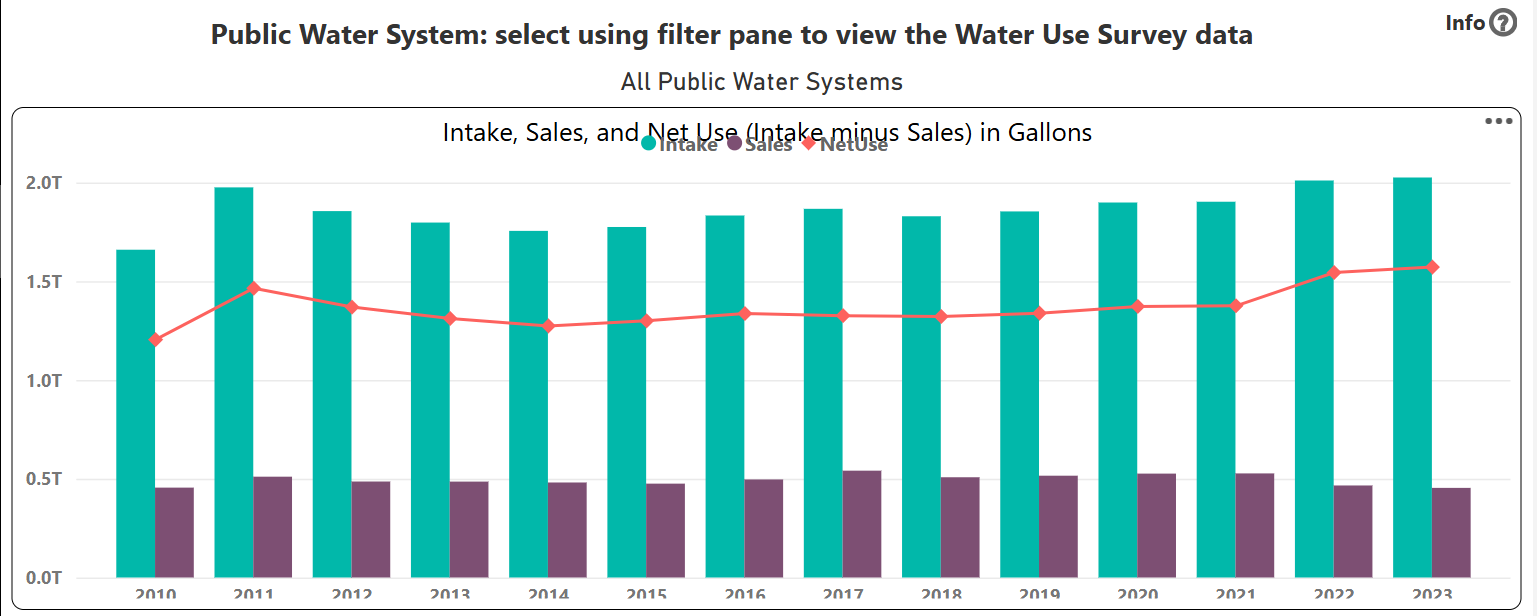
That’s not quite right. Those numbers match mine, but the correct interpretation is in trillions of gallons (not millions).

Here’s a chart from the TX water board:

Ah! That makes sense.

5M / 2T = 2.5E-6 which is <<1% of state use.

1% of water use would be 4,000 large data centers

One large multinational with offices and factories throughout the USA has an energy division that is hiring engineers as quickly as they can. They plan to ramp up the manufactory of large transformers and related grid needed items as fast as they can. They cannot meet demand. Both AC and HVDC are being ramped up.

HVDC transmission loses less than AC and is useful for linking grids at different frequencies and that are not synched.

3 Likes

Interesting. Can you name it? I’d like to watch the progress. Thx.

1 Like

Great dialogue
So lots of PP talk on energy and AI. Now throw in water like we need another problem.
Thursday interviews with Paul hit on the everything bubble. So what to do ?
How do we get conversations going on investment actions after the easy ones:paying down debt, getting out of city, planting a garden, putting $$ into means of production on the homestead, irresponsibility long certain metals. after all coming out the other side with principal in tact may look like a BIG win in hindsight.

What do old PP non traders do? What is the investment to make that just is not that complicated and will not get slammed when SHTF? Lots to be said on gold and silver.
I subscribe to Uranium Insider and they recommend a portfolio of U stocks. U is not for the faint of heart. In the last 18 -24 months have seen +30 to -30% rises and falls - the upside seems tremendous but with a stock market that is in a huge bubble looking for a pin i just have to wonder can even these U stocks hold up? Would other energy stocks be better or help round out the action steps?
Bonner private research has EOP as their trade of the decade a buy and hold

1 Like

Did you ever wonder just how much power a single query of ChatGPT consumes?

TLDR: I just read in an industry rag of relevance to my line of work the answer. Turns out for the new GPT 5.0, the estimate is roughly equivalent to very bright LED bulb running for an entire hour (roughly 18 watt-hours) - that’s for a single query! And OpenAI previously (some undefined time ago) reported handling 2.5 Billion queries per day. By now it could be 5-10 Billion per day, I might surmise.

“Each GPT-5 query consumes roughly 8.6 times the electricity required by GPT-4” - this makes me ask myself all sorts of nefarious thoughts about motivations and such. As an engineer, I cannot possibly fathom releasing a new product that’s 8.6x as inefficient as the prior one, and claiming “progress!” with a straight face.

Source (Digitimes citing others): OpenAI's GPT-5 consumes over eight times the power of GPT-4, researchers estimate

Article in full (since you need to setup and use a free login to view it, and I want to save you the hassle):

OpenAI’s GPT-5 consumes over eight times the power of GPT-4, researchers estimate

Ollie Chang, Taipei; Sherri Wang, DIGITIMES AsiaMonday 18 August 20250

Credit: AFP

OpenAI’s latest flagship model, GPT-5, delivers markedly stronger reasoning performance than its predecessor—but at a sharply higher environmental cost. According to a new analysis, each GPT-5 query consumes roughly 8.6 times the electricity required by GPT-4.

Power hunger jumps with advanced capabilities

Citing data from Tom’s Hardware and The Guardian, the University of Rhode Island’s AI Lab estimates that a single GPT-5 query uses an average of 18.35 watt-hours, compared with just 2.12 watt-hours for GPT-4. That puts GPT-5’s energy draw behind only OpenAI’s o3 reasoning model and China’s DeepSeek R1 in the ranking of most power-hungry AI systems.

Shaolei Ren, a professor at the University of California, Riverside, says GPT-5’s “thinking mode,” which processes tasks for longer periods, can use five to ten times more power than a standard response. Its capacity to handle text along with images and video further increases the model’s already substantial energy demands.

Estimates based on industry benchmarks

OpenAI has not disclosed deployment specifics. The URI team derived its estimates by multiplying average response times by hardware power consumption, drawing on configurations typical of Nvidia DGX H100 or H200 systems, Microsoft Azure data center efficiency metrics, and factors such as Power Usage Effectiveness (PUE), Water Usage Effectiveness (WUE), and Carbon Intensity Factors (CIF). The researchers cautioned that their calculations involve multiple assumptions and that actual consumption may vary.

Environmental impact scales with usage

OpenAI previously told Axios that ChatGPT handles up to 2.5 billion queries each day. If every one of those queries were processed by GPT-5, researchers estimate daily energy use could hit 45 gigawatt-hours, which is about the same as the output of two to three nuclear power plants and enough to supply electricity to 1.5 million US homes for a day.

Researchers warn that GPT-5’s heavy power consumption for complex tasks could drive up demand at AI data centers, increasing costs as climate policies tighten in parts of the US. Environmental scholars told The Verge that AI has two things in common with Bitcoin mining: a constant push to scale up and a lack of transparency over actual energy use and carbon emissions.

Industry disputes over transparency

OpenAI CEO Sam Altman wrote in a June 2024 blog post that ChatGPT’s average per-query energy use was only 0.34 watt-hours, roughly equal to an oven running for one second or a low-energy light bulb glowing for a few minutes. The claim drew skepticism from industry experts, and Wired reported that critics questioned whether Altman’s figure accounted for image generation, model training, or the energy needed for server cooling, raising doubts about its reliability.

Article edited by Jerry Chen

1 Like

It seems the plan to use AI to run the world and control everybody may not be successful, based on the resource requirements. I take that as very good news.

Our world runs beautifully on a natural power source which takes no effort from us. Sun grows food, we eat food, we have metabolic energy to do work. We use our big brains to make agricultural multipliers to production. Even if we don’t get into petrochemical advancements, the Roman Empire was fairly impressive just using sun-based human efforts.

AI does not fit within the natural resource budget on our planet, so it will likely be a flop at large scale use. We may have a short run of it concentrated in a few places, but it won’t last on a global scale because it simply can’t be fed enough to keep it alive.

5 Likes

Of Roman empire, was there toxic building materials and food products? I remember wine bottle having lead or something but they had tips and guides how to avoid that as refining methods at the time couldnt remove it. But mostly I mean construction material in buildings and devices all around us: especially construction has seen constant “innovation” of asbestos, then every year new materials simply for cost reasons but health in decades long living in house are unknown. Poor people existed 2000 years ago, who couldnt order architect designed fancy buildings, but other than that I dont know.

Generally they knew more about substances(no doubt fully city dweller lawer/clerk knew as little as now though as it wasnt relevant for their job and direct survival) than we do as companies want us just to trust sticker on drug bottle or food item and not discuss it.
Im more referring to easy - hard framework: have to first buy a book, then read it, and hope it was good one to gather intel like this.
Maybe this AI urge is very similar as medieval times: centralized power needs powerful tools. Resource scarcity and wasted money was always result. Humans in general dont need it but central power demands it to subjugate people, more powerful system for more people and 100mn+ is already giant, let alone billions now.

Cost benefit analysis then becomes, if we have coarse energy sources, is extremely high end electronics needed for AI systems worth the capital and effort… that resource is out of global food (production+supply) needing also immense amount of workforce globally… so at some point “capital”(money resource allocation roughly pointing our “value system” of priorities) has to make a choice and draw boundary(this cold war and post 90s mentality has been that energy is basicly abundantly free, dirt cheap, so no worry… thus electronics as societal luxury surplus).

1 Like

Yeah, but… We may be running out of time.

https://x.com/milesdeutscher/status/2021487637299855540?s=20

Agentic AI is going to be so much fun. Let’s empower AI to interact with the physical world.

https://x.com/ControlAI/status/2021303480116199523

2 Likes

The math showing future shortfalls in the availability of energy-related resources seems always to assume that the population remains about the same or goes up slightly. You don’t suppose the psychopathic billionaires in charge have a plan that makes a different assumption? They’ve already indicated their preference for AI over humans. And COVID showed their willingness to kill masses of people without apparent regret. What an awful possibility.

1 Like

I agree. I think population decline has already started. The demographic charts show us topping out some time in the future, but in hindsight, i think we will find the top has already happened and we’re on the downslope now. They don’t want people to know that and react to it, they want us far along in the decline before we’re allowed to notice it, too late to do anything about it. Just my opinion.

1 Like

Great insight! Wasn’t IBM founded in WWII, to keep track of the prisoners of the Nazis in the concentration camps?

We never needed super computers until we wanted to control people on a large scale. Before that, taxation was sufficient.

IBM was founded earlier… lots of companies, also IBM, did business whole of 1930s with (nazi) Germany. They just happened to have convenient tech that regime needed. Paper archives do almost as well as computers at the time so I cant say what was biggest benefit, other than german precise “engineering” (technocracy) to keep records(basicly do inventory of your things, just labor and will to do it).

For 20mn+ population of course calculations are easier with computer(more like typewriter) once those were recorded on special punch cards.
So Id say same as with DOGE today: if your data is good(it rarely is with government), then it can give query from data fast. Before that all “developed” countries had some sort of church records (on paper, still even today good enough to study various things 500 years back).

First even remotely current version of computer was built in 1940s for WW2 purposes.

I assume that most of this can be recycled… some may be lost in cooling towers I suppose.