Creak! Pop! This Thing’s Gonna Blow!

Originally published at: https://peakprosperity.com/creak-pop-this-things-gonna-blow/

Every bubble is in search of a pin. The current stock market bubble isn’t just magnificent; it is without equal in the historical record.

As I like to say, plan accordingly.

Bubbles exist when asset prices rise beyond what incomes can sustain. This dynamic could not possibly be more evident than in this observation:

(Source)

A trillion of CapEx (Capital Expenditures) in a technology base that has a 5-7 year depreciation schedule, indicative of a short useful lifespan, with an income stream of $20 billion, indicating it would take 50 years to reach $1 trillion in revenues, to say nothing of profits?

That fits the definition of a bubble as cleanly as one could possibly hope for (or fear as the case may be).

Meanwhile, the recession indicators continue to mount:

Unless this time is different, a recession has already begun, according to the LEI. It just hasn’t yet been officially recognized.

Supporting the leading indicator series is this chart of existing homes for sale nearing the levels seen right before the GFC kicked off:

Of course, existing homes are wildly unaffordable, but what could help would be if long-term interest rates came down. On that front, the creaking and popping noises are reaching something of a crescendo. Japan’s bond market seems out of control, and yields are screaming higher:

The same is happening in Germany, France, the UK, and to a lesser extent, the US. But even here, the long bonds are not coming down in yield as Trump might have hoped as a result of having strong-armed the Fed into lowering short-term rates at the upcoming September FOMC meeting.

So, I’m not expecting much to change in the US real estate situation any time soon. That’s a big ship with enormous inertia, and right now its bow is swinging toward falling prices and lower sales.

But all of that is merely a backdrop for the most magnificent bubble of our times, captured neatly in this one chart of NVDA’s stock price:

I asked Paul via text what his recollection was of why the bubble finally burst in 2000. He offered that it was a Broadcom earnings call where there wasn’t any particularly bad news, just a slight downward inflection to future earnings potential.

Pop!

That’s all it took.

NVDA just had an earnings call last night (after the time I recorded this Finance U episode) and the earnings were fine. But there was a slight hesitation among observers to believing NVDA’s CEO and his wildly optimistic projections:

(Source)

Obviously, NVDA is in a bubble, and obviously, someday that bubble bursts. Is that day today? Beats me, but I do know it’s coming, and my wish is for everyone to have a risk-managed approach to protecting their wealth when it finally bursts.

But that’s a vain wish because here’s the other bubble rule that’s both invisible and inviolable; It’s impossible for a majority of people to avoid massive losses.

It’s not a question of perception and action; it’s simply math. The true underlying value of the bubble’s assets is a fraction of what they trade for at the peak. That fraction represents what remains to be divvied up among those who own the bubble’s assets. By definition, there’s no way for a majority to come out whole.

Which means there’s a first-mover advantage that’s exceptionally large. Again, that advantage will belong to those with the ability to know a bubble when they see one, a nimble approach to investing, and with a good strategy in place before the bubble begins to unwind.

To schedule your first meeting with Paul and/or his amazing team – by far the best I’ve ever encountered – please click this link, fill out the simple form, and then respond promptly to their outreach to schedule your no-obligation consultation and portfolio review.


FINANCIAL DISCLAIMER. PEAK PROSPERITY, LLC, AND PEAK FINANCIAL INVESTING ARE NOT ENGAGED IN RENDERING LEGAL, TAX, OR FINANCIAL ADVICE OR SERVICES VIA THIS WEBSITE. NEITHER PEAK PROSPERITY, LLC NOR PEAK FINANCIAL INVESTING ARE FINANCIAL PLANNERS, BROKERS, OR TAX ADVISORS. Their websites are intended only to assist you in your financial education. Your personal financial situation is unique, and any information and advice obtained through this website may not be appropriate for your situation. Accordingly, before making any final decisions or implementing any financial strategy, you should consider obtaining additional information and advice from your accountant or other financial advisers who are fully aware of your individual circumstances.
12 Likes

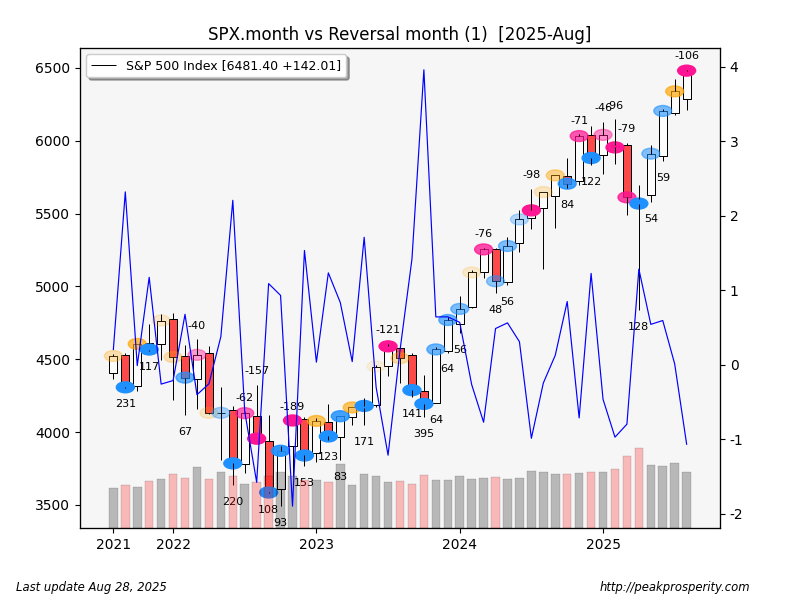
Two observations.

First, my new experimental SPX monthly model is giving off a reversal signal. It just looks one month forward. A signal of -106 is pretty strongly bearish. (the 2 and 3 month forward versions - which are less accurate - are also bearish).

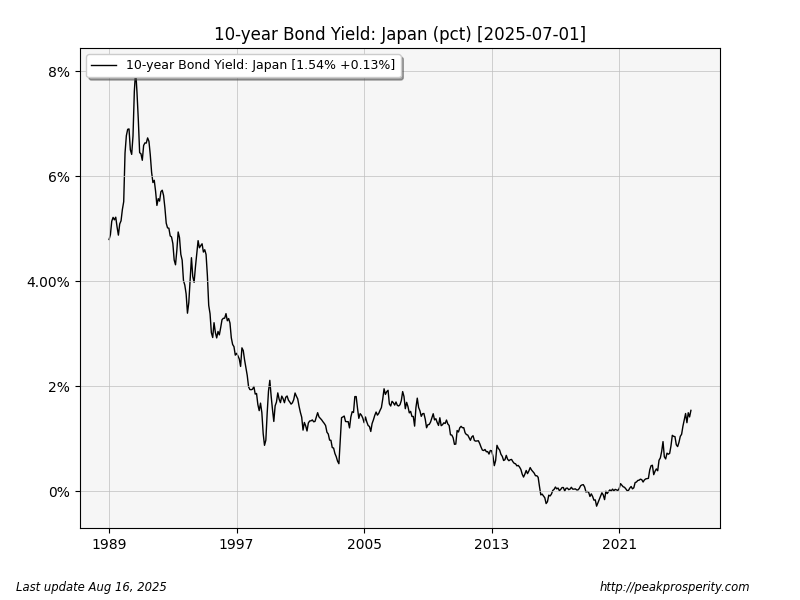
Second, I have this ancient monthly series from FRED, called IRLTLT01JPM156N. Looking back to 1989, the Japanese 10 year isn’t at an all time high yield - but it is definitely a 15 year high, and the trend does look like it is slowly blowing up. So far, JPY/USD isn’t breaking out (2024 high=161, now=147) - but that’s something to watch.

I’ve noticed that sometimes the folks on twitter post charts that exaggerate what’s going on, possibly to gain clicks and likes.

Just two data points. I really wish I had that leading economic indicator series…

2 Likes

I am so glad I listened to you and put in solar with batteries and added additional capacity this year. I got it, Energy is the master resource and while solar didn’t look like a great investment financially, with the rise in energy prices I think this will prove to be a great financial investment as well as great piece of mind for the future.

11 Likes

The end of a 40-year bull run in bonds says we can’t ignore long term trends.

Lots of cycles at play at once, with different periods. The long term cycles are big drivers and most folks still haven’t figured out interest rates are (overall long term) heading up, and commodities are waaaay dirt cheap relative to stocks.

Retail lives and dies by recency bias.

3 Likes

I also added solar and had charger put in for an electric car 3 years ago expecting gas prices to go to $10
I sleep better

5 Likes

Me too. Having ZERO experience with solar, I bought a used system for less than an ounce of gold. I may have still paid way too much but when I check prices for new systems that have the same stuff and same kwH rating, they cost eight ounces of gold or more. I bought 51 used panels (told they were 25 year panels used for ten years); two inverters; two chargers; eight batteries, and various other related things. I’m getting smarter but still have to mount the panels on the roof, get the ATS and wire everything up. Hopefully I won’t kill myself. But I got it all figuring the solar power would keep the freezers full of beef going better than a shiny disc when energy costs are unaffordable or utility power is unobtainable. I live very rural where it’s the code of the west in terms of building inspections. I do follow UBC’s when I’m doing my own work.

I’m glad I listened to Chris’ energy videos as well.

8 Likes

We have a potluck dinner group that meets every 6 weeks or so. One of the participants is a retired electrical engineer and he has offered to help us design solar backup for our property.

I would encourage people who don’t have experience in this to find someone who does and perhaps barter with them to exchange goods for expertise.

6 Likes

FYI banks do not create money they create credit. Credit seems like money but it is not, it is a figment of the imagination & can disappear just as quickly as it appeared.

4 Likes

I do listen to these weekly financial podcasts, though some of the terminology is over my head. They are interesting, but it just keeps happening that I come away profoundly confused.

We know that the monetary system itself is rigged, and that powerful forces are working to steal as much of the value of our labor, skills creativity and savings until they break the already-mathematically-broken system. Also, they are changing the rules to enable a sharp escalation in control over how we use “our” money. So how does it make sense to talk about retirement in this way?

It seems a certainty that long before I hit my eighties in fifteen years or so, there will be so many other claims on what I took to be mine as to be a different game entirely.

Though I have thoroughgoing working class conditioning re: work ethic, supporting oneself and saving, I am motivated to turn as much as my savings into tools and capacities built into my homestead as I can, simply so that that value is harder to steal from me than money in investments. It is a battle to not save my savings. I feel horrible spending them down, but so far, I can’t see another option. OK, metals and preps of course, but after that?

How is it sensical to plan for a retirement in a way that assumes the system will continue to function (i.e., maintain the value of my holdings, and allow me access to them) while we note weekly evidence that it’s already a broken sham? Am I wrong?

Anyway, having to have two million dollars to feel “safe” is already another realm than I inhabit… Never going to hit a million, and not feeling safe with money even just in the bank, let alone the markets.

Susan

9 Likes

Susan,
How about AGNC? You can call them directly, register your securities with Computershare, don’t need a brokerage account, can start with $250 at $50/month, can transfer funds in an IRA, etc.

I invested $62,500, starting in 2022 - no more than $10,000 a month - money I got through an inheritance. The shares were worth $77,000+ with dividends paying $971/month, as of July. I reinvest the dividends. In not too long, it should cover the condo fee. A good illustration of Chris’ one drop of water doubling every minute story.

3 Likes

I suspect some moves will end up being really confusing between “now” and “then”.
If we have a serious recession, how will Dr Copper do because “commodities”? Rally? I’m guessing not. Oil? Does it rally during recessions? Probably not. Although maybe it will behave differently in a stagflationary-recession. I should look into that.

And those bonds. I suspect some of them will do well (Ed Dowd thinks this), and if money flees war (international capital flows), then bonds of one country might do a lot better than bonds of another country. Same if the equity market sells off. Bonds probably do well, at least in some places.

I feel pretty safe in saying the AI bubble stocks will probably not do well. And we’ll probably get a risk asset correction. But what comes next? Maybe after the crash will be the time to think about “commodities”. Gold could be an exception. I’m just not sure which group silver belongs to.

The JGB-10’s 30-ish year move is really pretty amazing. Maybe a breakout above 2 is important?

3 Likes

I agree completely. I see absolutely no way out of this economic and financial mess without a great deal of pain. When debts cannot be paid, the lender pays. That means the wealth of America will take the hit required to bring wealth and income into balance. Once again, Chris Martenson does an excellent job of explaining. Keep up the great work, Chris.

1 Like

@herewego well said. Additionally, following the same line of thinking, i am finding the sense of freedom obtained doing something that adds to civilization (not financialization) provides a ĺot of self satisfaction.
Then know we can use that positive attitude and knowledge to help others help themselves when the time comes will be a life well lived.
We certainly will be spiritually and emotionally better off than the debt slave masses as we put ACTION into play on our homesteads (large or small) daily vs living a consumer driven life.
Rick

3 Likes

Insiders are selling.
https://x.com/malone_wealth/status/1961281400063316310?s=61&t=Mwt6vB5qMDygkHDLxH9PhQ

7 Likes

For me it’s a matter of balancing living in a world that has not collapsed and might not with living in one that increasingly seems like it will. I am at an age where I am thinking about my final lap. Resilience to me means reducing the need for income by reducing the needs for future spending.

Along these lines I bought a small tractor years ago. It saves my knees and back and reduces spending on land maintenance, it will enable me to keep doing my own work and to live my chosen lifestyle longer.

I have been planting permaculture to reduce spending on berries, and fruit. I also have an her garden. Small things but as food gets increasingly expensive it will become more important.

Increasing the energy efficiency of my home over time has caused my energy bills to remain static for 17 years.

I am likely going to reroof my home in the near future so it’s good to go for the remainder my my time here.

Tools are largely covered. Ditto many things I might need like light bulbs, socks and underwear. An extra set of utensils, and a few new kitchen knives and bread pans in reserve. Some long term food storage and medical and first aid supplies.

I have decent camping stuff and have selected items that accommodate aging campers, so worst case I can always afford a vacation of some sort.

I own some land as another form of investment / savings but like you I really like having some savings for the short term, medium, long term.

I also look at what I own and look for ways I could increase income if need be. I find this mental drill comforting. My basement is a rentable apartment. Most homes have master bedroom suite that could easily be rented out as a studio apartment with a kitchenette and possibly a separate entrance. Not that anyone would want to give up their own living space, but it’s nice to know there are options in a worst case scenario, I could increase my income by 1500 a month or more quickly. My farm truck and tractor could be put to work making money doing small side jobs. I could do package delivery work with my car. I had an outlet for an RV added too the wall on the back of my house. There is an extra opening/ injection point on the septic that could be used to an RV to dump. This could also be another income source, even though it is intended for relatives that own the things.

There are many baskets for our eggs, and even more ways to arrange the eggs among them. Looking at what you already have with fresh eyes, you might find you are more resilient than most.

14 Likes

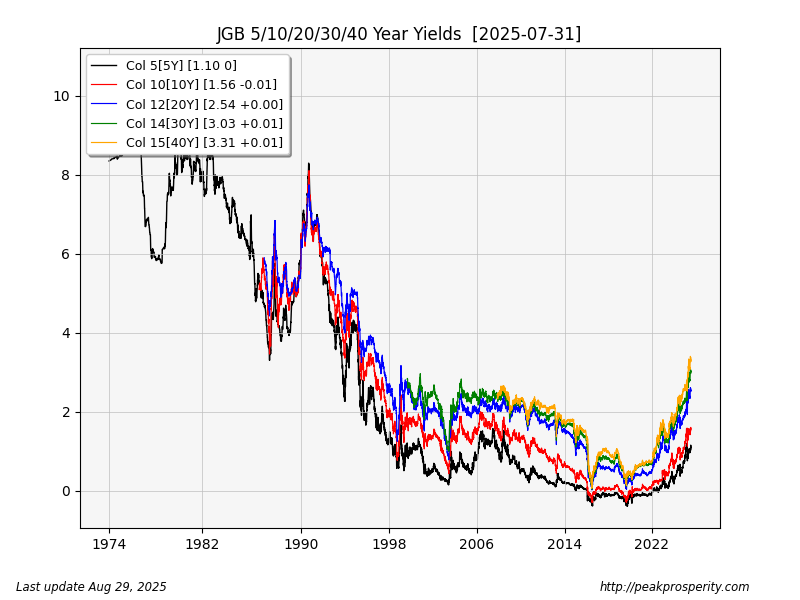
I tried to find historical values of various JGBs dating back to the 80s. I ended up going to Japan’s Ministry of Finance and got a csv file.

Here’s the (daily) yield chart of the 5/10/20/30/40 year yields since “the beginning of time”; 1974 was the first entry for the 1-8 year bond yields. The 10 and 20 year didn’t appear until 1986, the 30 year didn’t appear until 1999, and the 40 year didn’t appear until 2007. Who knew? Not me.

6 Likes

Dave do you draw any conclusions?
30 and 40 all time highs since issuance. Others not. When J issued 30/40 did it delay rate increases on shorter end?
Through out time rates go up and down. Bond bull has ended and the peopke are adjusting or is it more than that?

1 Like


2 Likes

My guess is, Japan MOF was trying to sell 30 and 40 year debt right at or near the yield-lows (price-highs). I mean - 2% locked in for 30-40 years is pretty amazing if you’re the seller (borrower).

The 20 year might be a better indicator because it has a longer trading lifetime. Peak for the 20-year was 7.74% in 1990, low was 0.022% (!) in 2016. Now its 2.5%. That’s not disaster, but the trend has definitely changed. Is it going vertical now? 70 bp move over the past 12 months.

If there’s a confidence collapse, we could see things adjust pretty fast. That’s the risk.

2 Likes

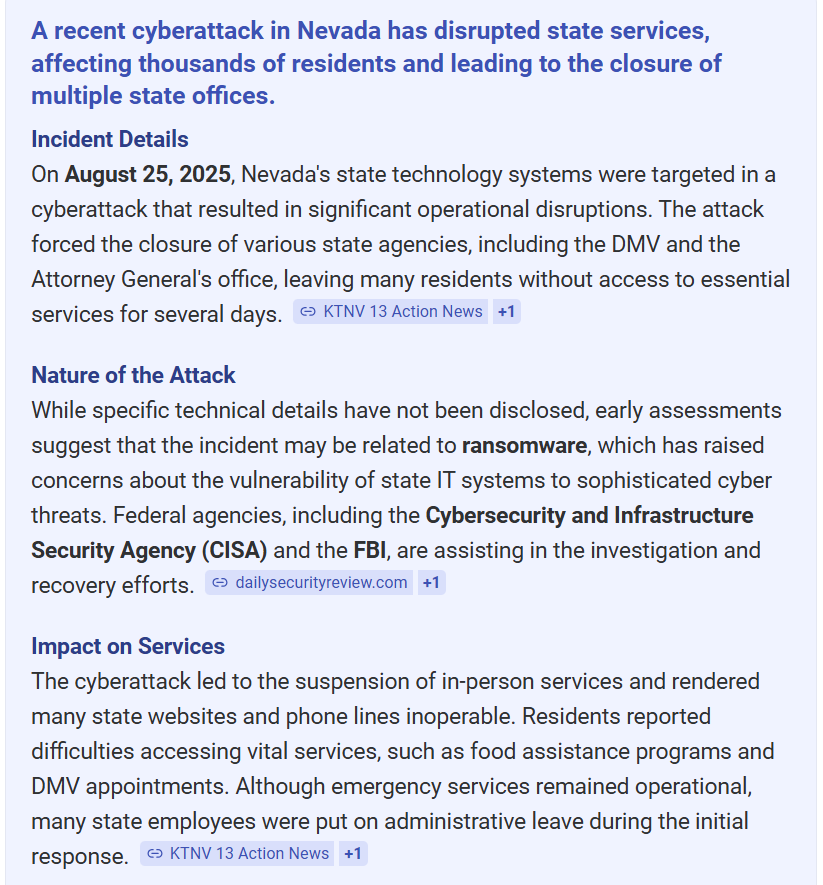
The pin may have arrived:

3 Likes