Here’s a concise bit of explanation about the physics involved from a post on X.
TL;DR - the bullet cannot have taken a sharp turn in CK’s neck.
++++++++++++++++++++++++++++
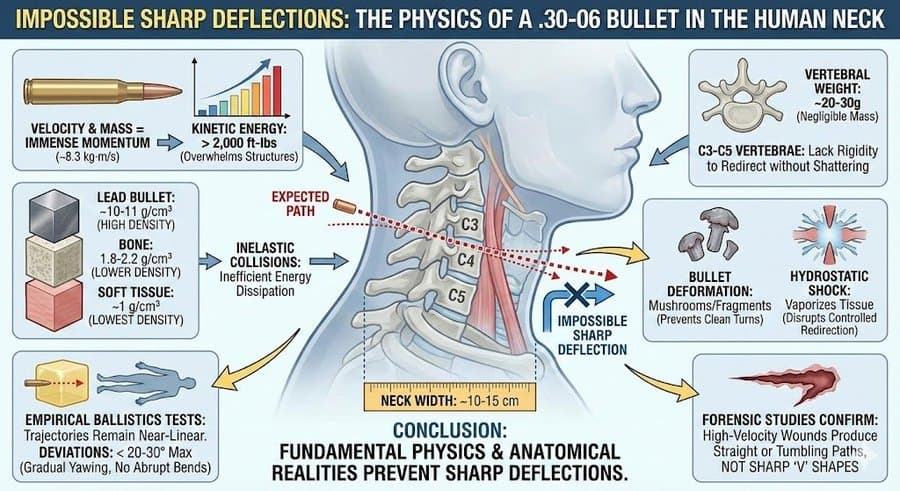
Here are the calculations as a nice infographic.
Included condensed explanation here:
A .30-06 rifle bullet possesses immense forward momentum due to its high velocity and mass, making sharp angular deflections within the human neck highly improbable.
In a 6 ft 3 in male, the C3-C5 cervical vertebrae, while dense, lack the rigidity and mass to redirect such a projectile without shattering.
The bullet’s kinetic energy exceeding 2,000 ft-lbs overwhelms neck structures, causing penetration or fragmentation rather than a precise ricochet.
Density mismatches between the bullet (around 10-11 g/cm³) and bone (1.8-2.2 g/cm³) or soft tissue (1 g/cm³) result in inelastic collisions that dissipate energy inefficiently.
Sharp deflections would require an instantaneous perpendicular force unattainable in the neck’s heterogeneous medium.
The confined space of the neck, roughly 10-15 cm wide, limits any path change to gradual yawing over longer distances, not abrupt bends.
Empirical ballistics tests in gelatin and cadavers show trajectories remain near-linear, with deviations under 20-30° at most.
Inelastic interactions ensure the bullet deforms or mushrooms, further preventing clean angular turns. Vertebral weight (about 20-30g each) is negligible compared to the bullet’s momentum of around 8.3 kg·m/s.
Hydrostatic shock from the impact vaporizes tissue, disrupting any potential for controlled redirection. Forensic studies confirm that high-velocity wounds in the neck produce straight or tumbling paths, not sharp “V” shapes.
Thus, the notion of impossible sharp deflection is supported by fundamental physics and anatomical realities.
(Source - X)