Awesome analysis - love it!
1 Like
https://x.com/justin_hart/status/1818701467190165566
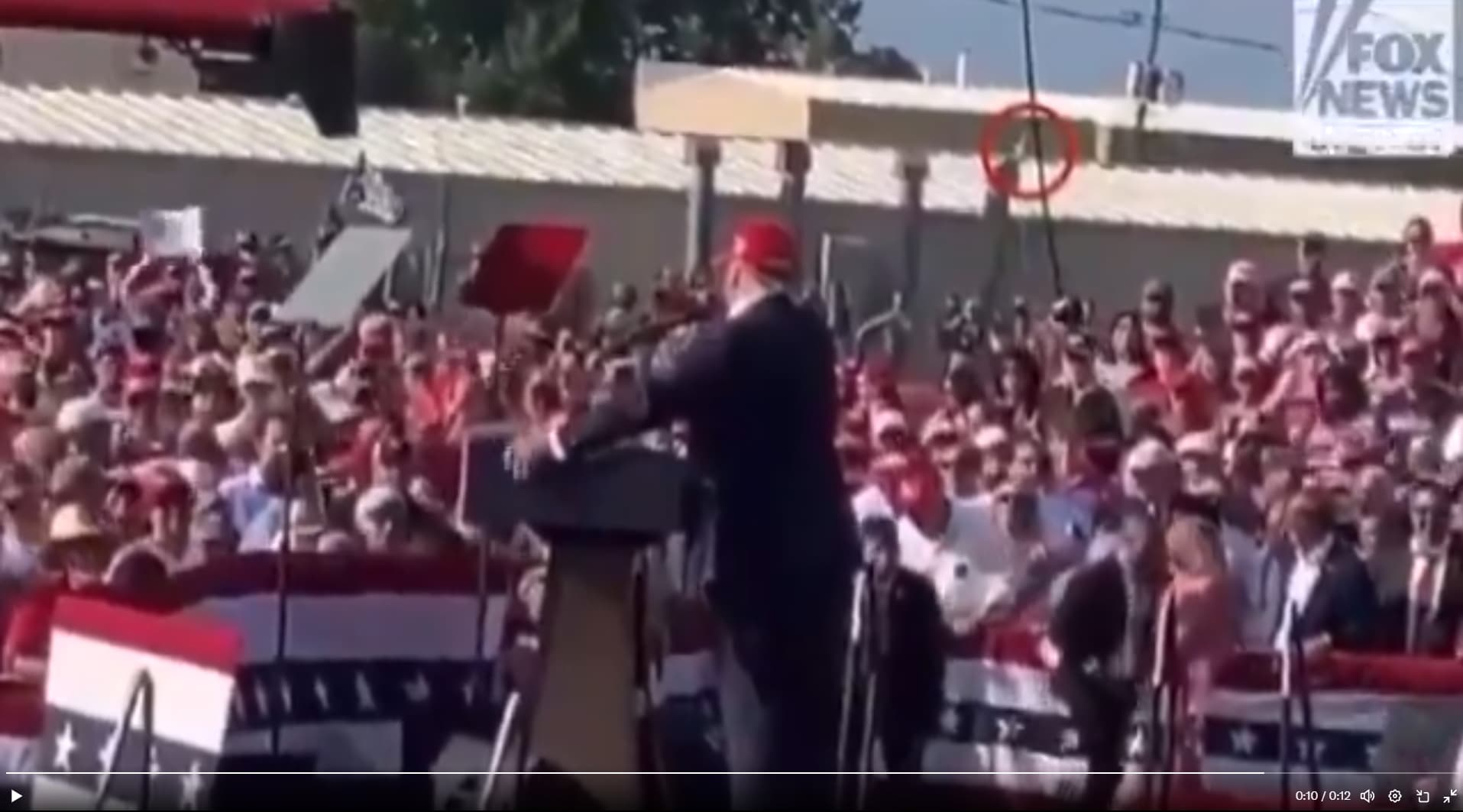
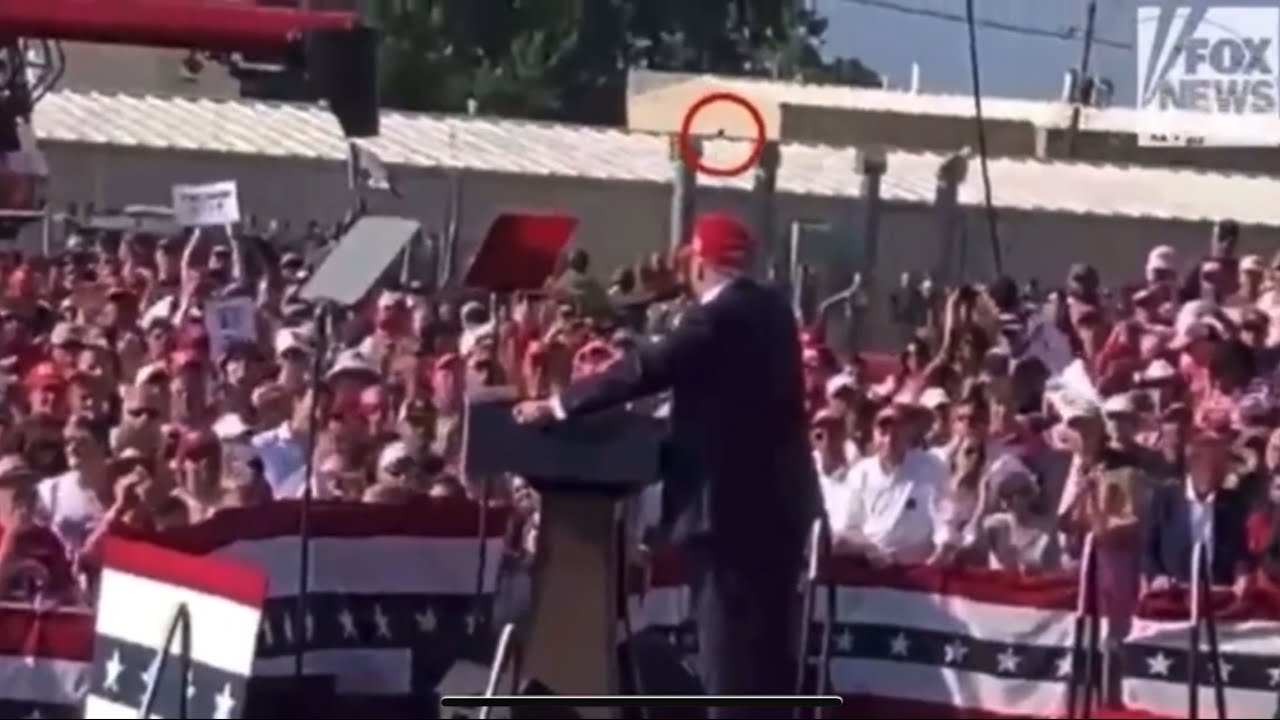
A view from behind Trump looking towards AGR which appears to show Crooks walking on the roof, crossing the breezeway, and getting into position.
4 Likes
And there’s this to add to the ladder issue (comment 131 from VegaPatriot): So It's Back To First Principles - #131 by vegaspatriot
So the official story is that Crooks accessed the roof quite a distance from his shooting location. Much of his trajectory would have been on flat roofs viewable by sniper team 2 and at least for the first part, by sniper team 1. Crawling would not have helped hide him from the sniper teams on these flat roofs.
Edit based on the video zubird88 just shared in the comment just above. I think the top of his head appearing as he walked suggested he did exactly that as it appears he was walking eastward on the roof across the breezeway. How could both sniper teams have missed him?
1 Like
Good find!!
Here’s a bit of info for you regarding the ejection of spent casings from an AR-15: Most AR-15s, and especially the cheaper versions (like the DPMS), are “overgassed”. Especially if they are firing actual NATO 5.56 rounds. The manufacturers do this for weapon cycling reliability in dirty environments. What this means is that the spent casings are actually thrown out of the receiver in a more forward direction (for a right-handed gun, like most are, this means out to the right and forward a bit). This would explain why 3 of the 8 spent casings found on the roof were on the opposite side of the roof’s peak.
Playing Devil’s advocate, why wouldn’t all 8 casing eject to the rally side of the roof ridge?
I think we can rule those lower windows out. Even if they did open at the side the shooter would only be able to angle the gun out in the wrong direction
4 Likes
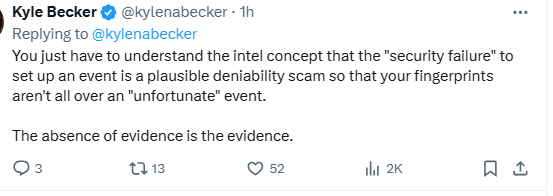
Exactly correct. The SS is not a Keystone Cop operation. You can bet that Jill’s protection team was well planned and professional. I knew this was planned when I watched a video of an interview with a vendor. She said that this event was different. In other events, if there were line of sight issues, the protective team rented large construction equipment to act as temporary barriers. She said there were none at this event. The timing was suspicious. Not only had Trump not picked his VP, but it would have thrown the RNC convention into chaos. In the Democratic side, there was a Biden family fight to keep Joe in power against concerns he would lose to Trump. If there was no Trump, Joe might have been able to stay as candidate. After the assassination attempt failed, Joe had no way to stay in the race and was removed. I think that it all .makes sense. Trump had to be taken down for the WH deep state to stay in power. Desperate times…
9 Likes
Possible. But also possible that they were planted there by LEO. This form of investigation fortification is much more common than is commonly known.
3 Likes
5 Likes
Thank you C… this is the kind of analysis that we need to see and develop in parallel with the physical/scientific evidence that is being so heavily focused on here.
8 Likes
I have spent some time measuring the time intervals starting at the sound of shot 1 to shots 2 through 8. I have yet to find a recording that shows a significantly different time delay for the arrival of any of 2 through 8. Until and unless I find a recording that shows such a variation, I have to assume all the shot sounds came from (nearly) the same position.
Of course, that does not preclude multiple shooters operating close to each other, but such a scenario rules out Crooks being only one of them.
3 Likes
…unless a second shooter was directly under him in the same building.
1 Like
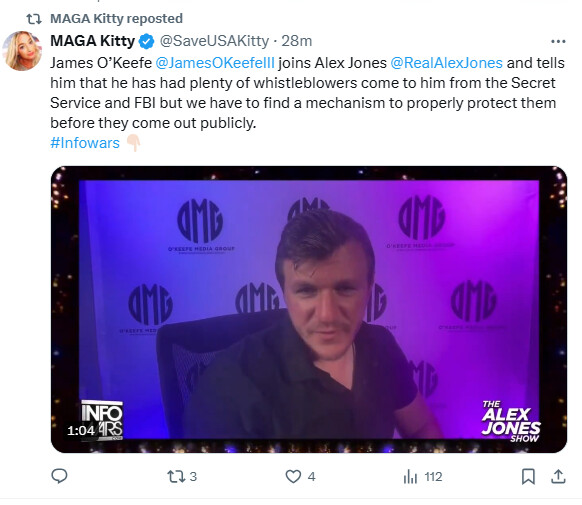
Potential whistle blowers know they will be attacked and their lives ruined… the deep state has made this abundantly clear over recent years.
x.com
8 Likes
A Time Domain Analysis aims to determine the location of gunfire using acoustic data from multiple microphones. By analyzing the time differences in the arrival of sound waves at several fixed and several variable location microphones, we can triangulate a shooter’s position with a relative degree of accuracy.
What We Have:
- Speed of Sound:
- At an altitude of 1,043 feet, with a temperature of 90°F and pressure of 28.83 inHg, the speed of sound is approximately 351.7 meters per second (m/s) (Butler, PA historical weather). Speed of sound calculated by ChatGPT
- Fixed Microphones:
- At least three microphones with known, fixed locations capturing both the supersonic crack and the muzzle blast. RSBN News, Trumps mic and the Stewart video.
- Variable Location Microphones:
- Several microphones with slightly varying locations. Some with and some without supersonic crack.
- Ammunition Velocities:
- Typical velocities for .223, .308, and .300 Win Mag ammunition.
What We Assume:
- All rounds fired are supersonic.
- All rounds fired were either .223, .308, or .300 Win Mag.
What We Need:
- Audio recordings with a minimum 20 kHz sample rate.
- A fixed reference in time. Calculated below. Without knowing the instant the 1st shot was fired, we have to assign T0 (Time Zero) to another definitive event.
- Confirmed dimensions.
How to Use This Data:
- Determine Distances:
- Calculate the distances between the fixed microphones to establish a spatial reference triangle.
- Estimate Gun Location and create a fixed reference in space and time:
- Create a 900 x 900 cell graph with each cell being approximately 1 square meter.
- Identify the fixed microphone with the shortest time difference between the supersonic crack and muzzle blast (assuming it is the Stewart video). This establishes your fixed spatial and time reference point, the center of the graph and the beginning of time, denoted as vector LT0,0 (Location and Time Zero, Zero).
- Using the Time Difference of Arrival (TDOA) of the supersonic crack and muzzle blast you calculate the distance from the gun to each fixed microphone. This orients and fixes each point of the spatial reference triangle and allows us to triangulate the gun’s location.
- Assign the remaining fixed microphones and suspected gun location a location vector relative to LT0,0. For instance, without the actual data, the RSBN microphone might be denoted as LT-4,-30, meaning 4 meters west and 30 meters south. Trumps microphone might be LT1,-20 (1 meter east and 20 meters south), Microphone 5 might be LT-20,15 (20 meters west and 15 meters north) and the gun might be LT10,10 (10 meters east and 10 meters north).
- Validate the locations and create a Timeline:
- For each microphone, create a triangle between LT0,0, microphone location and suspected gun location, with LT0,0 being the corner across from the longest edge of the triangle. Calculating the longest edge of the triangle provides the distance of each vectored location related to the origin of the gun shot.
- Compare this calculated distance with the distance calculated using the Time Difference of Arrival (TDOA) of the supersonic crack and muzzle blast at each microphone.
- You now have a timeline that provides Time of Detection in relation to LT0,0 for each microphone.
- Incorporate Variable Microphones:
- Integrate data from the other microphones with slightly varying locations to refine the analysis.
Once you have all the audio tracks temporally aligned to LT0,0, pinpointing the location of all subsequent shots should be relatively easy to triangulate using the same graph.
Factors that affect a qualitative Analysis:
- Elevation:
- Over short distances (a few hundred yards), minor elevation differences are unlikely to cause significant variations in sound propagation times or perceived intensity.
- Environment:
- In cases where there is a sharp temperature gradient or significant differences in atmospheric pressure due to elevation changes, even small differences can impact the speed of sound. However, a 10 to 20-foot elevation difference is usually not enough to create such conditions unless the overall environment is already highly variable.
- Recordings Without Supersonic Reports:
- Audio recordings that lack a supersonic report can only be considered if they have a relatively fixed location and only after the spatial triangle and T0 have been established.
*Audio recordings with sampling rates less the 20k will likely not have sufficient resolution.
- Audio recordings that lack a supersonic report can only be considered if they have a relatively fixed location and only after the spatial triangle and T0 have been established.
6 Likes
Assuming this is true, this would add extra “evidence” that Crooks was the single shooter and did not have any accomplice.
The first three shots have a different sound than the last 5 shots. You can imagine that the sound reflection (perhaps even resonance or amplification) in the first 3 shots will be different than the sounds of the last 3 shots which are behind the crest and the lower frequency sounds are blocked by the roof. This would explain the difference in the sounds in all recordings.
I believe he took the first 3 shots while prone and had time to aim carefully, perhaps with the rifle resting on the crest of the roof. Crooks knew he was “protected” for these initial shots. He was calm and had time to aim for his best opportunity. The 3 shell casings ended up on the opposite side of the roof.
Then Crooks retreats back a bit, perhaps kneeling or even standing upright further back on the roof. He takes aim (perhaps) and rapidly first 5 shots in succession that fail to hit any target but scatter casings on his side of the roof. At this point, he is signalling to the sniper teams - “please take me out and remove me from the earth, my job is done”.
It is a miracle that Trump survived this failed attempt. Now we are in this quagmire and coming perhaps a bit closer to finding out how high this conspiracy was fomented. The second shooter theory was interested to put forward to comment but it didn’t fully make sense to me.
I hope that the FBI took photos of the crime scene before they cleaned it up showing the location of the casings and even the casings themselves and where they landed. It’s also possible that the ammunition in the first 3 shots was different than the last 5 shots, this is less likely but possible. The crime scene would be able to easily determine if the casings were from different ammunition. This information has never been released as far as I can tell.
3 Likes
Thank you. The point remains that .007 seconds difference at 2630 ft/s (or anything 2500-3300 ft/s) implies over 18 feet (or something way to far) that Crooks would have had to move closer to Trump, reposition, resight, and start shooting pretty accurately all within 2.873 seconds.
1 Like
Plausible, but it does not jibe with the report of .22 seconds in shots 1-3 and .213 seconds in shots 4-8, as recorded by Trump’s mic. That difference implies Crooks would have moved 18-24 feet closer to Trump, reposition, resighted, and shot #4 all within 2.783 seconds.
In recording labeled 1 by Chris, from Trump’s mic, he did measure a report of .22 for 1-3 and .213 for 4-8. That’s an absurd difference in terms of feet for Crooks to have covered from #3 and #4.
1 Like
Hi Chris, a new re-subscriber here, you may remember me from the Covid days. Nice to be back. So this is just an anecdote but you may find it interesting. On the evening Trump was shot, or possibly the next day, I was watching videos online and I came across one featuring a young man, guesstimate around age 17, very fair hair, tousled/curly, quite a lot on top, fairly thin face with fairly pointed chin. He was talking into the camera. He said in an agitated voice that the countersniper was called Greg and the reason he didn’t shoot was that he was told to stand down. He was very passionate, like he was defending the conduct and honour of this person - as if it was either a friend or a family member. This was definitely within 24 hours of the shooting and he gave the impression he was absolutely certain of the accuracy of his information. Not sure if I can refind this video, I doubt it. It would have been on YT.
5 Likes