The Return of Peak Oil: Why It Matters and What’s Next

Originally published at: https://peakprosperity.com/the-return-of-peak-oil-why-it-matters-and-whats-next/

If you’ve been paying attention to the energy world lately, you might have noticed a phrase creeping back into the conversation: peak oil. For some, it’s a relic of early 2000s debates—doomsday predictions that never quite panned out.

For others, like me and the community at Peak Prosperity, it’s a concept that never really went away. It just took a nap while the U.S. shale boom dazzled us with record production.

But Guess what? Nap time is over! Peak oil is back, and if you’re not clued in, you might be in for a rude awakening. The world’s your oyster if you get it; if you don’t, well, you’ll be roadkill flattened by the Peak Oil realities.

My view isn’t based on belief—it’s about data, logic, and facing reality head-on. Oil is finite. Geological limits are real. And despite headlines touting U.S. energy dominance (I’m looking at you, Forbes, December 2024), the cracks are showing.

The big news came thundering across our desk this week when Bloomberg dropped a bombshell from CERAWeek, the big energy powwow held in Houston: “The specter of peak oil production looms once again.”

Uh oh. There’s that phrase in the news again: Peak Oil.

Industry insiders are buzzing, and the shale party might be winding down. Let’s unpack why this matters, what’s changing, and what it means for the future.

The Shale Mirage: A 15-Year Joyride

For the uninitiated, peak oil doesn’t mean we’re running out of oil tomorrow—it’s simply the point where production hits its max and starts sliding, often because the easy stuff’s gone. It’s a matter of geology and the physical limits of a finite resource.

Back in 1970, U.S. conventional oil (think gushers from straight-down wells) peaked. Alaska and the Gulf of Mexico gave us a modest bump through the early 1970’s, but it wasn’t until the shale revolution—unlocking “tight oil” from source rocks in places like Texas and North Dakota—that production soared again. Charts from the Energy Information Agency (EIA) went parabolic, and peak oil skeptics crowed, “See? False alarm!”

But here’s the catch: shale’s a finite game too. After 15 years of relentless and sometimes ill-advised drilling, the best spots—tier-one acreage—are tapped out. Echoing this, Scott Sheffield, a shale pioneer, told Bloomberg TV, “You’re really got to hunker down. It’s really hard to make any money at $50 [oil].”

The top-shelf inventory is shrinking, and what’s left (tier two, tier three) yields less bang for the buck. The Permian, Eagle Ford, Bakken—these big-name shale plays are hitting their limits. Occidental Petroleum predicts a U.S. crude peak in the next five years; ConocoPhillips sees a plateau this decade, then a slow decline. Me? I’m betting that the topping process has already begun.

Narrative Shift: The Real Game-Changer

Here’s where it gets juicy. The data’s been screaming this for years—drillable acres are finite, and depletion is real—but people typically don’t move on data. They move on stories.

For 15 years, the narrative was “peak oil’s dead, shale’s king, and US energy dominance is a forever thing.” Now, that story’s crumbling.

I call it “the beginning of the end of U.S. energy dominance in oil.” It’s not just about wells drying up; it’s also about the fictions we tell ourselves. As the narrative shifts, so will markets, policies, and opportunities.

Take price. Shale’s economics are brutal—$50 a barrel won’t cut it. When you factor in all-in sustaining costs (debt, depreciation, overhead), it’s outright impossible for tier-two and -three plays to produce profits at $50/bbl.

Adding uncertainty, if OPEC floods the market and prices tank, U.S. output won’t decline slowly—it’ll crash. Meanwhile, demand’s wobbling too; China’s economic hiccups could cap its oil thirst. The result? A topping process—that will be shorter than the industry is currently admitting to the public, then down we go.

Winners, Losers, and the Big Picture

This isn’t just oil nerd stuff— okay, it’s that – it’s also a tectonic shift. The way I see it, it’s like having “two exponential pressures on prosperity”: oil gets pricier to extract and we get less of it. That’s a recipe for upheaval.

Entire industries, from transportation to manufacturing, could stagger. Regions tied to shale—like Texas or North Dakota—might face one of oil’s patented mega-busts. But flip the coin, and there are opportunities. Nuclear energy, efficiency tech, or even untapped oil elsewhere could boom. Investors who see “where the puck is going” stand to win big.

This is a very different future from the world anybody grew up in. Post-WWII America rode cheap, abundant oil to prosperity. A peak oil world flips that script—think higher costs, tighter budgets, and a scramble for alternatives. It’s not doom (yet), but it’s a wake-up call.

My advice? Tune out the wishful thinking, dig into the data, and get ahead of the curve. This episode will give you a two- to three-year head start. Use it wisely.

Final Thoughts: Eyes Open, Ears Perked

I’m not here to scare you, my intention is to arm you with actionable intelligence. Again, Peak oil’s return isn’t about running out; it’s about adapting to a world where oil’s no longer the cheap, easy king. The U.S. might plateau, decline, or crash, depending on prices and politics. Either way, it’s a pivot point.

An extraordinary host of brand-new winners and a whole host of brand-new losers awaits. Whether you’re an investor, a curious individual with a family to feed, or just someone filling up your tank, this matters.

So, grab a highlighter, ditch the denial, and start thinking. The shale hiatus is over, and peak oil’s back on the menu.

Will you be blindsided, or are you ready to oyster it up? Your move.


15 Likes

And this is why Trump wants Canada, for our rocks and black gold.

4 Likes

More news:

Wildcatter Harold Hamm Says Shale Needs $80 Oil for Costly Fields

Speaking Thursday, Hamm, 79, the co-founder and chairman of closely held shale driller Continental Resources, warned that US drillers need $80-a-barrel oil to be able to cover costs at some wells.

“There are a lot of fields that are getting to the point that’s real tough to keep that cost of supply down,” he said in a Bloomberg Television interview. “When you get down to that $50 oil that you talked about, then you’re below the point where you’re going to ‘drill, baby, drill.’”

Hamm said he has yet to speak with Wright, the former chief of frack-provider Liberty Energy Inc., about the costs that shale operators face and the oil prices they need to thrive.

“He and I are good friends and understand each other quite well,” Hamm said. “I look forward to that conversation.”
(Bloomberg)

And you need steel tube to drill wells. The tariffs are not helping on that front:

https://x.com/Rory_Johnston/status/1900151341311218042

7 Likes

Two things I expect to be all but guaranteed to happen as a result of oil shortages: inflation and war.

6 Likes

If Trump administration manages to cause wide global recession, does it slow both down? Less inflation, wars slowing down or stopping?
BTW does it hold true, oil countries very rarely started wars, it is others oil poor countries who do… Iraq as example 1990 but otherwise I cant think examples.

2 Likes

But Chris, when I told my neighbour about peak oil, she said there is “lots” of oil in the Arctic. End of conversation. :grimacing:

9 Likes

I cant think how “easy” it is to drill frozen sludge that refuses to flow through pipes… if there are wells to be found there. -40C or whatever north canada has is brutal environment, let alone even colder arctic.

So where the puck is going…?
On shore or off shore drillers, mid tier oil products, energy service…?

4 Likes

As you summed it up some years ago, the next 20 years will be completely different from the past 20.

I, for one, am heeding the warning but mostly feel impotent. Keep stacking what little I can and at some point perhaps learn some in demand manual skill that’s not too back-breaking. Electrician, nurse? My current line of work (IT) won’t cut it with AI, outsourcing and discretionary compression.

3 Likes

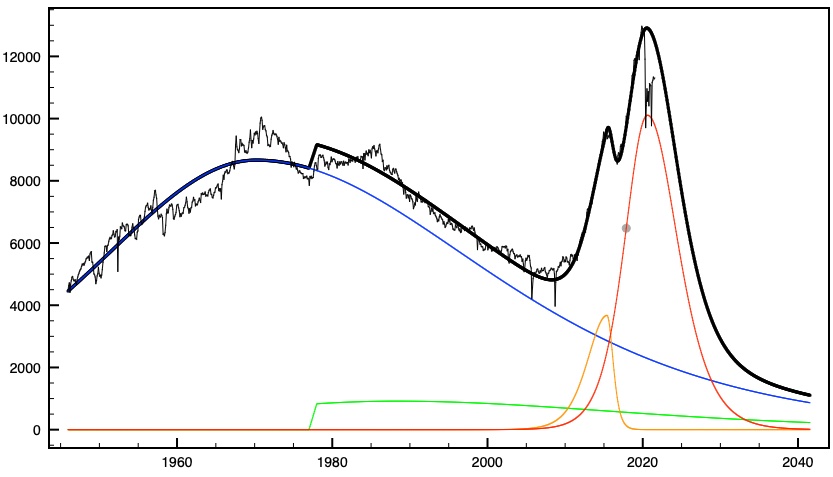
Here’s what I’m getting. It pretty well jibes with Art Berman’s plot that Chris showed. Berman’s plot shows the actual measured split-outs for conventional, Alaska & Gulf, and tight oil sources, while my plot is one fit of four logistic distributions to the aggregate EIA numbers. Note that the data I’m using ends in 2022, because that’s when EIA stopped reporting crude-only numbers and started juicing them by adding in gas liquids (essentially the wet farts out of gas wells; it makes the numbers go up and to the right, so all’s good, yeah?) Anyway, chopping things off at 2022 doesn’t change the result much.

Jaggedy black line is EIA data from https://www.eia.gov/dnav/pet/pet_crd_crpdn_adc_mbblpd_m.htm
Thick black line is the total fit.
Blue line is conventional oil. Peak is 1970.
Green line is Alaska (& maybe Gulf, doesn’t matter); peak is 1988
Orange & Red lines are two tight oil peaks, in 2015 & 2020.

The fits were for peak year, amplitude, up-slope time parameter, & down-slope time parameter. With 16 total params, I used a hybrid GA/gradient search method. There are some ensemble-derived uncertainty bounds produced also, but putting 3x the lines on one plot gets ridiculous.

The big take-away I see from this is that sometime around 2029, the US oil supply is going to look a lot like 2008. Remember that summer, when pump prices shot to $5/gal? Adjust for inflation from 2008 and we’re looking at $10/gal.

Another take-away is how that first tight oil peak absolutely collapsed in a true “Seneca cliff” fashion, 3x faster down than up. If the second, bigger peak does the same, and that’s still TBD, stuff could happen fast circa 2026-2027.

I’ve been playing this game since 2018, and the results have been fairly consistent all along. I’ve shown these results to semi-normie friends and family who are adept at stock trading, and keep getting brushed off with “Eh, put your money in a nice safe index fund. And take up golf. We’re playing at 8 tomorrow, wanna join us?” So my question to the PP community is: We’ve all already more or less braced for impact. Now how do we turn a buck off this foreknowledge?

12 Likes

Here is an interesting Peak Oil Chat by an energy group discussing this topic and other things related to Oil. It is disjointed at best as Art takes over the convo.

1 Like

What exactly does it mean that the energy cliff is right around the corner while at the same time, everyone’s rushing to build massively energy-hungry AI data centers?
Is there some mental disconnect in their minds or is it some desperate bid based on the hope that AI will end up solving this problem?

4 Likes

Maybe they are hoping AI will unlock fusion.

1 Like

I think more likely humanity will reduce or lift regulations on nuclear fission to support the AI.

I can imagine burying a nuclear fuel underground and letting it harness energy to support the data center situated on the ground above the nuclear ‘plant’. Perhaps the lifespan of the nuclear fuel could be in decades, probably far longer than the actual capabilities of the data center that it powers which may need to be rebuilt with newer silicon every few years.

1 Like

What is discretionary compression?
With datacenters being built, I doubt we can have as many of those around in next 30 years towards end of that next cycle. Thus they could be “ghost cities”. ICT as such will stay but there wont be money ie comfy jobs in it… how much per user do we pay for phone sub with lots of features… not a lot. If outsourcing stops, prices rise some and we can just be without some aspects.
In regards of peak oil, outsourcing is enabled by very cheap (intercontinental) air travel. Short range can be there but who knows what happens with long range. I consider this future more interesting. Perhaps humanity will innnovate more as we progress towards 1800s society (time wise… distances are again real for average person on earth).

There is … all humans IMHO seem to have gambler logic within them… psychologist explain this as 1:10 rule, if we get one bad news/thing happen, we need 10 good things to balance it out (this was communication thing in relationships)… and we tend to remember bad things very long time and try to recoup losses so to speak… that seems healthy human psyche at work, if it doesnt work like this, risks are various paralysis etc psych conditions. Although our vision of “human” in west is some superman robot that never sleeps, so some correction is needed.
As Chris also mentioned, AI can help in spesific problems (protein folding) in right hands but it cant solve foolish liberal wasteful money spending and resource spending to reach always line go up in everything, also human population on earth, regardless of what that means in life quality, jobs and environment(I mean in broad sense, is it “fun” to work 10 hours a day, commute 2 hours to work and live in windowless cubicle in NYC or Tokyo? in western standards that is “good life” but it truly sucks and brainrot happens from that stresslevel just to survive).

1 Like

People not having money for non-essentials such as subscription based models. A big part of software is discretionary: telegram premium, Spotify, YouTube premium. Also ads for products people won’t buy.

Specialized physical labor is where it’s at for men who stay fit. You only have to compete with 50% of the population (by inclination and strength difference) and there won’t be electrician or plumber robots.

IT is still going to be important and there are many subfields but it is already over flooded.

5 Likes

I’m not disputing your analysis, but I can recall reading about ‘peak oil’ in a newsletter or something my father showed me when I was a teen. That would have been the 1970s, maybe early '80s.

I work since 20 years in the oil & gas industry as a well tester (downhole & at surface, on and off shore), meaning that our main job is to put newly drilled wells in production for the first time and gather as much data to allow the geologists to calculate the size and profitability of the reservoir. My area of operations is mainly Europe, North Africa, while I did some gigs in Siberia and Israel in the past (-55° C , the Siberian toilet and the love of the Russians for Italian music are experiences I’ll never forget!!).

I can testify that the situation if pretty flat, oil prices are absolutely too low, while Europe is in extreme need of cheap energy after cutting their own balls by provoking and wanting war with Russia in any way possible.

We are mainly busy at the moment in cleaning out old wells in the attempt to boost their production or plug and abandon wells which are mainly exhausted/not profitable.

400$ oil would be a blessing for me personally as I am a day rater and remember guys getting 1500€/day when the price was around the 150$ mark after the GFC!!! :heart_eyes::joy::pray:

5 Likes

Art Berman’s latest Blog: “The Global Reset: Energy, Geopolitics, and Market Upheaval”

Excerpt: Former Pioneer CEO Scott Sheffield warns $50 oil makes it hard to survive. With China’s demand peaking and supply rising, he sees $50-$60 as the new floor. “You’ve really got to hunker down. Layoffs may be coming,” he warned.

“When you get below the cost of supply, you can’t ‘drill, baby, drill.’”

Harold Hamm, Continental Resources CEO

3 Likes

I’ve been hearing the chicken little calls regarding peak oil for 25 years. The fact is there is plenty of oil and especially gas left. California has as much oil as TX. South America is awash in the stuff. This does not even account for the massive fields in the ROW. The only restrictions are political, not geological. When we get a much higher price, Mr. Market will work his magic. Expect large price hikes at some point as infrastructure and politics catch up with the needs of demand. Relax we are good for hundreds of years.

2 Likes