That AI description was very interesting and quite detailed. Thank you. In the future, I think it would be clearer to say “the mach cone collapses” instead of saying it “freezes”.
1 Like
No, Andy. No one here agrees about anything, except for three forum members that did independent Time-Difference of Arrival (TDOA) analysis all ended up agreeing that the first 8 shots all came from the same location. I spent dozens of hours doing very detailed analysis of crack-boom data and produced three YouTube videos to show my results. I shared my data so that others could replicate or refute my conclusions. Since you’re new here I’m guessing you haven’t seen my videos. Here is the third and most comprehensive one:
A link to the data set can be found in the video’s description.
After this video was released, I analyzed some other cell phone recordings which allowed me to use muzzle blast times for all of the audio time stamps. This removed all of the uncertainty related to bullet velocity, etc. I did not produce another YouTube video since it takes so much time to do them, but you can check out this forum post to see the result:
2 Likes
I was hoping for clarity - who’s YouKnowWhom?
Crooks? There’s no consensus on that.
I’d suggest you preface them with an “F”, like “F17” for Flamecensor shot #17.
Maybe I misunderstood. I just meant that Source 4 was in a spot where the crack should have been heard.
Would that be the roof of AGR6? That’s my conclusion from a crack-bang analysis of shots 1 and 4.
What velocity did you come up with?
How did you sync the recordings? Were there timestamps on them?
I’m confused. Bullet velocity is only necessary for the crack, not the bang.
I’d suggest that my hearing is better but, yes,
YouKnowWhom is TMC.
You didn’t hear the squirrel sneeze 1/2 second before King’s ‘shot 34’(‘shot 35’, if a squirrel didn’t sneeze).
And, pure pareidolia is worse than you know.
I see maybe 10 enemy faces in the picture posted months ago by SonjaX6.
I see faces in Collins’ bodycam frames, too.
But, back on topic to unreported shots…Hercules 2 East told HSGA Counsel(Majority) that he heard ‘endless’ shots(page 56, line 17) that sounded ‘suppressed’(page 57, line 2)…and why did Officer Glasgow say, “We got shot at!”?
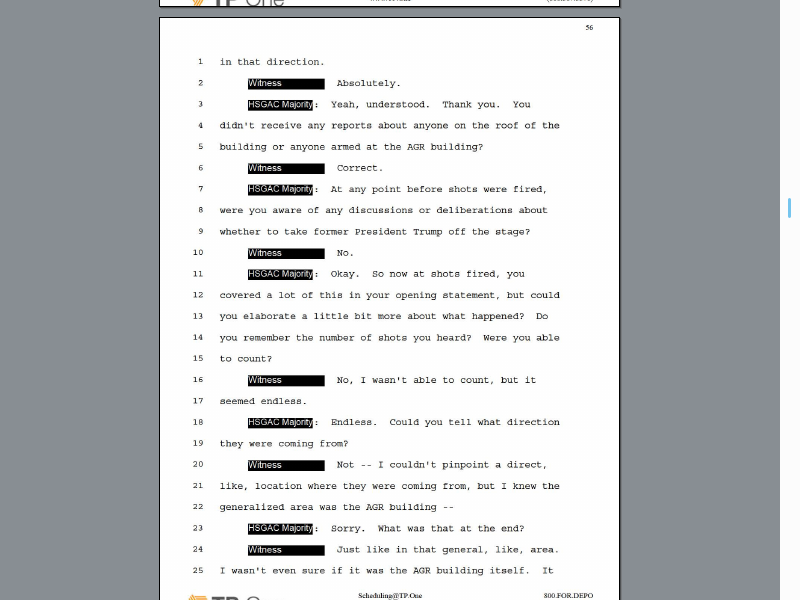
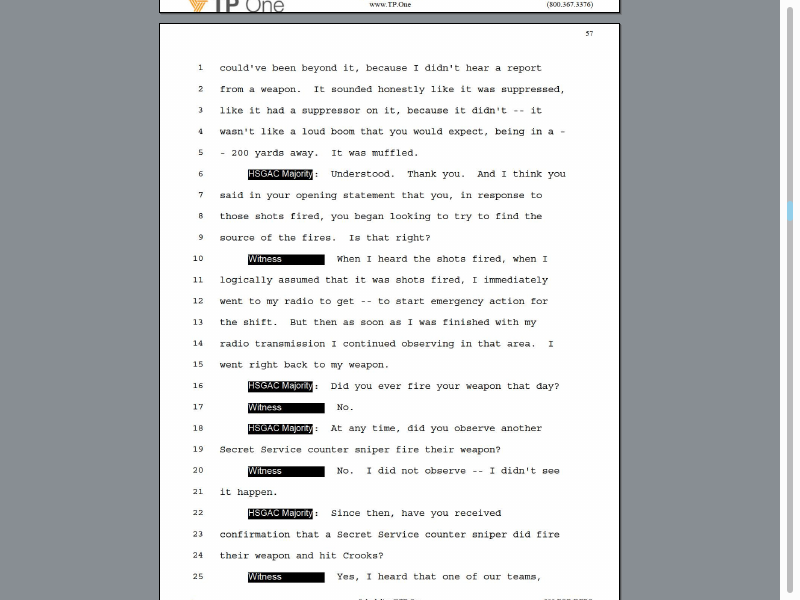
I have no expertise in ballistics or audio, so I can’t evaluate that evidence. But in general, witness reports of a few seconds under pressure with echos, crowd noise, speaker amplification, and shrapnel flying, aren’t to be taken as gospel.
OK, I’m three minutes into your video and I have some questions.
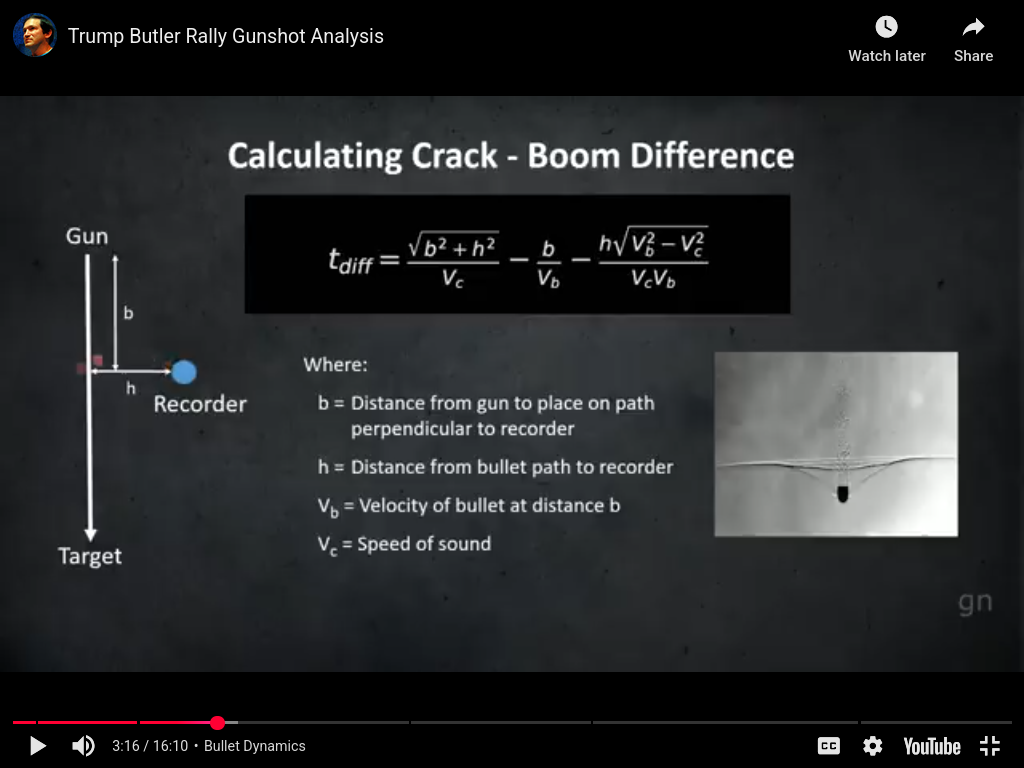
First a quibble: my understanding is that TDoA refers to analysis of the same sound heard by two different witnesses, whereas crack-bang is analysis of two different sounds heard by the same witness. You seem to use them interchangeably.
The crack-bang formula you put up around 2:16 involves the distances b and h. But aren’t they precisely what is in question? You may assume values of b and h and see if the calculated crack-bang gap matches that measured. But you say you are using the formula to derive the boom time from the crack time? Is that right?
Ah yes, the variation on the straw man argument where the person picks the weakest of the opponent’s 10 arguments, debates that one point and then declares total victory.
The “Big One” of the inserted/AI people hypothesis is the man who is simply a reverse image of another man and is slid in without any movement, just in time to obscure Mr. Comperatore getting shot.
I don’t care if you buy into it or not. The idea of altered videos probably plays into the hands of “Trump faked it” people more than anyone else, so I’m NOT talking about it to advance my own overall view of what’s going on.
Furthermore, I still believe that the important people in the videos are real and unaltered. Obviously I’d be fairly quick to suspect them if something suspicious turns up, but they do seem real and unaltered apart from the foreground people.
I don’t know the history of the two videos I’ve linked. I think it’s quite possible the people who took the videos got paid for the rights, and the contract probably allowed for certain modifications to be made - maybe in 6 point type in page 13 of 15 pages of legalese, and maybe worded in such a way that the person wouldn’t really understand what was going to be done. Maybe there was wording about making the video clearer or more suitable for people to watch.
Might you I don’t consider this all that nefarious. Certainly not compared to the shootings! It’s just stealth censorship.
You should also watch my first two videos since they cover a lot of background details that I did not repeat in the third video.
No. I used the boom times when they were clearly discernible, but when they weren’t I would use the crack time to derive the boom time.
TDOA computation requires time-synched recorders. Since the smartphone videos have no native sync mechanism, it was necessary for me to pick one of the 10 shots to be “ground truth” and then force the recorders to align at that one instant in time. Everything else gets derived from there. Watch the other videos to see what I mean.
Do you know of a video, or image, showing Hercules2East, stumbling down or falling down?
I have videos of him down tightly to the roof, as Trump says ‘take a look…’, but I may remember Herc2East a few seconds earlier ‘falling’ down to the roof.
It may have been from an Oliver Alexander X Post.
Any video of Hercules2 during Trump’s ‘that’s a bit old, that chart’ words also would be good.
Thanks.
OK, forget all of them.
I’ll claim that 1 shot, to 2 men, proves a 2nd shooter, because Crooks is the 8x8 blond/pale pixels, in his spot 11 or 12 meters from AGR6’s East end, 7 seconds before Trump’s ear, and the line from Copenhaver to Trump to the roof points 20+meters West of Crooks.
Do you believe that Copenhaver was shot twice, as he’s claimed?
This version of the RSBN broadcast has the wide angle shot from 8:21, shots start 8:59.
Hercules 2 East starts out (what we can see here) basically sitting up before adopting a lower posture. I imagine he’s trying see more of what’s going on with the cops underneath that big tree. this is the guy that radioed to the other secret service that locals were “working something at the 3’oclock”. Actually that’s 38 seconds before shots start, so it’s exactly when Det. Collins starts running around to the south side of the AGR building, isn’t it?
That is literally the only video I know of that shows them for any length of time before shots start.
The wide angle RSBN video that I know of only starts very soon before shots start. And of course RSBN’s wide angle camera was placed off to the side - it cannot see the Herc 1 team at all because the south jumbotron is blocking it. Obviously I’m a little suspicious about that placement. They couldn’t just have RSBN have a wide angle camera right next to the regular one? They have to set up another media platform off to the side just for RSBN’s wide angle feed?
I forgot - Stacy Bennett’s video shows Hercules 1:
1 Like
Yes, Detective Collins’ feet(and hands) hit the ground and he started running South and then West at 18:10:57, and he apparently heard gunshots at 18:11:32, when he started running back East, so 35 seconds is my best guess.
Dayve’s camera swung from East to North at 18:11:05, for the shot that US Marines sniping Instructor Clay Martin insisted was 300 Blackout subsonic ammunition.
Louder shots, sounding like 45 caliber, were much easier to hear, at 18:11:15 and 18:11:25.
Also, thanks for the links, but I think Oliver Alexander or someone had images of Hercules2East almost airborne above the roof, looking like an ice hockey skater going down to the ice after being tripped.
But I didn’t read of any action like that in the interviews.
OK, thanks Greg, I think I get it now.
- You sync the recordings using one shot and an assumed origin;
- you used the now synced recordings to confirm that the shots 1-8 came from the same location;
- having confirmed that they did, you can now use the synced recordings to determine the origins of shots 9 and 10;
- if an origin assumed in step 1 doesn’t allow the recordings to determine locations for shots 9 and 10; it can be discarded as untenable;
- the only known tenable location for the origin of shots 1-8 is the AGR6 roof;
- which gives the origins of shots 9 and 10 as Zaliponi and Hercules 1 resp.
Is that right?
It occurs to me that you could exploit the movements of TMX and DJStew:
Having established that shots 1-8 originate in the same place, you can compare one of the stationary recordings with TMX and Stew to apply TDoA-type analysis to draw hyperbolas for pairs of observations of different bullets by the same observer.
For example, if the time between shots 1 and 2 is t1 for TMX, and t2 for the police car, then we know that TMX was (t2-t1)/c closer to the shooter for shot 2 than for shot 1. You can therefore draw the corresponding hyperbola.
Repeating this for all shots for TMX and Stew, you should be able to determine the location of the shooter.
OK, fair enough, let’s look at the “reverse image” man. I’ll call them Left and Right.
It’s true that Left and Right are dressed very similarly. But:
- L does move.
a. When we first see him he is videotaping with his phone.
b. Next we see him look left toward the source of shots.
c. We see his head and body move slightly as he turns. - He isn’t a mirror image.
a. L is older and grayer than R.
b. L has more muscular arms.
c. R is tanner.
d. L is wearing his glasses, R has them on his hat brim.
I think a more likely explanation is that black sleeveless shirts and dark baseball caps are popular summer wear in west PA.
But I sincerely admire your ability to spot those two look-alikes. Most people would not have noticed.
Here’s figure 7 from the House task force report.
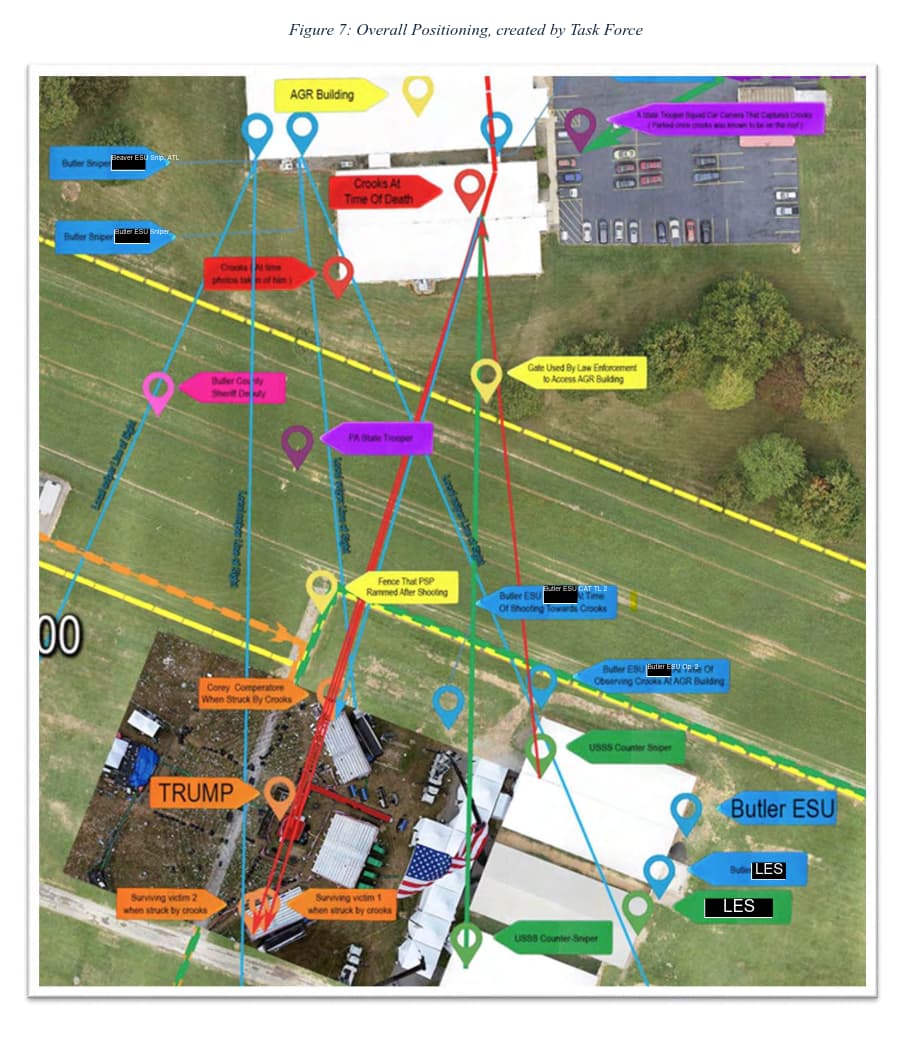
Can we work from this, or do you think it’s compromised?
I just woke up, with none of my only drug(black coffee) but the red lines to the corner are difficult to see, and I have many other sitemaps that make a shot from ear to arm look ridiculous.
To start with the Taskforce map: Crooks’ position is at least 2 or 3 meters West of the bloodtrail, and West of other locations for Crooks.