Yes. You have correctly summarized the approach I took and the conclusions.
Keep in mind that we lack native precise location info for the moving recorders, and it’s no easy task to determine their positions through video analysis, but a couple of the other forum members did put a lot of time into doing just that and seemed to be quite successful. I’m not planning to conduct any further analysis myself, but I would definitely encourage you to try a variation on my approach to see what you come up with. The data that I used is all archived here: TDOA_v4
And here are some posts I bookmarked that you might find interesting and useful.
@vt1 showing refinements to recorder positions: ref1, ref2 and ref3
One other point. The position of the police cruiser just to the east of AGR6 would have made it impossible for it to record cracks from the roof of that building. All the rifle shots heard must have been booms.
I don’t think this affects your analysis much since it would just translate the booms you used by an additive constant.
I did. It seemed like to only way to determine the boom times for those two recorders that were in front of the muzzle, but very close in both proximity and line-of-fire. However, subsequently, I was able to find the NTD and “Don’t Run” recordings that were far enough from the shooter and far enough off-line for me to use just boom times for the analysis. So, that takes bullet velocity out of the picture. I wish I had figured that out a lot sooner. It would have save me a lot of time.
Is it possible that analysis can be done using just the crack-boom time differences and the known locations of stationary recorders? Is that the approach that you and @unhandyandy are working on? If so, it will be interesting to see what you come up with.
Keep in mind that smartphones are not designed to record extremely short-duration sounds like gunshot cracks. Whatever analog+digital filtering they employ is going to stretch that sound out a bit. For that reason, I always used the rising-edge of the cracks as my timestamp, not the peak amplitude.
The raw file could be used to detect a fake. This applies to the bullet photo as well as to the blood on the hand photo.
In addition, the red liquid on his hand could also have been squeezed out by him with his hand from a very small bag hidden in his cap.
Again: It’s a big club
That makes perfect sense. It’s the same old trick that the elite have been pulling for centuries. They keep the population divided while controlling both sides. That way, the population is constantly distracted.
It’s a big show that earns tens of billions every year.
Isn’t it also possible that the audio compression results in the recorded leading edge coming early? I’m no audio expert, but I think the compression algorithm works on blocks of time.
I don’t consider your theory impossible, but you have to compare it in plausibility to the official theory, which in my mind wins handily. Of course there’s no arguing about what one finds “more plausible”, it’s ultimately a subjective judgement.
I’m impressed by the approach you took with your Kirk analysis. Well done, Andy. And when the boom times were unclear, you analyzed all the possibilities instead of just picking one. Nice.
That didn’t occur to me, so yes, I guess it’s possible.
That’s all I did with the 1 line calculator I wrote last year, but I cared only about the podium microphone, and finding only the range(distance), not direction or location, because that’s what Chris Martenson and John Cullen seemed to be doing.
So I didn’t know and couldn’t find a formula, but I made one that seemed to work, but I knew that muzzle velocities were being guessed, and no one was concerned about a slowing bullet.
In javascript, this is the distance calculating line:
d=ct/((1/vs)-(1/vb));
where ct was the time gap.
The whole javascript function was:
he didn’t have a last shot, because he didn’t have a first shot
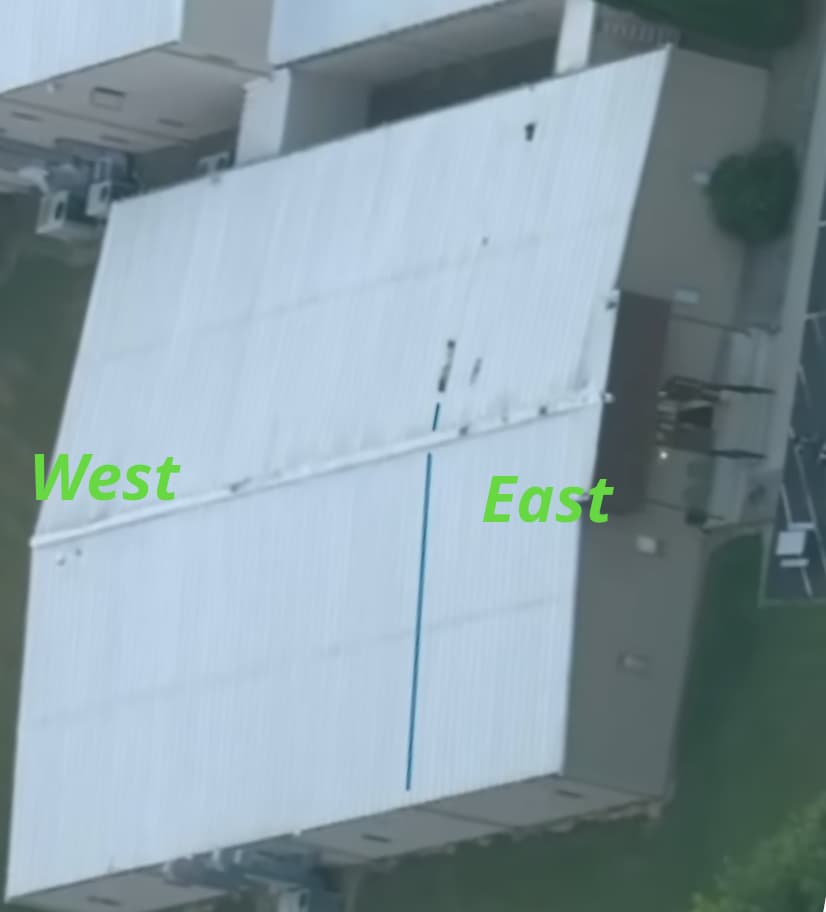
Dayve’s video was very shaky, but single frames aren’t, and I can see that he was in line 1 roof valley west of the 2nd window(counting from east corner)
I think so…I’ve never known Source 4 or TNX very well…
I hope you and greg_n are the only 2.
Two congressmen, Eli Crane(R Arizona) and Cory Mills(R Florida) have expressed concern about another small problem you 2 have:
A suppressed bullet hit the bleacher rail 1/4 second before Copenhaver’s arm flip(as you know, 0.03 second after Trump’s “ohhh!”).
That bullet was behind the back of cornerman Dan, whose body blocked ALL angles from AGR6.
The dustball rolling off the rail was 45° offcourse, headed southwest, not south.
I think it’s beneficial to ponder all of the conspiracy theories and then see whether the evidence fits them or not. But what I’ve see here is that many of the forum participants get a certain idea in their head and then that’s all that matters to them. No amount of persuasion helps, so I kind of gave up on trying.