Which building would give a greater than a 10 degree angle of attack and still hit the neck without having an exit from the body ?
Yep, it was my first approach. But the weird results made me skeptical.
We should avoid any assumptions.
In the Butler case a year ago, there was a debate about applying Occam’s razor — the idea that the simplest explanation is usually the best. While this principle is essential when studying fundamental laws of nature, it may not apply as well in cases involving high-profile violence, where deception or manipulation is likely. Therefore, instead of relying on the simplest assumption, we should aim to make no assumptions at all.
- Occam’s razor (simplicity) works well in physics or natural laws.
- But in criminal or violent cases, simplicity can be misleading because of human motives and deception.
- Therefore, the better approach is zero assumptions — rely only on verified evidence.
We can hear the shock wave, it implies supersonic projectile. However, the projectile thought to be lodged, so I cannot rule out a sigificant velocity drop.
People mentioned an audible Doppler shift. Perhaps we can use that to learn about the velocity of the projectile. An ordinary supersonic projectile does not make the Dopper sound, only if it whistles, makes turbulence in air. And that makes additional deceleration. However, it might fade away so quickly. Most probably we cannot observe the limit.
I used five audio files provided by: https://www.youtube.com/@Audio-Freq
You’re right.
Essentially we need as many equations as unknowns we have.
By the way, you can find my quadratic regression approach:
But in some situations, a crack will not be heard at all by the witness, since the crack propagates strongly only along the direction perpendicular to its front; for example, a witness behind the rifle will not hear a crack, nor would a witness too far in front, if the bullet’s trajectory is not infinite.
You’re absolutely right, but it is not in simplified textbooks.
Dunno.
Usually you cannot arbitrarily slow down the audio, due to the high pass filter protection of loudpeakers against direct currrent.
Years ago I used this method to make audible a very short transition.
2 Likes
" Another case study in narrative misdirection is Germany’s handling of the National Socialist Underground (NSU) – a neo-Nazi terror cell that murdered 10 people (mostly immigrants) and bombed multiple locations between 2000 and 2007. For years these racist killings were not recognized as far-right terror at all ; instead, German authorities insisted the murders must be gang or mafia violence within immigrant communities . Police and media spoke of the “Döner Murders,” suggesting Turkish organized crime, and even interrogated victims’ families as suspects, while ignoring clues pointing to neo-Nazi perpetrators"
How likely is it that terrorists will carry out terrorist attacks for years without informing the public that these are acts of terrorism?
1 Like
For clarity, I meant that ignoring deceleration doesn’t improve the model; taking it into account might improve it significantly.
Avoiding any assumptions is a noble goal, but I don’t think it’s practical when investigating an event in the past which cannot be duplicated exactly in a lab. The best is probably to examine hypotheses, i.e. coherent sets of assumptions, and test their plausibility against the witness data.
We have no quantifiable data on that. I doubt they really heard a Doppler shift. It may have just been the crack-bang, since the former is higher in pitch than the latter.
For the hypothesis of a shooter on the Losee roof, I have two unknowns, muzzle velocity and deceleration, and 10 “equations”, i.e. witness records of crack-bang gaps.
Did you use screenshots from Audio-Freq’s videos? Or did you get the original videos? What crack and bang times did you find? What location coordinates?
I followed that link, but you don’t explain clearly what you’re doing. Do you mean statistical regression? What are your dependent and independent variables? What are p,q,r,s, and t? What is “348”?
Please write up your results clearly so other people can follow what you did.
1 Like
Which sound? The crack, the bang, or both?
Silly question, but what about the weapon’s condition. How would that impact the situation. Also there should be a bunch of 30-06 brass somewhere. And lead for that matter.
One would think the perp would have needed to practice with the weapon for some time to have confidence with it. Has he been seen shooting anywhere. Is there a wood pile or berm near his home. Does he shoot or camp with a group?
Grandpas rifle, was it just picked up the night before, of has the kid had custody of it for some time.
So many questions.
1 Like
At this distance, both.
Files are here:
https://drive.google.com/drive/folders/17tevnZsbVxGKyoar-J4vjv2NhWGj0-J5
That was a gut guess approximation. There are a lot of peaks in some audio any I tried a Pythagorean quadratic regression. It should be reworked or improved.
Okay, but we should estimate the uncertainty by this. Tomorrow I’ll draw a picture. Now just quickly my idea: It will vary your C point. The question is - how much. And what does mean in milliseconds. Worst case estimation?
Probably we should know (guess) the velocity at point C and the average speed for RC section. So what could be the error if we use the same C point for all observers?
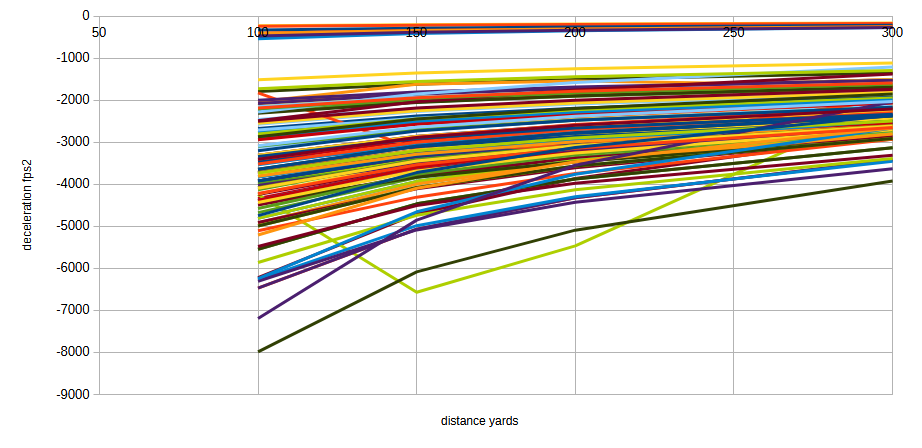
Last year we calculated the speed of hundred different rounds, as function of the distance.
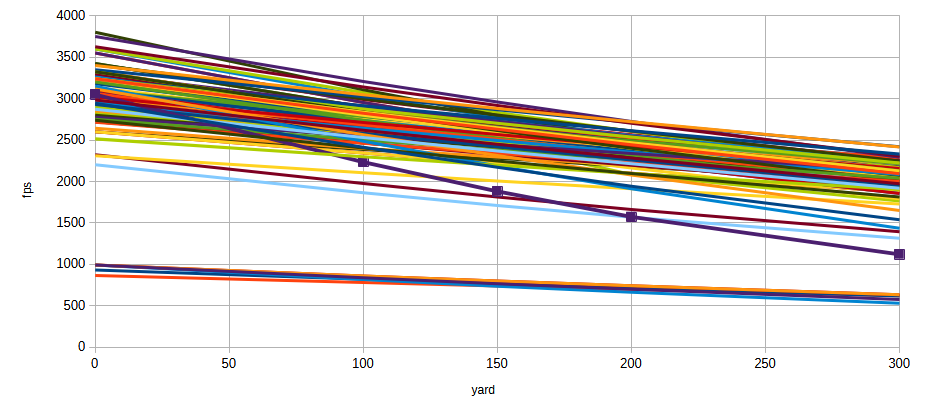
Not only that is weird.
Allegedly he found a hidden location to assemble the rifle, concealed to surveillance cams. How did he know that? How did he know that the cam cannot see him?
Then like a triatlon game, runs, shoots and runs away.
And he made a single deadly shot, the most deadly one.
(If I were CiA, I would immediatelly hire that dude.)

data table:
Gun Control Means hitting your target.
Sorry, a little chuckle from me. You two obviously are not from Utah, nor spent much time on location.
Plug this into your favorite search engine:
Tyler Robinson grew up
I’m not going to post a bunch of news links, you can click on a few yourself, and most are just what the news pulled from family social media accounts/posts and interviews with neighbors. One news link talked to a friend of Tyler’s who was in the Boy Scouts with him, others have pics of Tyler when he was young holding a rifle.
The boy scouts had a “Rifle Shooting Merit Badge” as well as a “Shotgun Shooting Merit Badge” which is defacto required training in Utah for just about any young man. Hunting is a family pastime in Utah (deer, elk, moose, black bear, cougar, grouse, turkey, migrant birds, and other seasons “anything that moves”), with hunting safety and knowledge passed down from father to son (and daughters). The Governor signed the Constitutional Carry bill and you only need to be 600 ft. (Utah Code § 76-10-508) from a structure to hunt/shoot. The gun-toting young men and women of Utah know to have a good backstop when shooting. You can shoot just about anywhere on public land (State, BLM, FS).
These merit badges teach first and foremost gun safety and lots of field practice. I’m sure the Robinson family kept Grandpa’s old hunting rifle in the gun safe or in a nice ornate antique glass and wood framed case with a small lock on it.
And he didn’t miss, no one else was injured, gun safety in action (innocent until proven guilty).
I believe the FBI & other 3-letter acronym agencies hire a number of RM’s (Returned Missionaries). Dependable, honest, America loving and gun savvy Mormons. For some satire, read some of Good Ol’ Ed’s books.
What chaps my hide is why there were no “observers” on the roofs. Put me up there in bermuda shorts, a hawaiian shirt, my fishing hat, give me a radio and some binocs (a parisol maybe?)–no need for me to be armed. Spread out a 1/2 dozen old farts on the roofs around ANY outdoor gathering with loud colored clothing and this would deter most idots with a grudge. Have we not learned anything from history? Always control the high ground.
3 Likes
I’ve been saying the same thing. After Trump’s shooting in Butler, PA any REAL security manager would know we’ve entered a new era in which covering the high ground is mandatory. Volunteers would work and I’d volunteer for the role if a request went out (but I’d want a scoped rifle). I figure not covering the high ground was gross incompetence or the security manager did it on purpose to facilitate the crime.
6 Likes
Thanks. Did you write the report there, “1 Charlie Kirk Audio Forensics.pdf”?
Correct me if I’m wrong, but I don’t think that’s a “thing”. Can you explain what you mean?
I examined this carefully in the case case of constant deceleration. I doubt if any more general assumption is necessary, but I’m happy to be proven wrong.
You definitely do not want to make that assumption. The point C depends on the position of the observer.
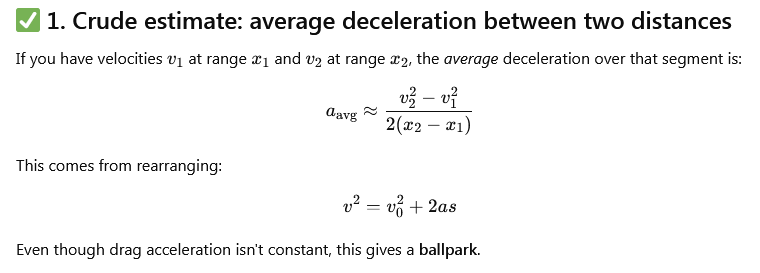
That graph suggests constant deceleration would be a reasonable approximation.
No, that was the British guy.
Probably it is nothing. You can ignore it. But dunno…
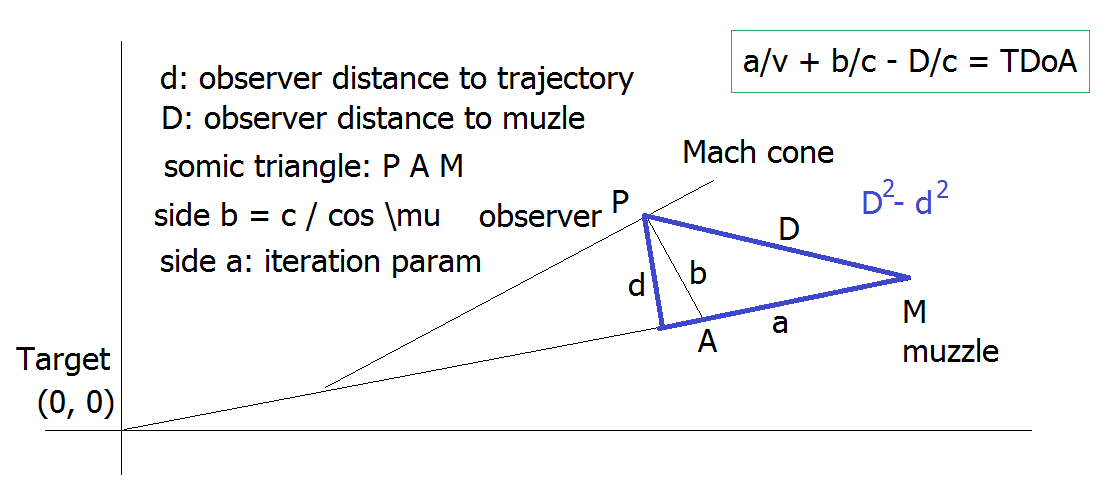
There is a right triangle.
These are groups of points along a straight line.
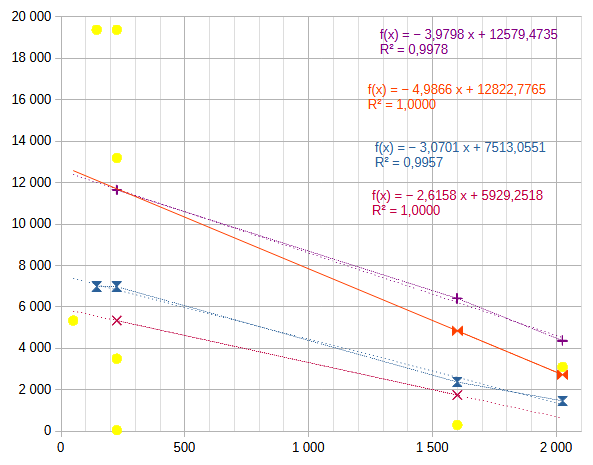
But maybe you have a better idea to guess the speed of the bullet.
I have no rifle. 
But I’ve been thinking on a worst case calculation.
Assuming the point C is almost the same between two observers. They must agree on the trajectory from R to T, also the average speed from R to C. And that might give us a time difference between two observers.
(However, substraction is not the best when there are similar values, small difference between them. Again, some regression might be useful with pairs of observers. But the idea is not entirely clear for me.)
Of course, not any pair of observers.
Indeed I guess it might be replaceable with average speed. When point C for two observers is close enough.
(Truth is the awkward term of philosophers, hundred years before. Science now prefer concept: invariant.)
By the way, there was an echo problem in Butler. I tried to calculate the wave propagation. But there are mathematical tricks behind the application of traditional Huygens-Frsnel principle. So I tried to enhance it by phase space and Green’s function.
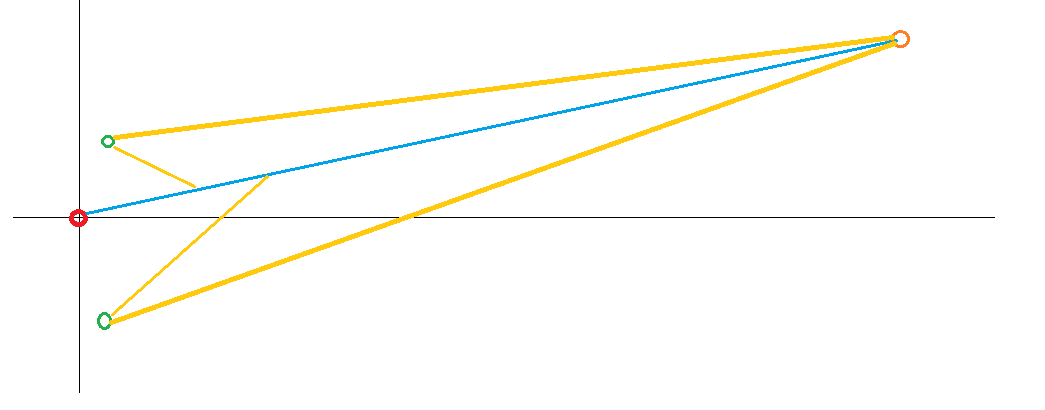
Now some calculus. Assuming the distance of the rifle is greater than the distance of observers.
1143 fps
1 ms means a little more that a foot. Is it neglectable?
I respect Audio_Freq’s audio expertise, but he seems to know very little math or physics. He seems to think that analyzing the crack gives the location of the shooter, but it actually gives the location of C. I read his report but found nothing reliable in it.
As I said in my article, I tried many different speeds to see which fit best. The best was 2900 fps with a deceleration of 1000 fps^2.
It isn’t necessary to hope that two observers have the same C. For a given rifle location, bullet speed, and deceleration we can compute what the crack-bang gap would be for each witness. That is what I did in the article.
2 Likes
He was shot from behind.
If you take the high quality right side angle in .mov format, pause it at the first frame that shows the shot puff his shirt up, and adjust the exposure levels to overexpose his hair, you can clearly see a divot in the back of his head with real depth to it. When you really tweak the exposure levels in an app that allows adjusting the levels using a curve, you can see a point within that divot that is greater intensity, if you overexpose it fully the divot and his earhole are the darkest two points in the image.

He considered the distance between left and right mic.
Interesting.
Depending on you check the crack or bang, you can learn something about both points C and R.
That is enormous velocity drop.
g ≈ 32.2 ft/s²
about 31 g
Did you calculate the speed of projectile at the target?
s(t) = v(0) \times t - a \times t^2 / 2
Velocity at the target ≈ 2750 fps
That’s only about a 150 fps loss over 140 yards, which is tiny — and shows how unrealistic a constant deceleration of only 1000 fps² is for a real bullet at those speeds.
One mathematically valid but physically impossible time**, typically corresponding to the projectile having gone past, slowed down, reversed direction, and crossed the same point on the way back.
VegasPatriot has answered that problen one year ago. I was reluctant to mention it, but they know what he knew. However, the escalation would cancel the lone gunman myth.
Obviously 17 HMR
1 Like
I believe Audio_Freq was analyzing the first transient, which would be the crack. He is not good at explaining clearly exactly what he’s doing.
Also note that it’s impossible to get any accurate location information from TDoA on L and R channels because the granularity of the signal is so crude. We’re talking about measuring gaps of just a few ticks in a 44100 Hz signal, where the first tick is about 3°, and later ticks get progressively worse in terms of signal/noise. And it’s difficult to tell if you’re seeing the same sound in both channels, or noise, because you’re trying analyze individual data points, not a curve.
It’s an interesting approach, but I don’t think it yields much usable information - especially if you’re just analyzing the crack, as Audio_Freq did.
No, for a bullet, that is not large. It means a drop from 2900 fps to 1900 fps at a distance of 2900 ft. At 500 ft that’s about a drop of 200 fps, to about 2700 fps.
Of course the bullet decelerates much faster than g, it takes a lot of energy to produce the Mach wave.
So do you think 1000 fps^2 is too big or too small? You’re contradicting yourself.
Which problem? What do you mean by escalation? How is this relevant to my article?
1 Like